This is a question I often hear from players who feel they have plenty of strength, but somehow the ball does not come off the racket as powerfully as they expect:
“Mr. Su, I can swing hard, so why doesn’t all that power seem to reach the ball?”
My answer is simple:
Power is not only about how much force you produce. It is also about how efficiently you transfer that force into the racket and then into the ball.
This is one of the reasons I developed the Pistol Racket.
Where Does Your Power Go?
When you hit a powerful forehand, the energy doesn’t come from your arm alone.
Your legs, waist, shoulder, forearm, wrist, and racket all have a role to play.
But if the connection between your hand and the racket is not efficient, some of that energy is lost through unnecessary movement and compensation.
You may feel like you are swinging with everything you have, while the ball tells a very different story.
I often tell players:
Don’t only ask how much power you can produce. Ask how much of that power actually reaches the ball.
Why the Grip Matters
The hand is the final connection between your body and the racket.
Traditional handles can require the hand and wrist to make additional adjustments during a powerful stroke.
When the racket is not naturally aligned with the forearm, part of the movement has to be used to stabilize and correct the racket.
That is energy you could otherwise use to attack the ball.
This was one of the problems I wanted to solve with the Pistol Racket.

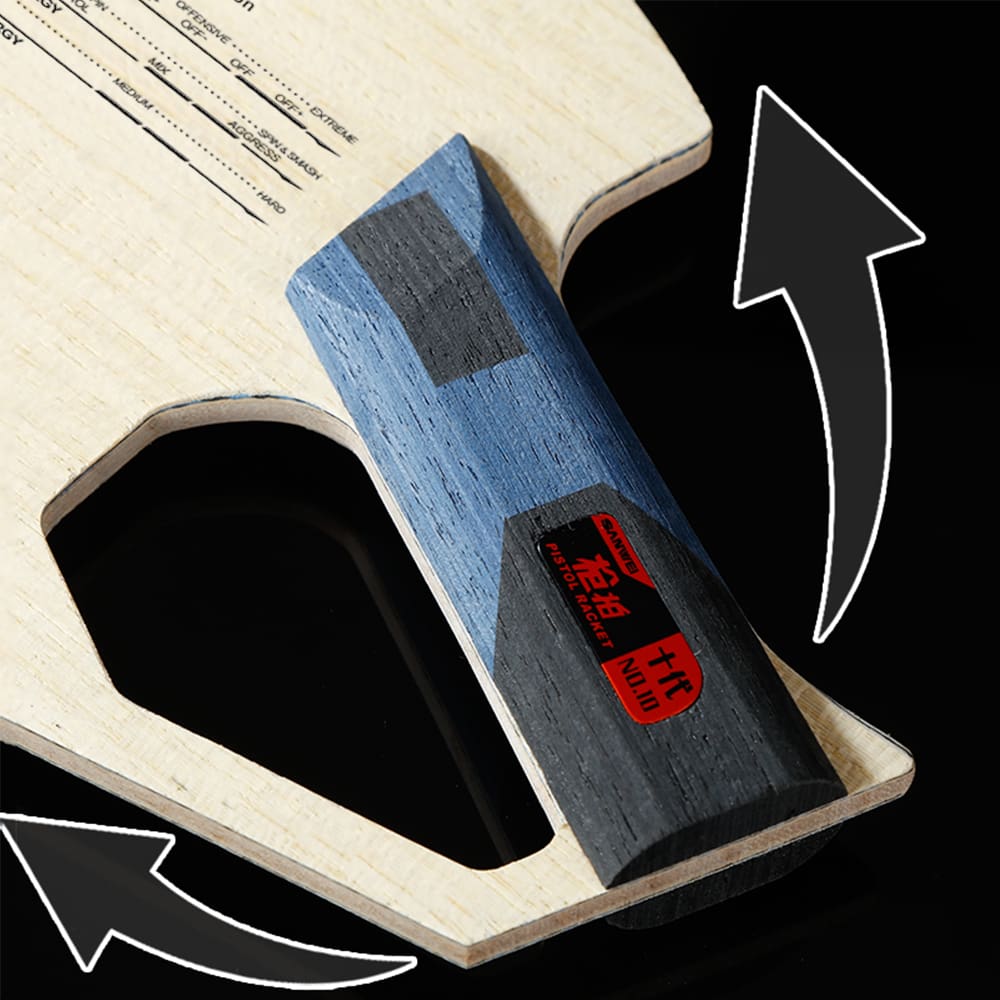
Sanwei Pistol Racket 10th
- ITTF Approved: Fully compliant with ITTF regulations, the Sanwei Pistol Racket is approved for use in any level of table tennis competition, ensuring you stay competitive at all times
- Ergonomic Swing Design: The unique design aligns the hitting point with the natural extension of your arm.
- Dual-Channel Force Guidance: Simplified movements enhance power and speed by up to 15%, giving you a competitive edge
- Anti-Rotation Palm Support: The built-in anti-rotation palm support stabilizes the racket
- Guided Motion for Shortened Training Cycles: The Pistol Racket’s design promotes proper technique and reduces errors during training.
- More structures are available for selection.
- FL/ST handles are available to suit players of varying skill levels.
- Free Shipping Worldwide!
The Pistol Racket’s Dual-Channel Power Transmission
The Pistol Racket uses what I call a dual-channel power transmission design.
The idea is to create two complementary paths for transferring force from the hand and forearm into the racket.
Instead of concentrating the load around a single grip position, the handle is designed to work with the natural structure and movement of the hand and forearm.
Combined with the Pistol Racket’s ergonomic orientation, this helps create a stronger and more direct connection between your body and the racket.
The racket feels less like something you are simply holding.
It starts to feel more like an extension of your arm.
Why Does This Matter During a Forehand?
Think about throwing a ball.
You don’t consciously calculate every joint in your arm.
Your body naturally coordinates the movement and transfers energy toward the target.
That is the kind of natural movement I wanted to bring into racket design.
When the grip and forearm work together naturally, you can focus on accelerating through the ball rather than constantly correcting the racket.
For many players, this creates a more solid feeling at impact and makes their existing power easier to use.
More Power Doesn’t Mean More Tension
There is another mistake I see all the time.
Players want more power, so they grip the racket harder.
But a tighter grip does not automatically create a stronger shot.
Too much tension can actually make the swing less fluid.
Good power requires a balance between stability and relaxation.
The racket needs to stay stable at impact, but the movement leading into impact should remain fluid.
This is another reason I pay so much attention to handle design.
How Should You Practice?
If you want to improve your power transfer, don’t simply try to swing harder.
Start with controlled strokes.
Pay attention to whether:
- Your grip remains stable.
- Your forearm and racket move as one unit.
- Your acceleration happens naturally.
- You are contacting the ball in front of your body.
- You remain relaxed until the acceleration phase.
Once the movement becomes efficient, you can gradually increase speed and power.
Final Thoughts
After more than 30 years of designing table tennis equipment, I have learned that the strongest player is not necessarily the player who can produce the most force.
It is often the player who can transfer force most efficiently.
That is the philosophy behind the Pistol Racket.
Its ergonomic design and dual-channel power transmission are intended to create a more direct connection between your hand, forearm, and racket.
You still need good technique and proper training.
But when your equipment works with your body’s natural movement, you can spend less energy fighting the racket—and more energy putting that power into the ball.
—
Su Zhimin
Founder of SANWEI Sports