Have you ever experienced this?
During practice, your forehand is powerful, your topspin is consistent, and you can keep the ball on the table for a long time. But as soon as you enter a real match, everything seems to change. You start making simple mistakes, your attacks become less reliable, and even shots you normally hit with ease become difficult.
Why does this happen?
In my experience, one important reason is that your technique is not yet stable enough to withstand the pressure of a match.
Match consistency is not just about concentration or confidence. It also depends on whether you can reproduce a reliable stroke when the situation becomes stressful.
1. Build a Stroke You Can Repeat Under Pressure
During practice, you often know where the ball is coming from. Your partner may feed the ball at a comfortable speed, allowing you to prepare early and use your preferred hitting position.
A match is completely different.
The ball may arrive faster, deeper, shorter, or wider than you expect. You have less time to prepare, and you must make decisions while moving.
If your forehand depends on a very specific body position, even a small change can cause an error.
That is why I always emphasize the importance of a stable basic hitting posture.
You should develop a natural swing that you can repeat without having to consciously rebuild your entire movement for every shot.
Start with controlled strokes and focus on your contact point, racket angle, and recovery. Then gradually introduce different placements and speeds.
The goal is not to make every shot identical. It is to maintain the same reliable technical foundation even when the incoming ball changes.
2. Don’t Try to Win Every Point With One Shot
Another common mistake is trying to hit the perfect winner too early.
When players feel pressure, they often swing harder than usual. They may open their racket face too much, change their timing, or use extra wrist movement to generate more spin.
Sometimes the result is a spectacular winner.
More often, it is an unnecessary error.
A good attacking player does not need to hit every ball at maximum power. The real skill is knowing when to apply pressure and when to build the point.
Try establishing a reliable first attack. Once you have a favorable position, increase the speed or placement of your next shot.
Remember, a powerful attack is only useful if you can control it.
The more repeatable your attacking technique becomes, the more confidently you can play an aggressive game.

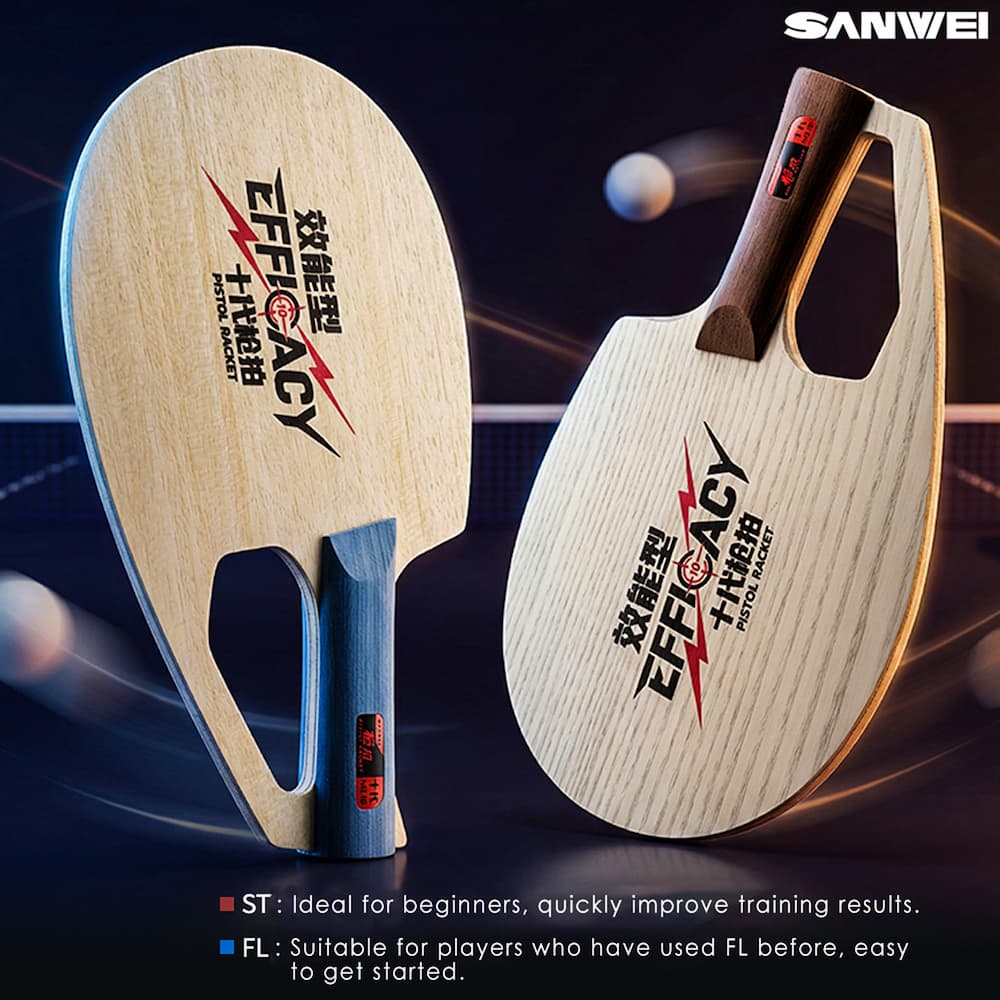
Sanwei Pistol Racket 10th
- ITTF Approved: Fully compliant with ITTF regulations, the Sanwei Pistol Racket is approved for use in any level of table tennis competition, ensuring you stay competitive at all times
- Ergonomic Swing Design: The unique design aligns the hitting point with the natural extension of your arm.
- Dual-Channel Force Guidance: Simplified movements enhance power and speed by up to 15%, giving you a competitive edge
- Anti-Rotation Palm Support: The built-in anti-rotation palm support stabilizes the racket
- Guided Motion for Shortened Training Cycles: The Pistol Racket’s design promotes proper technique and reduces errors during training.
- More structures are available for selection.
- FL/ST handles are available to suit players of varying skill levels.
- Free Shipping Worldwide!
3. Pay Attention to Your Grip and Racket Control
When a match becomes tense, many players unconsciously grip the racket too tightly.
This can make the arm feel stiff and interfere with the natural movement of the forearm and wrist. You may then begin making small, inconsistent adjustments to the racket face.
Before each point, take a moment to relax your hand and shoulders.
Keep your grip secure, but avoid squeezing the handle unnecessarily. Focus on a clear contact point instead of trying to control every detail of the ball with your wrist.
Equipment can also influence how naturally you hold and move the racket.
This was one of the considerations behind my development of the Pistol Racket.
Unlike a traditional FL shakehand handle, its design aims to align the racket more naturally with the extension of the forearm. For players who struggle to maintain a consistent forehand position, this different handle design may help establish a more intuitive and repeatable swing.
The objective is not to eliminate the need for technique. It is to make the relationship between your hand, forearm, and racket feel more natural, so you can concentrate on the game rather than constantly adjusting your grip.
4. Train for Match Conditions, Not Just Perfect Practice
If you want to become more consistent in competition, your training needs to include situations that resemble competition.
Hitting 100 comfortable forehands is useful, but it does not fully prepare you for a match where every ball may require a different movement.
Here are three exercises I recommend:
Exercise 1: Controlled consecutive attacks
Ask your partner to block several balls to your forehand. Focus on maintaining your basic posture and recovering after each stroke. Increase the speed only when you can keep the ball under control.
Exercise 2: Random placement
Have your partner vary the placement between your forehand and middle. Your goal is to adjust your footwork while keeping your fundamental swing as consistent as possible.
Exercise 3: Pressure scoring
Play short games where you start at 8–8. Practice sticking to your normal tactics instead of suddenly trying to finish every point with excessive power.
These exercises help you connect technical consistency with decision-making under pressure.
5. Develop a Simple Routine Between Points
Consistency is also a mental habit.
After an error, some players immediately think about the score, the opponent, or the possibility of losing. Their attention moves away from the next ball, and the previous mistake begins to affect the next point.
A simple routine can help.
- Take a breath and relax your shoulders.
- Identify one thing you can improve on the next point.
- Return your attention to the serve, receive, or first attack.
Don’t analyze five technical problems between points. Choose one clear reminder, such as “get into position early” or “finish the stroke and recover.”
A short, repeatable routine can help prevent one mistake from turning into several.
6. Why the Right Equipment Can Help
After more than three decades in table tennis, I believe equipment should support a player’s technique rather than force the player to constantly adapt to it.
The Pistol Racket was developed with this principle in mind. Its handle design aims to create a more natural relationship between the racket and forearm, while its dual-channel power transmission concept focuses on transferring force efficiently through the stroke.
For players who rely heavily on forehand attacks, a more intuitive racket-hand relationship may help them maintain their basic hitting posture and repeat their movements with greater confidence.
Of course, no racket can guarantee consistency in every match. Footwork, timing, tactical choices, and regular practice remain essential.
But if your current handle makes it difficult to find a comfortable and repeatable forehand position, trying a different design may be worthwhile.
Final Thoughts
How can you improve your consistency during table tennis matches?
Start by making your technique more repeatable. Maintain a reliable hitting posture, avoid unnecessary tension, build your attacks instead of forcing winners, and practice under conditions that resemble real competition.
Most importantly, don’t confuse consistency with passive play.
The goal is not to avoid mistakes by becoming afraid to attack. The goal is to develop a reliable technique that allows you to attack confidently without losing control.
That is also the idea behind the Pistol Racket: helping players find a more natural relationship between their hand, forearm, and racket, so they can focus on playing rather than constantly correcting their movement.
When your technique becomes reliable, you no longer have to choose between playing aggressively and playing consistently. You can work toward both.
Su Zhimin
Founder of SANWEI Sports