Have you been playing table tennis for several years, but recently feel that your progress has almost stopped?
You practice regularly. You play matches every week. Your forehand is stronger than it used to be, and you understand the game much better than when you started.
Yet, somehow, you keep losing to the same types of opponents. Your technique seems difficult to improve, your mistakes keep coming back, and the gap between your current level and the next one feels increasingly difficult to close.
If this sounds familiar, you are not alone.
In my experience, the longer you play, the more difficult it can become to improve—not necessarily because you have reached your limit, but because the way you practice may no longer be enough to help you progress.
Let’s look at why this happens and what you can do about it.
1. Your Existing Technique Has Become a Habit
When you first learn table tennis, almost every improvement feels noticeable. You learn to serve, return the ball, develop a forehand, and begin to understand spin.
But after several years, your basic movements become habits.
This is useful because you no longer need to think about every part of your stroke. However, there is a downside: if you developed a small technical problem early on, you may have repeated it thousands of times.
For example, perhaps you rely too much on your arm when attacking. Maybe your contact point is inconsistent, or you use your wrist to compensate whenever your body is poorly positioned.
These habits might not prevent you from playing reasonably well. In fact, you may have learned to compensate for them so effectively that you barely notice the problem.
But as your opponents become stronger, those small weaknesses become more important.
The solution is not always to practice more. Sometimes, you need to step back and examine how you play.
Record your forehand from different angles. Compare your movement during comfortable practice rallies with your movement during difficult match situations. Look for changes in your balance, contact point, and racket angle.
You cannot correct a habit you have never noticed.
2. You Are Practicing What You Already Know Instead of What You Need to Improve
Many amateur players spend most of their training time doing the exercises they enjoy or the shots they can already perform reasonably well.
If your forehand is your strongest weapon, you may spend a lot of time hitting forehands. If you enjoy attacking, you may rarely practice the awkward receives or defensive transitions that cost you points in matches.
This makes training enjoyable, but it can also limit your progress.
To improve further, you need to identify the specific situations that prevent you from winning more points.
Ask yourself:
- Do I lose points because my first attack is inconsistent?
- Do I struggle when the opponent changes placement?
- Does my backhand break down under pressure?
- Can I maintain my technique during long rallies?
- Do I make too many errors when I try to increase my power?
Choose one weakness and build a training plan around it.
For example, if your forehand becomes inconsistent when you move, don’t simply hit more stationary forehands. Practice moving into position, attacking, and recovering for the next ball.
Focused training is often more valuable than adding another hour of unfocused practice.

Sanwei Pistol Racket 10th
- ITTF Approved: Fully compliant with ITTF regulations, the Sanwei Pistol Racket is approved for use in any level of table tennis competition, ensuring you stay competitive at all times
- Ergonomic Swing Design: The unique design aligns the hitting point with the natural extension of your arm.
- Dual-Channel Force Guidance: Simplified movements enhance power and speed by up to 15%, giving you a competitive edge
- Anti-Rotation Palm Support: The built-in anti-rotation palm support stabilizes the racket
- Guided Motion for Shortened Training Cycles: The Pistol Racket’s design promotes proper technique and reduces errors during training.
- More structures are available for selection.
- FL/ST handles are available to suit players of varying skill levels.
- Free Shipping Worldwide!
3. You Can Play Well in Practice but Not in Competition
Another common reason for slow progress is the difference between training performance and match performance.
During practice, the ball may arrive at a predictable position. You have enough time to prepare, and you can repeat the same movement comfortably.
In a match, the situation changes constantly. You must read spin, adjust your position, choose your shot, and deal with the pressure of the score.
If your technique only works under comfortable conditions, your actual competitive level will eventually stop improving.
This is why I recommend gradually making your training more difficult.
Start with controlled rallies, then introduce random placement, different spins, and time pressure. Finally, practice playing short games with a specific tactical objective.
Don’t measure progress only by how many excellent shots you can hit during practice.
Measure it by whether you can execute your technique when the ball is difficult and the point matters.
4. Your Power Has Improved, but Your Control Has Not Kept Up
After playing for several years, many players become stronger and more confident. They can generate more racket speed and hit more powerful topspins.
But increased power does not automatically produce a higher level of play.
If your body position changes, your contact point becomes unpredictable, or your racket face is difficult to control, additional power may simply make your mistakes more costly.
This is an important distinction: improving your stroke is not just about generating more power; it is about making that power repeatable.
When training your forehand, pay attention to the relationship between your body rotation, forearm movement, racket angle, and contact point.
Try hitting at a moderate intensity while maintaining consistent placement. Then increase your speed gradually without allowing your basic posture to break down.
If you can only produce a powerful shot occasionally, there is still room to improve the efficiency and consistency of your technique.
5. Your Equipment May No Longer Match Your Needs
Equipment is not the main reason every player reaches a plateau, but it is worth considering when your technique and training have become more advanced.
A racket that feels comfortable when you first start playing may not necessarily suit the way you want to attack several years later.
For example, some players struggle to maintain a comfortable forehand position with their existing grip. Others feel that their hand and forearm are not working together as naturally as they would like.
This was one of the considerations behind my development of the Pistol Racket.
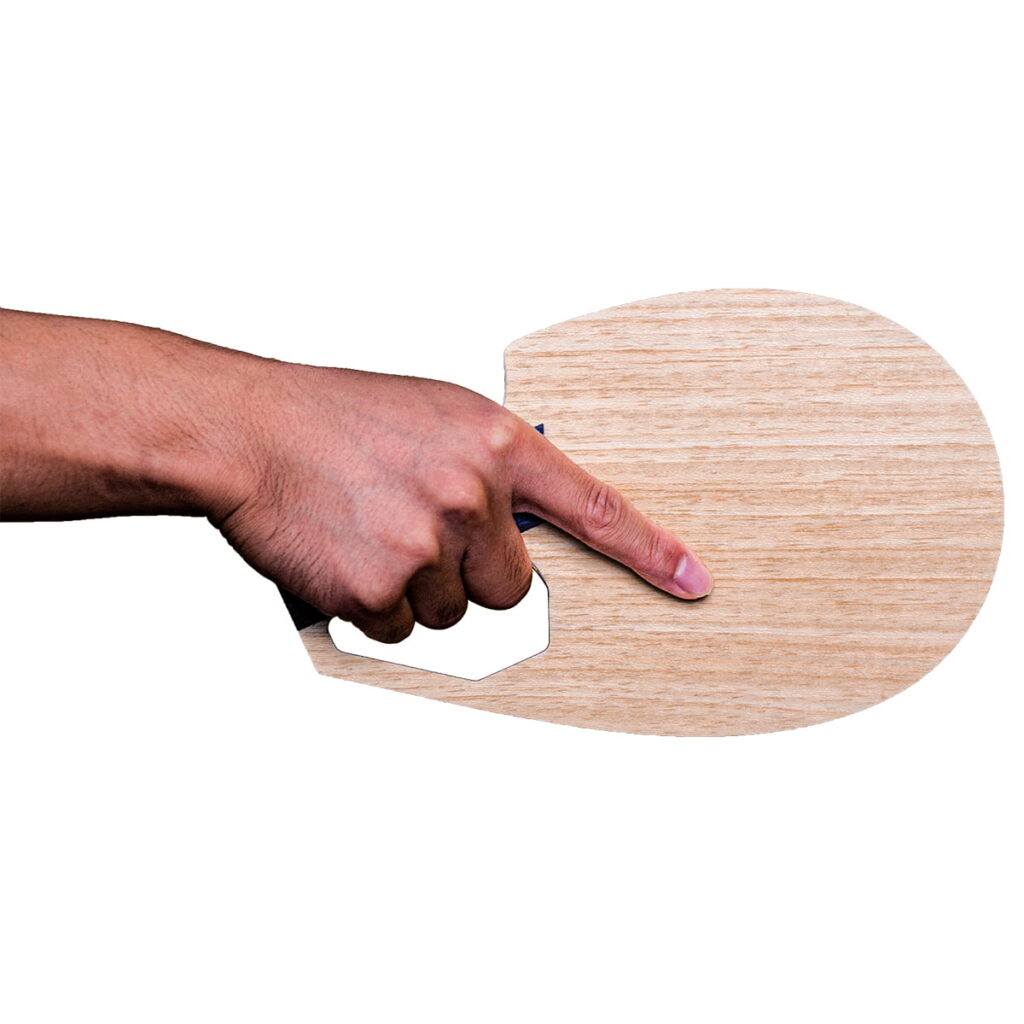
Unlike a traditional FL shakehand handle, the Pistol Racket uses a different handle design intended to align the hitting position more naturally with the extension of the forearm.
The goal is to help players establish a more intuitive relationship between the hand, forearm, and racket. For players whose forehand posture or racket control is inconsistent, this design may offer a different way to approach the problem.
The Pistol Racket also incorporates our concept of dual-channel power transmission, which focuses on transferring force efficiently through the stroke.
These design ideas are intended to support more repeatable movement and efficient power transfer, particularly for players who rely on forehand attacks.
However, I would not recommend changing your racket simply because your progress has slowed. First, identify the actual problem. If your footwork, timing, or tactical decisions are holding you back, those areas still need attention.
But if your current equipment makes it difficult to find a comfortable, repeatable hitting position, trying a different design may be worthwhile.
6. You May Be Trying to Improve Too Many Things at Once
There is another trap that experienced amateur players often fall into.
They watch professional matches, discover a new technique, change their grip, adjust their swing, and then try to modify their tactics—all within a short period.
Each change might have some value, but changing too many things at once makes it difficult to understand what is actually helping.
It can also make your existing technique less reliable before the new movement has become familiar.
My advice is to focus on one major improvement at a time.
If your biggest problem is forehand consistency, work on your hitting position and contact point first. If your strokes are reliable but you lose points because of poor decisions, focus on tactics instead.
Give yourself enough time to practice the change and test it in real matches before moving on to the next objective.
Progress is not always about adding more techniques. Sometimes, it is about refining the fundamentals you already have.
7. Measure Progress Differently
When you first start playing table tennis, improvement is easy to notice. You can return more balls, produce more spin, and win more matches.
As you become more experienced, improvement becomes less obvious.
You may not suddenly gain a completely new attacking weapon. Instead, you might reduce your unforced errors, recover faster after each stroke, or become more reliable against a particular type of spin.
These improvements can seem small, but they often make a meaningful difference in competition.
Try tracking one or two specific measurements during training:
- How many consecutive controlled forehands can you hit?
- How often does your first attack land on the table?
- Can you maintain your technique when the ball is placed randomly?
- How many unforced errors do you make in a short match?
By measuring a specific skill rather than relying on a general feeling that you are improving, you can identify progress that might otherwise go unnoticed.
Final Thoughts
If you have played table tennis for years and your progress is slowing down, it does not automatically mean you have reached your limit.
It may mean that your old training methods are no longer enough.
Examine your technique, identify the situations that cost you points, practice under more realistic conditions, and make sure your equipment supports rather than complicates your movement.
At SANWEI, this practical approach also guides the development of the Pistol Racket. Its design aims to help players establish a more natural relationship between the hand, forearm, and racket, supporting repeatable movement and efficient power transfer.
But no racket can replace focused practice or sound tactics.
After decades in table tennis, I believe that the next stage of improvement often begins with a simple question:
What is the one weakness that is preventing me from playing at the level I know I can reach?
Find that weakness, work on it systematically, and give yourself time to improve.
You may not see a dramatic change overnight. But when you address the right problem, your next breakthrough becomes much more achievable.
Su Zhimin
Founder of SANWEI Sports