
Over the years, I’ve met many amateur table tennis players who are passionate about improving their game. They buy new blades, experiment with different rubbers, watch professional matches, and spend hours practicing their favorite strokes.
Yet, when they play against stronger opponents, the same problems keep appearing. Their attacks miss the table, their timing becomes inconsistent, and shots that look excellent during practice suddenly become difficult to execute in a match.
Why does this happen?
In my experience, one of the biggest problems is that amateur players often focus too much on the shot itself and overlook everything that makes a good shot possible.
A powerful forehand is not just about swinging harder. A reliable backhand is not just about having a good rubber. And a successful attack does not begin when the racket touches the ball.
Let me explain several things I believe amateur players should pay more attention to.
1. They Focus on Hitting the Ball Instead of Preparing for It
Many players concentrate so heavily on their racket movement that they forget about the preparation that comes before contact.
Imagine two players receiving the same ball. One moves into position early, maintains balance, and has enough time to execute a comfortable stroke. The other reacts late, stretches toward the ball, and tries to compensate with a faster swing.
Even if both players understand the same technique, their results are likely to be very different.
The difference often begins with footwork and preparation.
Before attacking, you need to position your body appropriately, establish a comfortable distance from the ball, and prepare your racket in time. If your body is poorly positioned, even a technically sound swing becomes difficult to reproduce.
This is particularly important for forehand attacks. Players sometimes believe they lack power when the real problem is that they cannot consistently reach the right contact point.
My advice is to pay attention to your position before every shot. Ask yourself whether you are balanced, whether you have enough room to swing, and whether you can recover after making contact.
A good stroke starts before you hit the ball.
2. They Chase Power Before Building Consistency
This is another common mistake.
Many amateur players want to develop a more powerful forehand, so they try to swing faster and use more force. When the ball goes into the net, they swing harder on the next attempt. When it goes long, they make a quick adjustment with their wrist.
Eventually, their technique becomes a series of last-minute corrections.
The problem is that power is only useful when you can control where the ball goes.
A reliable attacking stroke requires coordination between your footwork, body movement, arm acceleration, contact point, and racket angle. If these elements are inconsistent, adding more force may simply make your mistakes more severe.
I recommend developing your stroke in stages.
First, focus on clean contact and a repeatable movement. Then work on placement and consistency. Once you can control the ball reliably, gradually increase the speed and intensity of your attack.
You do not need to hit every ball as hard as possible. In many situations, a well-placed attack with good spin is more effective than a harder shot that gives your opponent an easy opportunity to counterattack.
The goal is not to produce the most powerful shot you can manage once. It is to produce a high-quality shot repeatedly, even when the situation becomes difficult.
3. They Ignore the Relationship Between the Grip and the Stroke
When amateur players discuss equipment, they usually focus on blade speed, rubber hardness, spin, and weight.
These are all important considerations. However, the way you hold the racket deserves just as much attention.
Your grip influences how comfortably you control the racket, how naturally your forearm moves, and how consistently you can maintain the racket angle during a stroke.
If your handle feels uncomfortable or your fingers are constantly adjusting their position, you may develop unnecessary tension. Over time, that tension can interfere with your timing and make your movements less repeatable.
This does not mean everyone needs a special handle. Traditional handle shapes work well for many players. The important thing is to recognize whether your grip supports your technique or makes it harder to execute.
For example, at SANWEI, we developed the Pistol Racket around the idea that the relationship between the forearm and racket can influence the naturalness of a player’s movement.
Its distinctive handle is designed to support a more natural forearm-racket relationship, particularly for forehand-oriented play. For players who struggle with an uncomfortable grip or inconsistent forehand mechanics, it may be an alternative worth exploring.
However, a different handle will not automatically correct poor footwork, bad timing, or an unstable contact point. Equipment should support your development, not become a substitute for training.
Before changing your racket, try to identify the specific problem you want to solve.
4. They Forget to Recover After Each Shot
One of the easiest things to overlook in table tennis is what happens immediately after you hit the ball.
Amateur players often judge a stroke by its result. If the ball lands on the table, they consider it successful. If it misses, they assume something went wrong with the shot itself.
But a good shot should also leave you prepared for the next one.
Suppose you play a powerful forehand loop. If your body continues moving forward, your racket remains out of position, or your feet are too slow to recover, you may struggle when your opponent blocks the ball back.
Your first attack might be excellent, but the next shot becomes difficult.
This is why recovery matters so much.
After each stroke, work on regaining balance, returning your racket to a useful position, and preparing to move again. You do not need to return to exactly the same position after every shot, because the correct position depends on where you hit the ball and what your opponent can do next.
The important thing is to avoid becoming trapped in the movement of your previous stroke.
A simple training exercise is to practice attacking once and then deliberately preparing for the next ball, even when your partner returns it slowly. As you improve, increase the speed and variation of the return.
You will begin to understand that table tennis is not a collection of individual shots. Every shot affects the next one.
5. They Practice Their Strengths More Than Their Weaknesses
Most players enjoy practicing the shots they already perform well.
If you have a powerful forehand, it feels satisfying to keep looping the ball. If your backhand block is reliable, you may naturally gravitate toward drills that allow you to use it repeatedly.
There is nothing wrong with enjoying your strengths. However, if you want to improve your overall level, you must also spend time addressing the weaknesses that opponents can exploit.
Consider a player with an excellent forehand but poor serve receive. During cooperative practice, the player may look impressive. During matches, however, a difficult serve can prevent them from using their forehand at all.
In this situation, improving the forehand further may produce less benefit than improving the serve receive.
Look at your recent matches and identify the situations in which you lose points repeatedly.
Do you struggle against backspin? Are you uncomfortable when the ball goes wide? Do you attack well but lose control during the next exchange? Do you make too many mistakes when receiving serves?
Choose one weakness and make it the priority of your next few training sessions.
You do not need to neglect your strengths. You simply need to stop allowing your weaknesses to determine the outcome of every match.
6. They Don’t Practice Enough Under Match Conditions
A player may perform a stroke beautifully when the ball comes to a predictable position. But when the same player enters a match, the quality of the stroke suddenly drops.
This is not unusual.
During regular drills, you often know where the next ball will go. You can prepare early, establish your balance, and repeat the same movement.
In a match, you have to read the incoming ball, judge its spin and placement, decide what to do, and execute the stroke under pressure.
These are different demands.
To improve, you need to gradually move beyond predictable repetition.
Start with basic drills that help you establish your technique. Then introduce movement, variation, and uncertainty. Finally, practice situations that resemble the points you actually play in competition.
For example, if you want to improve your third-ball attack, do not practice only against a comfortable, predictable return. Vary the serve and the likely return so you must recognize the opportunity and adjust your position.
This teaches you not only how to execute the stroke, but also when and how to use it.
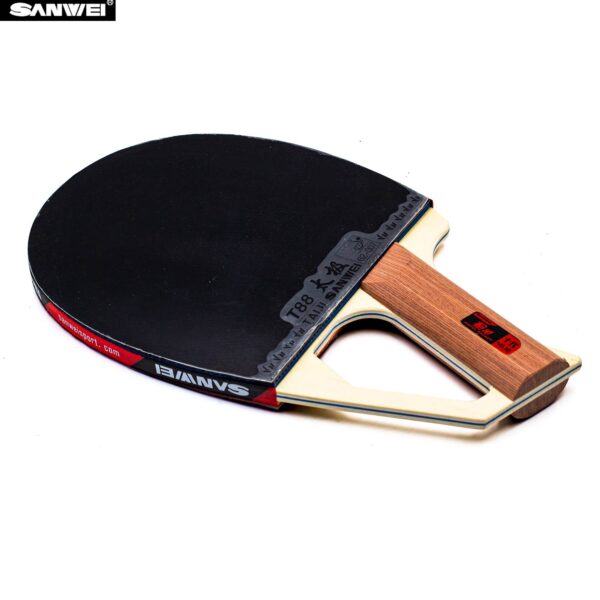
Sanwei Pistol Racket 10th Pre-Assemble Bat
- ITTF Approved: Fully compliant with ITTF regulations, the Sanwei Pistol Racket is approved for use in any level of table tennis competition, ensuring you stay competitive at all times
- Ergonomic Swing Design: The unique design aligns the hitting point with the natural extension of your arm.
- Dual-Channel Force Guidance: Simplified movements enhance power and speed by up to 15%, giving you a competitive edge
- Anti-Rotation Palm Support: The built-in anti-rotation palm support stabilizes the racket
- Guided Motion for Shortened Training Cycles: The Pistol Racket’s design promotes proper technique and reduces errors during training.
- Free Shipping Worldwide.
7. They Change Equipment Without Understanding the Real Problem
I have seen many players spend considerable time searching for the perfect blade and rubber combination.
They try a faster blade because their attacks lack power. They switch to a harder rubber because they want more penetration. When their control becomes worse, they look for another combination.
Sometimes, equipment changes are exactly what a player needs. But sometimes, the real problem lies elsewhere.
If your forehand lacks power because you contact the ball too late, a faster blade will not necessarily solve the issue. If your attacks frequently miss because your swing changes from one ball to the next, a more expensive rubber will not automatically make your technique consistent.
Before purchasing new equipment, ask yourself three questions:
- What specific weakness am I trying to improve?
- Is my current equipment contributing to that weakness?
- How will I determine whether the new setup actually helps?
If you cannot answer these questions, you may be changing equipment based on expectations rather than evidence.
Once you find a setup that suits your playing style, give yourself enough time to adapt. Constantly switching equipment can make it difficult to distinguish technical improvement from temporary differences in feel.
8. They Overlook the Importance of Relaxation
Finally, many amateur players hold the racket too tightly, tense their shoulders, and try to control every movement consciously.
This often happens when they become nervous or want to hit a powerful shot.
Unfortunately, excessive tension can make it harder to adjust your racket angle, accelerate the racket smoothly, and react to unexpected balls.
Relaxation does not mean holding the racket loosely enough to lose control. It means using only as much tension as necessary and allowing your movements to remain fluid.
During your next practice session, pay attention to your grip pressure between shots. Notice whether your shoulders remain tense after an attack and whether you are trying to force the ball rather than timing your movement properly.
If you find yourself becoming tense, slow down the drill and rebuild the movement with better balance and cleaner contact.
The ability to stay relaxed while maintaining control becomes particularly valuable when you face stronger opponents or play under pressure.
Final Thoughts
What do amateur table tennis players overlook most often?
In my experience, it is the importance of everything surrounding the actual stroke: preparation, footwork, grip, recovery, purposeful training, and the ability to remain relaxed.
Players naturally pay attention to visible results. They want faster attacks, heavier spin, and better equipment. But lasting improvement often comes from correcting the less obvious problems that prevent those results from appearing consistently.
If I could give amateur players one piece of advice, it would be this: Before asking how to hit the ball better, ask what is preventing you from hitting it well consistently.
The answer may be your positioning, your timing, your grip, or the way you practice. Find the underlying problem and work on it systematically.
At SANWEI, we believe good equipment should help players express their technique more effectively. But equipment is only one part of the picture. The real progress comes when you understand your game well enough to know what needs to change.
Su Zhimin
Founder of SANWEI Sports