This is a question I hear from players who are interested in the SANWEI Pistol Racket, and I think it deserves a serious answer.
Can changing your racket handle really make your strokes more consistent?
My answer is yes, it can help—but the reason is not that a special handle magically makes every shot accurate. The real question is whether the handle allows you to hold and move the racket in a way that better suits your natural mechanics.
After many years in the table tennis industry, I have come to believe that players sometimes overlook how much their grip influences the way they execute a stroke. We spend a great deal of time discussing blade composition, rubber hardness, and speed, but the connection between the hand, forearm, and racket deserves just as much attention.
This is one of the ideas behind the Pistol Racket.
1. Why Is Stroke Consistency So Difficult?
Before discussing the Pistol Racket, we need to understand why players struggle with consistency in the first place.
Imagine hitting ten forehand loops in a row. Even if you use what feels like the same movement every time, the results may vary considerably.
One ball lands deep on the table. Another goes long. A third lacks power, while a fourth produces excellent spin.
Why?
Small differences in your movement can lead to significant differences in the outgoing ball. Your contact point may change slightly, your racket angle may open or close, or your body may be in a different position when you make contact.
The grip can also influence these variations.
If you have difficulty maintaining a comfortable, repeatable hand position, you may unconsciously adjust your fingers, wrist, or forearm during the stroke. These adjustments are not always obvious, but they can make it harder to reproduce the same movement.
This is why consistency is not simply a matter of practicing more. It also depends on whether your technique and equipment allow you to repeat the movement comfortably.
2. The Connection Between Your Forearm and Racket Matters
One of the core ideas behind the Pistol Racket is the relationship between the forearm and the hitting point.
With a conventional shakehand handle, players develop their own ways of holding and moving the racket. For many players, this works extremely well. There is no reason to change a grip that is already comfortable and effective.
However, some players find that their forehand movement involves unnecessary adjustments. They may rely too much on the wrist to compensate for an awkward contact position, or struggle to maintain a consistent racket orientation during repeated attacks.
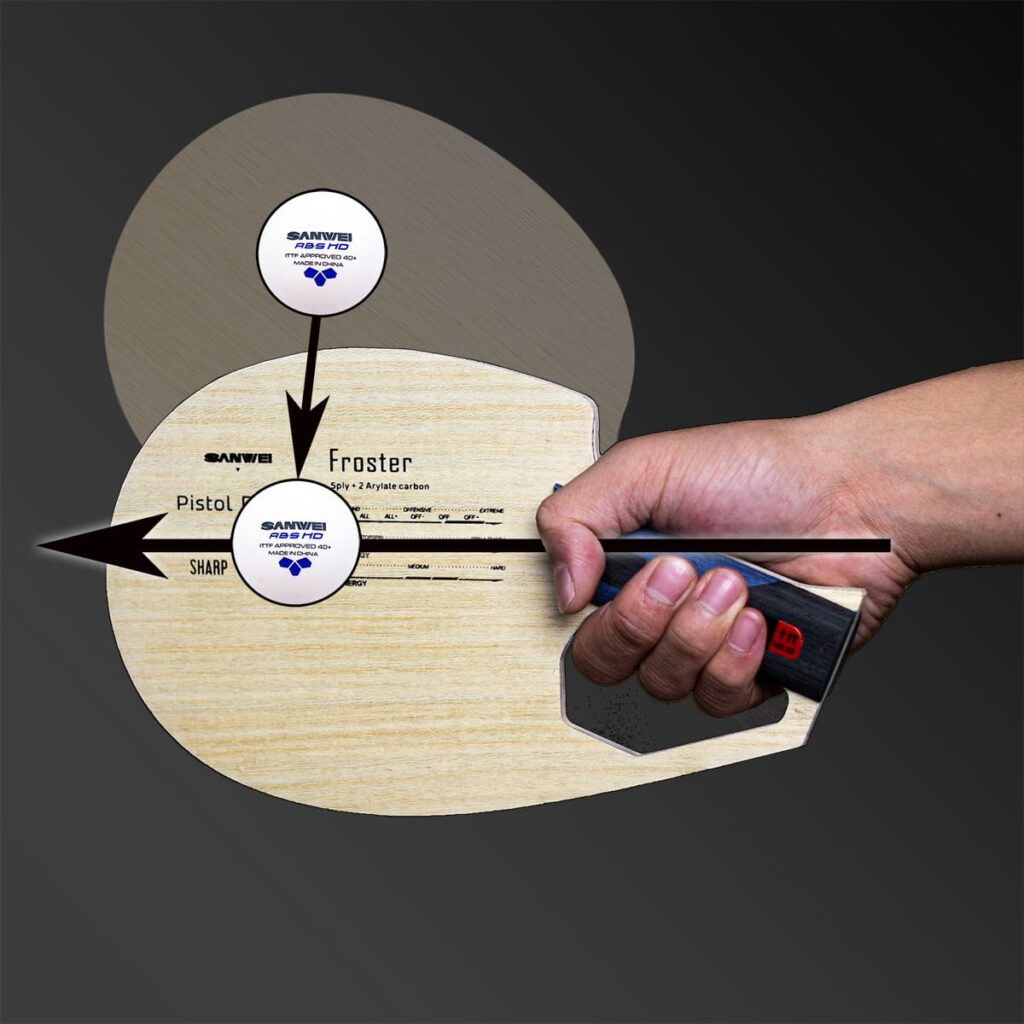
The Pistol Racket has a distinctive handle design intended to make the racket feel more like a natural extension of the forearm.
The idea is straightforward: when the relationship between your hand, forearm, and racket feels more intuitive, it may become easier to reproduce your intended movement.
For a player whose existing grip interferes with their forehand mechanics, this design can offer a different way to approach the stroke.
It is important to understand that this is not a universal solution. Players have different hand shapes, habits, and technical needs. The benefit depends on whether the design suits the individual player.
3. How Can the Pistol Racket Help Make Forehand Attacks More Consistent?
For many attacking players, the forehand is one of the most important strokes in their game.
But a powerful forehand is only valuable when you can execute it reliably.
The Pistol Racket was developed with this challenge in mind. Its handle design is intended to support a more natural forehand movement and a more repeatable relationship between the forearm and racket.
There are several ways this may help a player develop greater consistency.
A more intuitive grip
When a handle feels comfortable and natural, you can spend less attention adjusting your hand position and more attention reading the ball and preparing your stroke.
A more repeatable hitting position
The Pistol Racket is designed around the alignment of the hitting point with the natural extension of the forearm. For players who respond well to this relationship, it may make their forehand movement feel more direct and easier to reproduce.
More efficient power transfer
Consistency is not only about controlling the racket face. It is also about producing the intended stroke without unnecessary tension or compensating movements.
The Pistol Racket incorporates our design philosophy of dual-channel power transmission, aiming to support efficient force transfer into the stroke. When the movement becomes more natural and coordinated, a player may find it easier to combine speed with control.
These benefits are connected. A comfortable grip alone will not guarantee a consistent forehand, but a handle that supports your movement can make it easier to develop reliable technique through practice.

Sanwei Pistol Racket 10th
- ITTF Approved: Fully compliant with ITTF regulations, the Sanwei Pistol Racket is approved for use in any level of table tennis competition, ensuring you stay competitive at all times
- Ergonomic Swing Design: The unique design aligns the hitting point with the natural extension of your arm.
- Dual-Channel Force Guidance: Simplified movements enhance power and speed by up to 15%, giving you a competitive edge
- Anti-Rotation Palm Support: The built-in anti-rotation palm support stabilizes the racket
- Guided Motion for Shortened Training Cycles: The Pistol Racket’s design promotes proper technique and reduces errors during training.
- More structures are available for selection.
- FL/ST handles are available to suit players of varying skill levels.
- Free Shipping Worldwide!
4. Will It Also Improve Your Backhand?
This is another reasonable question.
Players should not evaluate a racket handle based on the forehand alone, particularly if they use both wings actively.
The Pistol Racket is primarily designed with attacking play and forehand performance in mind. However, changing to this handle does not automatically mean your backhand will become worse. Depending on your grip and playing style, you may find that your backhand remains comfortable or that certain aspects of your overall movement feel more natural.
There is one important consideration: adaptation.
A different handle can change the way you hold and orient the racket. Even if the new design suits you, your existing habits may take time to adjust.
I recommend testing both forehand and backhand strokes during the adaptation period. Pay attention to grip comfort, contact quality, racket-face control, and recovery after each shot.
If you specialize in defensive chopping or rely heavily on movements that feel particularly comfortable with a traditional handle, you should evaluate the Pistol Racket carefully before making a decision.
The right equipment should support your actual playing style, not force you to change it unnecessarily.
5. Can It Correct Poor Technique Automatically?
No—and I think this distinction is important.
If your footwork is poor, your contact point is inconsistent, or you repeatedly swing too late, changing the racket handle will not eliminate those problems.
A player who is out of position will still struggle to produce a reliable shot, regardless of the racket being used.
What the Pistol Racket is intended to do is provide a handle design that may support a more natural forearm-racket relationship. If your current grip is one of the factors making your forehand difficult to reproduce, the Pistol Racket may help you address that part of the problem.
But the improvement still needs to be developed through training.
Start with controlled forehand loops. Focus on balanced footwork, a consistent contact point, and a relaxed but secure grip. Once your strokes become more repeatable, introduce movement and variation.
Then evaluate the results in match-like situations.
This is the best way to determine whether the racket is genuinely helping you, rather than relying on the first impression you get when you pick it up.
6. How Can You Tell Whether It Is Working for You?
When trying the Pistol Racket, I suggest evaluating a few specific things rather than simply asking whether it feels powerful.
First, pay attention to comfort. Does the handle allow you to hold the racket securely without unnecessary tension?
Second, observe your forehand consistency. Over a series of comparable shots, can you maintain a similar contact point, racket angle, and ball placement?
Third, test your movement. Does the handle feel natural when you move to different positions and recover for the next ball?
Finally, try it in actual practice games. A racket that feels excellent during stationary drills must still prove suitable when you are moving, reacting, and making tactical decisions.
If possible, compare it with your usual racket under similar conditions. Keep the training drills and ball quality as consistent as you can, and give yourself enough time to adapt.
You may discover that the Pistol Racket helps you reproduce your forehand more comfortably. You may also discover that your current handle already suits you very well.
Both outcomes are useful. The goal is to find the equipment that best supports your development.
Final Thoughts
Can the Pistol Racket really improve stroke consistency?
I believe it can help the right player, particularly someone whose forehand movement is affected by an uncomfortable grip or an unnatural relationship between the forearm and racket.
Its distinctive handle design, focus on forehand mechanics, and dual-channel power-transmission concept all reflect the same principle: good equipment should work with the player’s movement, not against it.
However, consistency still depends on footwork, timing, contact quality, training habits, and the ability to perform under pressure. No racket can replace these fundamentals.
My advice is to look honestly at the reasons behind your inconsistent shots. If your technique needs work, train it systematically. If your grip or handle is making that work more difficult, consider whether a different design might help.
At SANWEI, we developed the Pistol Racket to offer players another way to approach forehand performance—not to promise an instant solution, but to explore how thoughtful handle design can support better table tennis.
Su Zhimin
Founder of SANWEI Sports