One of the most common questions I hear about the SANWEI Pistol Racket is: “I’ve been using a traditional FL handle for years. How is the Pistol Racket grip actually different? And will I need to learn how to hold a racket all over again?”
These are good questions.
After all, the traditional FL (Flared) handle has been used successfully by countless players, from beginners to world-class professionals. Most shakehand players are familiar with its shape, and their hands have adapted to it through years of practice.
So why did I develop a different design?
The answer lies in the relationship between your hand, forearm, and racket. The Pistol Racket is not simply a traditional handle with a different shape. It was developed around a different idea of how the racket should fit into your natural movement.
Let me explain the main differences.
1. The Fundamental Difference: How You Hold the Racket
With a traditional FL handle, you wrap your hand around the handle beneath the blade. The flared shape helps prevent the racket from slipping out of your hand, while your fingers and palm work together to maintain control.
This is a proven design, and many players find it comfortable and effective.
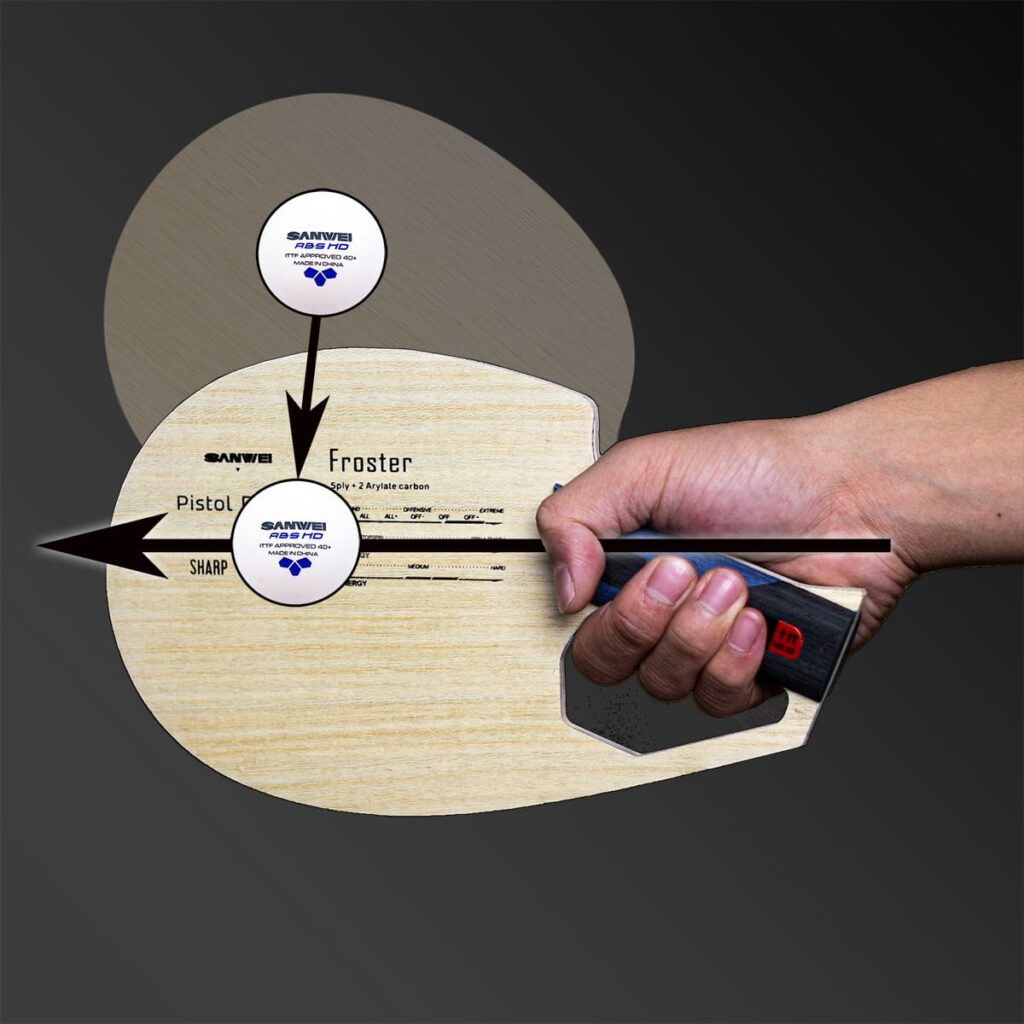
The Pistol Racket uses a distinctive grip structure integrated into the blade. Rather than simply wrapping your hand around a conventional handle, you position your hand against the specially designed grip area, with the palm and fingers supported by its structure.
The design aims to provide a more defined relationship between your hand and the racket.
One of the key ideas behind the Pistol Racket is to bring the hitting point closer to the natural extension line of the forearm. This is intended to make the racket feel more like an extension of your arm during a stroke, particularly during forehand attacks.
The important distinction is that a traditional FL handle is designed around a familiar, versatile grip, while the Pistol Racket is designed around a more specific relationship between the grip, forearm, and hitting point.
Neither design is automatically better for every player. They simply approach racket handling differently.
2. The Difference in Forehand Movement
The forehand is where many players are most interested in the Pistol Racket.
With a traditional FL handle, experienced players develop their own way of coordinating the hand, wrist, and forearm. Over time, these movements become automatic.
However, some players develop habits that involve unnecessary wrist adjustments or inconsistent racket positioning. They may find that their forehand feels powerful on some balls but difficult to reproduce on others.
The Pistol Racket was developed to address this type of challenge.
By changing the grip structure and the relationship between the hitting point and the forearm, the design aims to make the forehand movement feel more direct and intuitive.
For players who respond well to this design, potential benefits include:
- A more natural-feeling swing path.
- A more repeatable racket position during forehand attacks.
- Less need for unnecessary adjustments during the stroke.
- More efficient transfer of force from the arm into the shot.
These are design objectives, not guaranteed results. A player’s footwork, timing, technique, and individual hand structure still matter enormously.
But if your current grip makes it difficult to reproduce your forehand comfortably, trying a different grip design may help you identify a better way to move.
3. How Does the Grip Affect Stability?
Many players assume that stroke stability comes primarily from having a strong wrist or gripping the racket tightly.
In reality, excessive grip pressure can sometimes make your movements less fluid. If you tense your hand and forearm too much, it may become harder to adjust naturally to different incoming balls.
A suitable grip should provide enough support to control the racket without forcing you to maintain unnecessary tension.
The Pistol Racket incorporates an anti-rotation palm-support design intended to help stabilize the racket in the hand. This is an important part of its approach to grip stability.
The aim is to give the hand a more defined support structure, helping reduce unwanted racket rotation during strokes.
For players who struggle with racket-face consistency, this may be worth exploring. A more stable-feeling grip can make it easier to concentrate on the incoming ball, contact point, and intended shot.
However, stability does not mean the racket should remain rigid throughout every movement. Good table tennis still requires adjustments in racket angle and movement according to the incoming spin, ball placement, and tactical situation.
The objective is to reduce unnecessary movement—not eliminate the adjustments that good technique requires.

Sanwei Pistol Racket 10th
- ITTF Approved: Fully compliant with ITTF regulations, the Sanwei Pistol Racket is approved for use in any level of table tennis competition, ensuring you stay competitive at all times
- Ergonomic Swing Design: The unique design aligns the hitting point with the natural extension of your arm.
- Dual-Channel Force Guidance: Simplified movements enhance power and speed by up to 15%, giving you a competitive edge
- Anti-Rotation Palm Support: The built-in anti-rotation palm support stabilizes the racket
- Guided Motion for Shortened Training Cycles: The Pistol Racket’s design promotes proper technique and reduces errors during training.
- More structures are available for selection.
- FL/ST handles are available to suit players of varying skill levels.
- Free Shipping Worldwide!
4. Is the Pistol Racket Harder to Adapt to?
This depends on your existing habits.
If you have used a traditional FL handle for many years, your grip and strokes are already deeply established. When you try the Pistol Racket, the different hand position may initially feel unfamiliar.
That is normal.
A new grip changes more than the feeling in your palm. It can also influence how you position your fingers, orient the racket, and coordinate your movements.
I recommend starting with simple, controlled forehand and backhand drills rather than immediately testing the racket in intense matches.
Pay attention to the following:
- Does the grip feel comfortable after several minutes of practice?
- Can you maintain a consistent racket position during basic strokes?
- Can you transition between forehand and backhand comfortably?
- Does the grip remain comfortable when you move and attack at higher speeds?
Give yourself time to distinguish between unfamiliarity and a genuine mismatch.
At the same time, do not assume that every player must adapt to the Pistol Racket. If the design does not suit your hand or playing style, a traditional FL handle may remain the better choice.
Good equipment should support your game, not make you fight against your natural movements.
5. Does the Pistol Racket Replace the Traditional FL Handle?
No. I have never believed that every player should abandon the traditional FL handle.
The FL handle has earned its place in table tennis. Its familiar grip allows a wide range of players to develop their own techniques, and there is no reason to change a setup that already works well for you.
The Pistol Racket represents a different design approach.
When I developed it, I wanted to explore whether changing the relationship between the handle, forearm, and hitting point could help players move more naturally and transfer power more efficiently.
That philosophy led to its distinctive grip structure and dual-channel power-transmission design.
The objective is not to prove that one handle is universally superior. It is to give players another option—particularly those who want to explore a different approach to forehand mechanics and grip stability.
For players who prefer a more familiar handle shape, the current Pistol Racket 10th range also offers FL and ST handle options. It is worth checking the specific version carefully, because choosing the FL option does not mean the blade loses its distinctive Pistol Racket design.
6. Which Grip Should You Choose?
My recommendation is to start with your own playing experience rather than following a trend.
A traditional FL handle may be the right choice if:
- You already feel comfortable with your current grip.
- Your forehand and backhand are consistent.
- You value the familiar feel and flexibility of a conventional shakehand handle.
- You have no particular grip-related problem you want to solve.
The Pistol Racket may be worth trying if:
- You want to explore a different approach to forehand movement.
- You find your current grip uncomfortable or difficult to reproduce consistently.
- You want to investigate whether a more structured palm-support design suits your playing style.
- You are interested in the relationship between forearm alignment and power transfer.
Neither list is absolute. Players can have very different experiences with the same handle.
If possible, test both designs using similar rubbers and comparable training drills. Focus on comfort, contact quality, control, and your ability to execute repeated strokes—not just the power of your best shot.
That will give you a much better basis for deciding.
Final Thoughts
So, how is the Pistol Racket grip different from a traditional FL handle?
The biggest difference is not simply its unusual appearance. It is the way the grip structure is designed to support the hand and position the racket in relation to the forearm and hitting point.
The traditional FL handle offers a familiar, versatile grip that has served generations of players well. The Pistol Racket takes a different approach, with an emphasis on forearm alignment, palm support, and efficient power transfer.
For some players, this alternative may make forehand movements feel more natural and repeatable. Others may find that their traditional FL handle already suits them perfectly.
After decades of working with table tennis equipment, I believe innovation should give players more possibilities, not force everyone into the same solution.
My advice is simple: understand how you hold the racket, identify what you want to improve, and choose the design that best supports your technique.
Su Zhimin
Founder of SANWEI Sports