For many years, when players discussed table tennis equipment, the conversation usually focused on blade speed, rubber hardness, spin, and overall weight.
These are still important factors. But I’ve noticed that another question deserves more attention: Does the racket actually fit the way you hold it and move your arm?
After all, your hand is the only connection between your body and the racket. Every forehand loop, backhand block, and counterattack depends on how you hold and control that connection.
This is one reason ergonomic grip design has become an interesting area of equipment development. Players are beginning to look beyond the specifications of the blade and rubber and consider how the handle influences comfort, racket control, and the way they execute their strokes.
So, what makes ergonomic grip design worth discussing, and why does it matter to amateur players in particular?
1. Players Are Realizing That the Handle Is More Than a Place to Hold the Racket
When choosing a racket, many players spend hours comparing different blade compositions and rubber characteristics. Yet they may give very little thought to the handle.
This is understandable. A blade’s speed and a rubber’s spin are relatively easy to discuss, while the relationship between a handle and a player’s movement is more personal.
But the handle is not simply a piece of wood attached to the blade. It determines how the racket sits in your hand, how your fingers support it, and how comfortably you can maintain control during a stroke.
If the handle suits your hand and grip, holding the racket may feel natural. If it does not, you may find yourself adjusting your fingers, changing your grip pressure, or struggling to maintain a comfortable position.
These differences can become particularly noticeable during fast exchanges, when there is little time to correct your grip before the next shot.
Research published in Sports in 2025 examined a prototype table tennis handle designed to help beginners maintain a more stable forehand grip. The study found differences in racket-angle characteristics, although it did not find significant differences in overall shot success rates. This is a useful reminder that handle design can influence how players hold and move the racket, but the benefits depend on the design and the individual player.
In other words, the handle deserves consideration alongside the blade and rubber—not as an afterthought.
2. Comfort Can Influence How Consistently You Play
Have you ever played for an extended period and noticed that your hand becomes tense or uncomfortable?
Sometimes, players assume this is simply part of playing table tennis. They tighten their grip, adjust their fingers, and continue practicing.
However, it is worth asking whether the discomfort is related to how they hold the racket.
A handle that feels too thick, too thin, or otherwise unsuitable for your hand may make it harder to maintain a comfortable grip. Some players may respond by squeezing harder than necessary or repeatedly adjusting their hand position.
Over time, these habits can interfere with the consistency of their movements.
An ergonomic design aims to improve the interaction between the hand and the handle. Depending on the player’s needs, this may involve adjusting the handle’s shape, dimensions, contours, or support points.
The goal is not necessarily to make the handle softer or more comfortable in a general sense. It is to create a shape that works well with the player’s hand and intended movements.
Of course, comfort alone does not guarantee better performance. A comfortable handle cannot compensate for poor footwork or incorrect timing. But when a grip is uncomfortable, addressing it may remove one obstacle to developing more consistent technique.

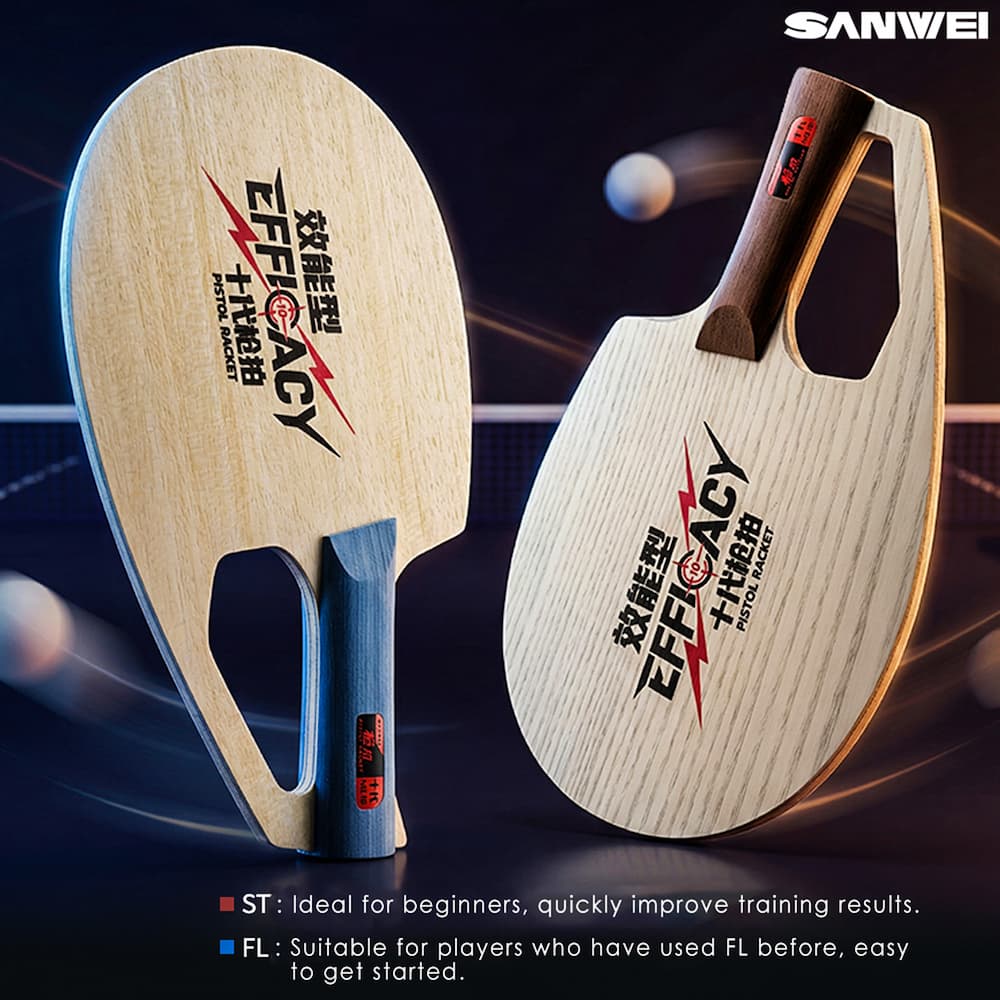
Sanwei Pistol Racket 10th
- ITTF Approved: Fully compliant with ITTF regulations, the Sanwei Pistol Racket is approved for use in any level of table tennis competition, ensuring you stay competitive at all times
- Ergonomic Swing Design: The unique design aligns the hitting point with the natural extension of your arm.
- Dual-Channel Force Guidance: Simplified movements enhance power and speed by up to 15%, giving you a competitive edge
- Anti-Rotation Palm Support: The built-in anti-rotation palm support stabilizes the racket
- Guided Motion for Shortened Training Cycles: The Pistol Racket’s design promotes proper technique and reduces errors during training.
- More structures are available for selection.
- FL/ST handles are available to suit players of varying skill levels.
- Free Shipping Worldwide!
3. Grip Design Can Influence Racket Control
One of the most important tasks in table tennis is controlling the racket face.
A small change in racket angle can affect whether the ball goes into the net, lands safely on the table, or travels long. Players must constantly adjust their racket orientation according to the incoming spin, speed, and placement.
Your grip is part of this process.
The way your fingers and palm support the handle affects how you position and control the racket. If your grip feels unstable, you may find it harder to reproduce the same racket orientation from one stroke to the next.
This does not mean that a particular handle automatically improves accuracy. Different grip shapes can encourage different hand positions, and players have different technical habits.
The important question is whether the design helps you maintain the grip you need for your playing style.
For example, a player who frequently attacks with the forehand may prioritize a grip that feels secure during acceleration. Another player may place greater importance on quick transitions between forehand and backhand.
An ergonomic handle should be evaluated in the context of these actual playing requirements.
4. The Relationship Between the Forearm and Racket Matters
This is an area I have paid particular attention to in developing SANWEI equipment.
When a player executes a forehand attack, the racket does not move independently of the arm. The hand, forearm, wrist, and rest of the body work together to produce the stroke.
If the grip feels natural, the player may find it easier to coordinate these movements. If the grip encourages an uncomfortable position, the player may develop compensating movements or unnecessary tension.
This is one of the ideas behind the SANWEI Pistol Racket.
Unlike a conventional shakehand design, the Pistol Racket uses a distinctive handle structure intended to support a different relationship between the forearm and the hitting point. The design aims to make the racket feel more like a natural extension of the forearm, particularly during forehand-oriented play.
Our approach also emphasizes efficient power transfer. Rather than asking players to generate more force simply by swinging harder, we want to explore how the grip and racket design can support a more natural, repeatable movement.
For players whose current grip feels awkward or whose forehand mechanics involve unnecessary adjustments, this alternative may be worth trying.
However, the Pistol Racket is not intended to replace every traditional FL handle. Many players perform extremely well with conventional designs. The value of an alternative grip depends on whether it suits the player’s hand, technique, and preferred style of play.
5. Ergonomic Design Is Not Just for Beginners
Some players assume that grip design matters mainly to beginners who are still learning how to hold a racket.
I see it differently.
Beginners may benefit from a handle that helps them establish a comfortable, consistent grip. But experienced players also have reasons to pay attention to handle design.
As players become more skilled, they often become more sensitive to small differences in equipment. They may notice how a handle feels during rapid transitions, whether they can maintain their preferred grip under pressure, or whether a particular shape suits their forehand technique.
An experienced player may not need to relearn the basics. Instead, they may be looking for a design that better complements the technique they have already developed.
That said, an established grip is also a deeply ingrained habit. Switching to a different handle may initially feel unfamiliar, even when the design has potential advantages.
This is why I recommend evaluating a new grip over multiple training sessions rather than judging it after a few strokes.
For advanced players, the question is not whether an ergonomic handle is automatically superior. It is whether the design offers a meaningful benefit over a grip they already know well.
6. There Is No Single Ergonomic Handle That Suits Everyone
This is perhaps the most important point.
People have different hand sizes, finger lengths, grip preferences, and playing styles. Even two players who use the same technique may prefer different handle shapes.
A player who relies heavily on forehand attacks may want something different from a player who emphasizes backhand play or defensive chopping.
This is why I do not believe there is one handle shape that every table tennis player should use.
Traditional FL, ST, and other handle designs each have their own characteristics. A well-designed conventional handle may suit a player perfectly, while a more specialized design may be better suited to someone else.
The best approach is to identify your needs before choosing.
Ask yourself:
- Does my current handle feel comfortable during longer training sessions?
- Can I maintain a secure grip without squeezing excessively?
- Do I frequently adjust my fingers during strokes?
- Does my grip support the movements I use most often?
- Is there a specific problem I hope a different handle might help address?
Your answers will help you determine whether exploring an alternative design is worthwhile.
Remember that ergonomic design should serve the player. The player should not have to change a successful technique simply to accommodate a fashionable handle.
7. How Should You Evaluate an Ergonomic Racket Handle?
If you are interested in trying a different grip design, I recommend testing it systematically.
Start with comfort. Hold the racket naturally and check whether your fingers and palm sit comfortably against the handle. Avoid squeezing tightly just to make the grip feel secure.
Practice basic strokes. Try controlled forehand loops, backhand drives, blocks, and transitions between both sides. Pay attention to whether you can maintain a comfortable grip throughout the movement.
Introduce variation. Once the basic strokes feel manageable, practice against balls with different placements and speeds. A grip that feels comfortable during stationary practice must also work when you are moving and reacting.
Evaluate your actual results. Consider consistency, control, comfort, and confidence rather than focusing only on the power of your best shot.
If possible, compare the new handle with your usual racket under similar conditions. Give yourself enough time to adapt, but remain honest about whether the design is helping.
This is especially important when trying a specialized handle such as the Pistol Racket. Its different grip structure may feel unfamiliar at first, so the initial impression alone is not necessarily a reliable measure of its suitability.
Final Thoughts
Why are more table tennis players paying attention to ergonomic grip design?
Because the handle is an important part of the connection between the player and the racket. Its shape can influence comfort, grip position, and how the player interacts with the racket during different strokes.
As players look for ways to improve consistency and make better use of their technique, it makes sense to consider the handle alongside more familiar equipment characteristics such as speed, spin, and weight.
At SANWEI, our work on the Pistol Racket reflects this philosophy. We want to explore how a different grip structure can support a more natural forehand movement and efficient power transfer, while recognizing that every player has different needs.
My advice is simple: do not choose a handle just because it looks innovative, and do not assume that a traditional design is outdated. Start with your own hand, your own technique, and the problems you want to solve.
The best racket is not necessarily the one with the most unusual design. It is the one that allows you to play comfortably, confidently, and consistently.
Su Zhimin
Founder of SANWEI Sports