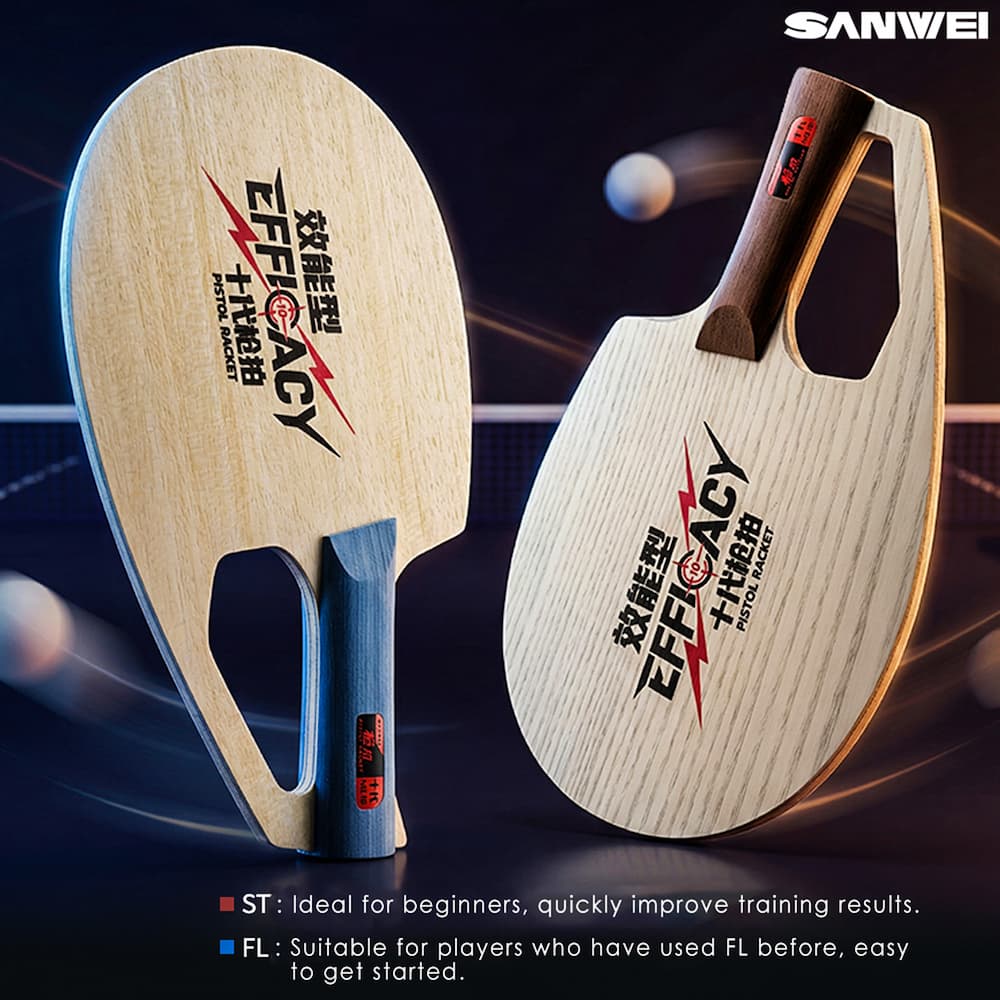
Whenever players see the SANWEI Pistol Racket for the first time, they usually have one of two reactions. Some are immediately curious about its unusual design. Others wonder why anyone would choose a racket that looks so different from a conventional shakehand blade.
Both reactions are understandable.
The Pistol Racket was developed around a different approach to grip design, forehand mechanics, and power transfer. It offers some interesting advantages, but it also has limitations that players should understand before deciding whether it suits them.
After decades of working with table tennis equipment, I believe that a good product should be judged not only by what it can do well, but also by the players and situations for which it may be less suitable.
So, let’s take an honest look at both sides.
1. Advantage: A Different Approach to Forehand Mechanics
For many attacking players, the forehand is their primary weapon. They rely on it to initiate attacks, put opponents under pressure, and finish points.
However, a powerful forehand is not simply a matter of swinging harder. The relationship between the hand, forearm, and racket also influences how comfortably a player can execute the stroke.
The Pistol Racket uses a distinctive grip structure designed around the relationship between the hitting point and the natural extension of the forearm.
The idea is to make the racket feel more like an extension of the arm, allowing players to develop a more direct and repeatable forehand movement.
For players who find that their conventional grip encourages unnecessary wrist adjustments or makes their forehand feel awkward, this alternative may be worth exploring.
The benefit is not that every player will automatically develop a better forehand. Rather, the design offers another way to approach the stroke, and some players may find that this approach better suits their natural movement.
2. Advantage: A More Defined and Stable Grip
Another important feature of the Pistol Racket is its palm-support structure.
With a conventional shakehand racket, players rely on their fingers and palm to maintain their grip and control the racket. This works extremely well for many people, but the exact feel depends on hand shape, grip habits, and personal preference.
The Pistol Racket incorporates a different support structure intended to help stabilize the racket in the hand.
For players who prefer a more defined grip, this can be an appealing feature. A secure-feeling racket may make it easier to concentrate on reading the incoming ball and preparing the next stroke instead of constantly adjusting the hand position.
This can be particularly relevant during forehand attacks and close-to-table exchanges, where players have limited time to prepare.
However, stability does not mean that the racket should prevent all movement of the fingers and wrist. Skilled players need to adjust their racket angle according to the incoming spin, ball placement, and type of shot.
The goal is to provide useful support while allowing the player to execute the movements their technique requires.
3. Advantage: Efficient Power Transfer
One of the central ideas behind the Pistol Racket is our dual-channel power-transmission design.
Many players believe that hitting a more powerful ball requires greater physical strength or a faster arm swing. In reality, effective power depends on how efficiently the body, arm, hand, and racket work together.
If your movement is poorly coordinated, you may expend considerable effort without producing the ball quality you want.
The Pistol Racket was designed to explore how the grip structure and racket geometry can support more efficient force transfer during a stroke.
For attacking players, the intended benefit is to help them produce powerful shots without relying entirely on excessive arm effort.
Of course, actual results depend on technique, timing, physical ability, and the blade structure selected. A handle cannot create power independently of the player.
But when equipment supports a player’s movement rather than working against it, it may become easier to develop an efficient and repeatable attacking technique.
4. Advantage: It Offers an Alternative for Players Who Have Reached a Plateau
Some players have been using a traditional FL handle for many years. Their technique is familiar, but they still struggle with certain aspects of their forehand.
Perhaps their grip feels uncomfortable during extended training. Perhaps they find it difficult to maintain the same racket position across different shots. Or perhaps they simply want to explore a different approach to their attacking technique.
In these situations, trying a different handle design can be a useful experiment.
The Pistol Racket is particularly interesting because it changes the way the player interacts with the racket rather than merely changing the blade composition.
For some players, this may provide a new perspective on grip, forearm positioning, and stroke mechanics.
However, I would not recommend changing equipment simply because you have stopped improving. First, identify the real cause of your plateau. If poor footwork or late contact is your main problem, a different handle is unlikely to solve it.
A new design is worth considering when it addresses a specific need—not simply because it looks innovative.
5. Disadvantage: It Takes Time to Adapt
This is one of the most important considerations.
If you have used a traditional FL handle for years, your grip and stroke mechanics have become deeply ingrained habits. You know where your fingers sit, how the racket feels during a forehand loop, and how to transition between strokes.
When you switch to the Pistol Racket, the different grip structure may initially feel unfamiliar.
You may need time to adjust your hand position, racket orientation, and coordination between the forehand and backhand.
During this period, your performance may not immediately improve. Some shots may feel less natural than they did with your old racket.
This is normal when adapting to a substantially different design.
My recommendation is to begin with controlled drills and gradually introduce more demanding situations. Pay attention to comfort, contact quality, and the ability to execute your usual strokes.
Do not judge the racket solely by your first few minutes of practice. Equally, do not assume that you must continue using it if the grip consistently feels unsuitable after a reasonable adaptation period.
The right equipment should ultimately support your game.
6. Disadvantage: It May Not Suit Every Hand or Playing Style
No handle design is ideal for everyone.
Players have different hand sizes, finger lengths, grip preferences, and technical habits. A structure that feels secure to one player may feel restrictive or uncomfortable to another.
The Pistol Racket is especially distinctive in the way it supports the hand. Because of this, players should pay attention to how the grip fits their individual hand rather than assuming that its ergonomic design will suit everyone.
It is also important to consider playing style.
For players who prioritize forehand attacks and compact attacking strokes, the design may be worth exploring. However, players who depend heavily on delicate touch, extensive finger adjustments, or specialized defensive movements should test it carefully.
Some players may find that the handle’s more defined support changes the freedom they are accustomed to when adjusting the racket with their fingers or wrist.
This does not automatically make the racket unsuitable for those techniques. It simply means that the player’s individual experience matters.
If your game depends on a particular type of wrist movement or touch shot, evaluate those strokes specifically before deciding.
7. Disadvantage: Changing the Handle Does Not Automatically Fix Technique
I want to make this point very clear.
The Pistol Racket is designed to support a particular approach to grip and stroke mechanics. It is not a replacement for proper training.
If your footwork is inconsistent, your contact point changes from one ball to the next, or you frequently lose balance during an attack, these problems still need to be addressed.
Likewise, a different handle cannot automatically teach you how to read spin, select the right shot, or make good tactical decisions.
A player may initially feel that the Pistol Racket makes certain movements more natural. But turning that feeling into consistent match performance still requires practice.
Start with basic strokes, focus on a stable contact point, and gradually introduce movement and variation. Then evaluate whether the design helps you perform more consistently under realistic playing conditions.
The best way to judge any racket is to examine how it affects your actual performance, not just how it feels when you first pick it up.

Sanwei Pistol Racket 10th
- ITTF Approved: Fully compliant with ITTF regulations, the Sanwei Pistol Racket is approved for use in any level of table tennis competition, ensuring you stay competitive at all times
- Ergonomic Swing Design: The unique design aligns the hitting point with the natural extension of your arm.
- Dual-Channel Force Guidance: Simplified movements enhance power and speed by up to 15%, giving you a competitive edge
- Anti-Rotation Palm Support: The built-in anti-rotation palm support stabilizes the racket
- Guided Motion for Shortened Training Cycles: The Pistol Racket’s design promotes proper technique and reduces errors during training.
- More structures are available for selection.
- FL/ST handles are available to suit players of varying skill levels.
- Free Shipping Worldwide!
8. How Can You Decide Whether the Pistol Racket Is Right for You?
Rather than asking whether the Pistol Racket is better than a traditional FL handle, I suggest asking whether it is better suited to your particular needs.
Here is a practical way to evaluate it.
First, examine your grip.
Does your current handle feel comfortable? Can you hold the racket securely without excessive tension? Do you frequently adjust your fingers during a stroke?
Second, identify your priorities.
Are you trying to improve forehand consistency, explore more efficient power transfer, or find a grip that feels more natural? A clear objective will help you judge whether the design is useful.
Third, test both sides of your game.
Practice forehand attacks, backhand strokes, blocks, short touches, and transitions. Do not evaluate the racket based only on your strongest shot.
Finally, assess it during matches.
A racket that performs well in predictable drills must also work when you are moving, reacting, and making decisions under pressure.
If possible, compare it with your usual racket under similar conditions. Give yourself enough time to adapt, and focus on repeatability rather than isolated moments of excellent performance.
The result should guide your decision.
Final Thoughts
So, what are the advantages and disadvantages of the Pistol Racket?
Its main advantages are its distinctive grip structure, its focus on the relationship between the forearm and hitting point, and its approach to power transfer and grip stability. For players who respond well to this design, it may offer a useful alternative for developing their attacking game.
Its main limitations are equally important: the grip takes time to adapt to, it may not suit every hand or playing style, and it cannot replace sound technique and purposeful training.
I developed the Pistol Racket because I believe there is room to explore different ways of connecting the player with the racket. That does not mean every player should abandon a traditional handle.
If your current racket fits your hand and supports your technique, there may be no reason to change. But if you have specific difficulties with your grip or forehand movement, trying a different design may open up another possibility.
Good equipment does not have to suit everyone. It has to suit the player who chooses it.
That is how I believe we should evaluate the Pistol Racket—and table tennis equipment in general.
Su Zhimin
Founder of SANWEI Sports