When amateur players want to improve their table tennis skills, they usually focus on three things: training harder, learning better techniques, and buying better equipment.
But there is another factor that deserves more attention: how comfortably and naturally you hold your racket.
Many players spend years experimenting with different blades and rubbers, looking for more speed, spin, or control. Yet they rarely consider whether their handle design works well with their hand and playing movements.
Can an ergonomic table tennis racket really help amateur players improve? My answer is yes, it can—but we need to understand what it can realistically do and what it cannot.
1. Why Does the Handle Matter More Than Many Players Think?
The handle is the connection between your hand and the racket. Every stroke you make depends on this connection.
During a forehand attack, for example, you need to coordinate your body movement, arm swing, forearm rotation, and racket angle. If your grip feels awkward or requires constant adjustment, it may become harder to reproduce the same movement consistently.
This does not mean that a conventional handle is inherently problematic. Traditional FL and ST handles have served generations of players very well. The important question is whether a particular handle suits your hand and playing style.
An ergonomic handle aims to make the relationship between the hand and racket more comfortable and functional. Depending on its design, it may help a player maintain a more natural grip, reduce unnecessary adjustments, or feel more secure during certain strokes.
Research also suggests that handle design can influence racket angles during table tennis forehand strokes. However, a 2025 study of beginner players found no statistically significant differences in overall success rates between the experimental and conventional handle groups during the test. This is a useful reminder: changing the handle can influence how you handle the racket, but that does not automatically translate into better performance.
2. Ergonomic Design May Help You Build More Consistent Strokes
For many amateur players, consistency is a bigger problem than a lack of power.
You may be able to produce a fast forehand occasionally, but struggle to repeat it five or ten times in a row. Your racket angle may change slightly, your contact point may drift, or you may grip the handle too tightly when the rally becomes faster.
These problems have different causes, and no handle can solve all of them.
However, if your existing grip makes it difficult to maintain a comfortable and repeatable racket position, a different handle design may help.
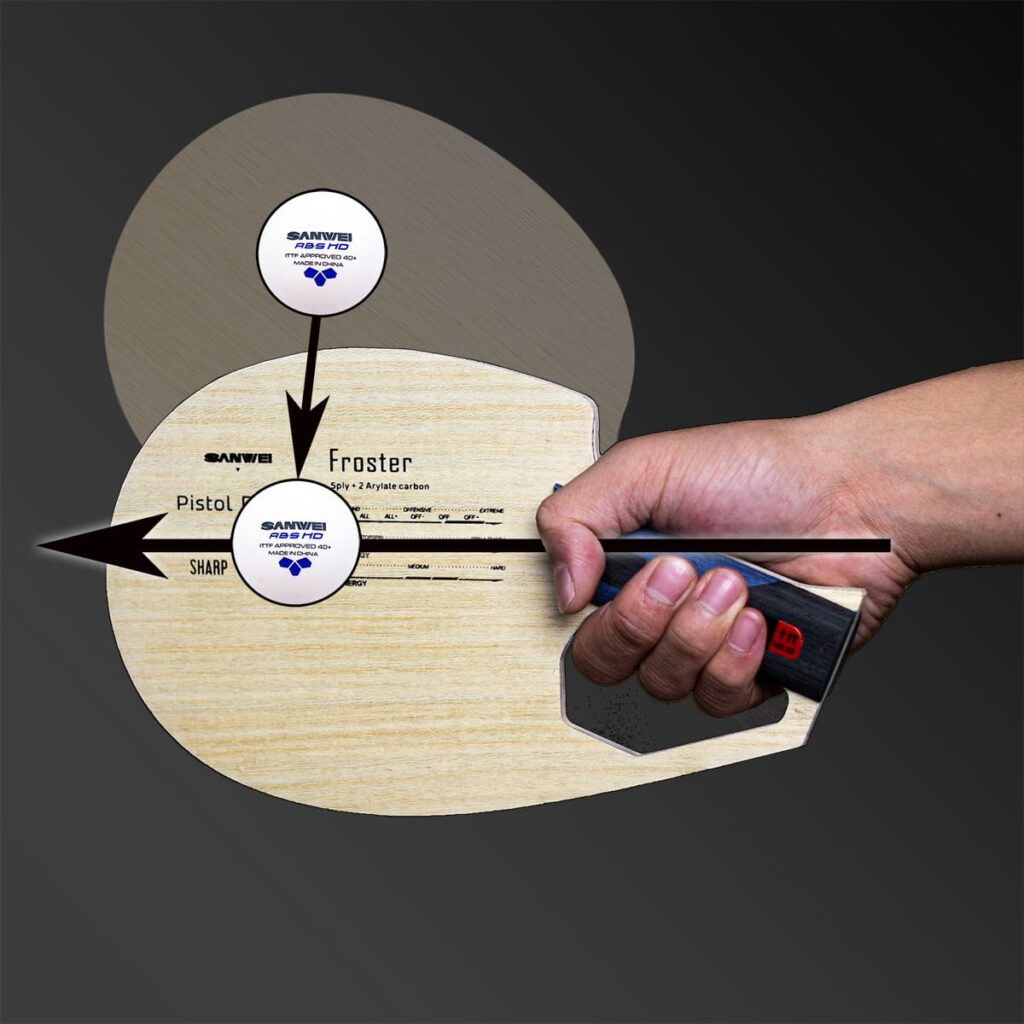
This is one of the ideas behind the SANWEI Pistol Racket. Its ergonomic swing design is intended to bring the hitting point into closer alignment with the natural extension of the forearm, while its anti-rotation palm support is designed to provide a more defined feeling of support in the hand.
For players who respond well to this design, the racket may make certain attacking movements feel more natural and repeatable.
But I always emphasize one point: a stable grip should support a natural movement, not force the hand and wrist to become rigid.
Good table tennis still requires flexibility. You must adjust your racket angle according to the incoming ball, spin, and intended shot. The goal is to develop reliable control, not to hold the racket in one fixed position throughout the entire rally.
3. Better Power Transfer Is Not the Same as Using More Strength
Another common problem among amateur players is trying to generate more power by swinging harder.
When a forehand lacks penetration, many players respond by using more arm strength. Sometimes this produces a faster ball, but it can also make timing less reliable and increase unnecessary tension.
Effective power comes from coordinating the body and racket efficiently. The legs, torso, arm, forearm, and hand all contribute to the stroke. The racket handle is only one part of this system, but it is an important part because it connects the player’s movement to the racket.
At SANWEI, the Pistol Racket incorporates a design concept we call dual-channel force guidance, intended to support efficient force transfer during the swing.
For a player who finds the grip compatible with their movement, this design may help them explore a more direct and comfortable way of executing attacking strokes.
It is important, however, not to confuse this with a promise of automatic power gains. If your footwork is poor, your contact point is late, or your swing mechanics are inefficient, an ergonomic handle will not fix those issues by itself.
In my experience, equipment is most useful when it complements sound technique. It should help you make better use of your existing abilities, not encourage you to rely on equipment instead of training.
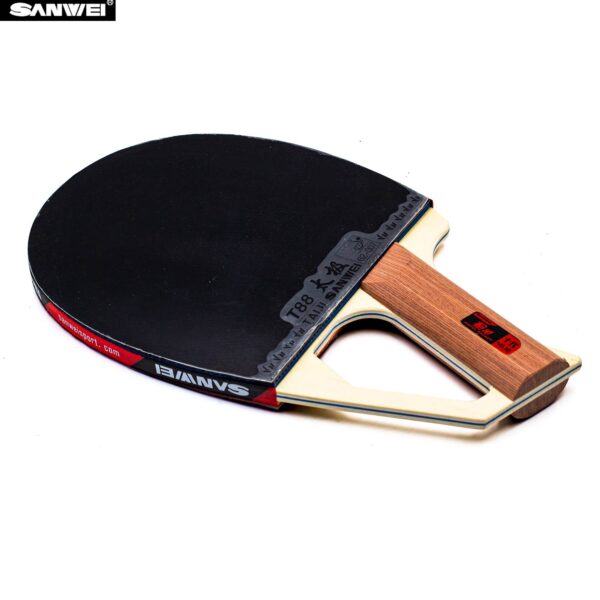
Sanwei Pistol Racket 10th Pre-Assemble Bat
- ITTF Approved: Fully compliant with ITTF regulations, the Sanwei Pistol Racket is approved for use in any level of table tennis competition, ensuring you stay competitive at all times
- Ergonomic Swing Design: The unique design aligns the hitting point with the natural extension of your arm.
- Dual-Channel Force Guidance: Simplified movements enhance power and speed by up to 15%, giving you a competitive edge
- Anti-Rotation Palm Support: The built-in anti-rotation palm support stabilizes the racket
- Guided Motion for Shortened Training Cycles: The Pistol Racket’s design promotes proper technique and reduces errors during training.
- Free Shipping Worldwide.
4. Can Ergonomic Rackets Help Beginners Learn Faster?
Beginners have a particular challenge: they are still developing their grip, racket angle, swing path, and contact point.
At this stage, a handle that feels comfortable and allows the player to hold the racket consistently may be helpful. A suitable design could make it easier to focus on learning the stroke rather than constantly adjusting an uncomfortable grip.
However, an ergonomic racket is not automatically the best starting point for every beginner.
Players have different hand sizes, finger positions, coordination patterns, and preferences. A handle that feels natural to one beginner may feel unfamiliar to another.
More importantly, beginners need proper instruction and repeated practice. They must learn how to position themselves, judge the incoming ball, control the racket angle, and recover after each shot.
A good handle can support this learning process, but it cannot replace it.
My advice to beginners is to prioritize comfort, control, and a suitable weight and balance. Do not choose a racket simply because it has the most unusual or advanced-looking design. Choose one that allows you to learn the fundamentals confidently.
5. What About Amateur Players Who Have Reached a Plateau?
I believe ergonomic design can also be worth exploring for players who have been playing for several years but feel their progress has slowed.
At this stage, players often have established habits. They may already possess a reliable forehand and backhand, yet still struggle with consistency under pressure or find certain movements less comfortable than they would like.
Sometimes the answer is more focused training. Sometimes it is a tactical problem. Sometimes the player has developed a technical habit that needs correcting.
And occasionally, their current equipment may not be the best match for their technique.
This is where trying a different handle design can be useful—not because it guarantees a breakthrough, but because it gives the player another option to evaluate.
For example, a player who relies heavily on forehand attacks may be interested in the Pistol Racket’s distinctive grip structure and forehand-oriented design. If the handle feels more natural and supports more repeatable movements, it may be a useful addition to that player’s equipment choices.
On the other hand, a player who is already comfortable with a conventional FL handle and has no particular grip-related problem may see little reason to change.
Before changing your equipment, identify the problem you want the equipment to solve. Otherwise, it becomes difficult to tell whether a new racket has genuinely helped.
6. What Ergonomic Design Cannot Do
I want to be clear about the limitations, because realistic expectations are important.
An ergonomic racket cannot automatically correct poor footwork. It cannot teach you to read spin, improve your tactical decisions, or develop a reliable recovery position. It also cannot guarantee that you will hit the ball harder or win more matches.
Furthermore, ergonomic design does not mean one shape fits every hand.
Some players prefer a conventional handle because it allows them to make small finger adjustments more freely. Others may find a more structured grip restrictive, particularly when performing delicate touch shots or specialized defensive movements.
That is why I do not believe that ergonomic handles should simply replace traditional designs. Different designs serve different preferences and playing needs.
The real question is not whether ergonomic rackets are universally better. It is whether a particular design addresses a real need for a particular player.
7. How Should You Test an Ergonomic Racket?
If you are considering an ergonomic racket, I recommend a simple and practical approach.
First, identify your main objective.
Are you trying to improve forehand consistency, feel more secure when holding the racket, or find a grip that feels more natural during your swing? Choose one or two specific goals rather than expecting every aspect of your game to improve at once.
Second, start with basic strokes.
Begin with controlled rallies, forehand drives, and backhand exchanges. Pay attention to comfort, racket angle, and whether you can reproduce your movements without unnecessary tension.
Third, test it under more demanding conditions.
Once the basic strokes feel comfortable, move on to footwork drills, transitions between forehand and backhand, and match-like situations. A handle that feels good during a stationary warm-up may feel different when you need to move quickly.
Fourth, allow time for adaptation.
A new handle can feel unfamiliar simply because your hand has become accustomed to another shape. Give yourself enough practice to make a fair comparison, but do not ignore persistent discomfort or restricted movement.
Finally, evaluate the results honestly. If your control improves and the racket feels more natural, that is meaningful. If you find that your conventional handle works better, there is no reason to switch.
The purpose of testing equipment is to find what works for you—not to prove that a particular design is superior.
Final Thoughts
Can an ergonomic table tennis racket help amateur players improve?
Yes, when its design addresses a genuine need in the player’s grip or stroke mechanics. It may support a more comfortable hold, help some players maintain a more consistent racket position, and offer a different approach to power transfer.
But improvement still depends on technique, purposeful practice, physical coordination, and decision-making. Equipment can support these things, but it cannot replace them.
This is the philosophy behind SANWEI’s work on the Pistol Racket. We are not trying to convince every player to abandon the traditional handle. We are exploring whether a different ergonomic approach can help certain players connect with the racket in a way that better suits their movements.
My advice is to look beyond claims about speed and power. Pay attention to how the racket feels in your hand, how naturally you can execute your strokes, and whether it helps you achieve the specific improvements you are looking for.
The best equipment is not necessarily the most advanced or unusual. It is the equipment that helps you develop your game while allowing you to play with confidence and control.
Su Zhimin
Founder of SANWEI Sports