When table tennis players talk about equipment, they usually focus on the blade and rubbers. They compare speed, spin, hardness, and control, hoping to find a combination that helps them play better.
But there is another part of the racket that deserves just as much attention: the handle.
The handle is the only part of the racket you hold directly. Every adjustment you make to the racket angle, every change in your swing, and every attempt to control the ball passes through your hand and the handle.
So why can handle design affect shot quality? And can a different handle help amateur players produce more consistent strokes?
In my view, the answer starts with understanding the relationship between the hand, forearm, and racket.
1. The Handle Is the Connection Between Your Hand and the Ball
When you hit a table tennis ball, the racket does not move independently. Its movement depends on how your hand holds and guides it.
Consider a forehand topspin shot. You need to coordinate your body rotation, arm swing, forearm movement, and racket angle. At the moment of contact, even a small difference in racket orientation can change the ball’s trajectory.
If your grip allows you to control the racket naturally, it may be easier to reproduce the movement you want. If the grip feels awkward, you may find yourself making extra adjustments with your fingers, wrist, or forearm.
These adjustments are not necessarily bad. Skilled players constantly adjust their racket angle according to the incoming ball and the shot they want to play.
The problem arises when those adjustments become unnecessary compensation for a grip that does not suit your technique.
This is one reason handle design matters. It influences how the player holds and manipulates the racket, which can affect the movements used to produce a shot.
A study published in Sports in 2025 examined a prototype table tennis handle and found differences in racket angles during forehand strokes compared with conventional handles. However, the study did not find significant differences in overall success rates. In other words, handle design can influence racket handling, but its effect on actual performance is more complicated.
2. Racket Angle Control Starts with the Grip
One of the most important factors in shot quality is racket angle.
When you attack with topspin, the racket must meet the ball at an angle that suits your swing speed, contact point, and intended trajectory. If the racket face is too open or too closed for the stroke, the ball may fly long, hit the net, or travel with less control than you intended.
Amateur players sometimes try to correct these errors by changing their wrist movement at the last moment. This can work occasionally, but it may also make their strokes less repeatable.
A more reliable approach is to develop a comfortable grip and a consistent basic movement, then learn to adjust the racket angle deliberately.
The handle plays a role because its shape affects how your hand sits around the racket and how easily you can maintain or change its orientation.
For some players, a conventional FL handle provides exactly the right balance of support and freedom. For others, a different grip structure may feel more natural and help them manage their racket angle during certain strokes.
Neither design is automatically superior. What matters is whether the handle allows you to control the racket effectively without creating unnecessary tension.

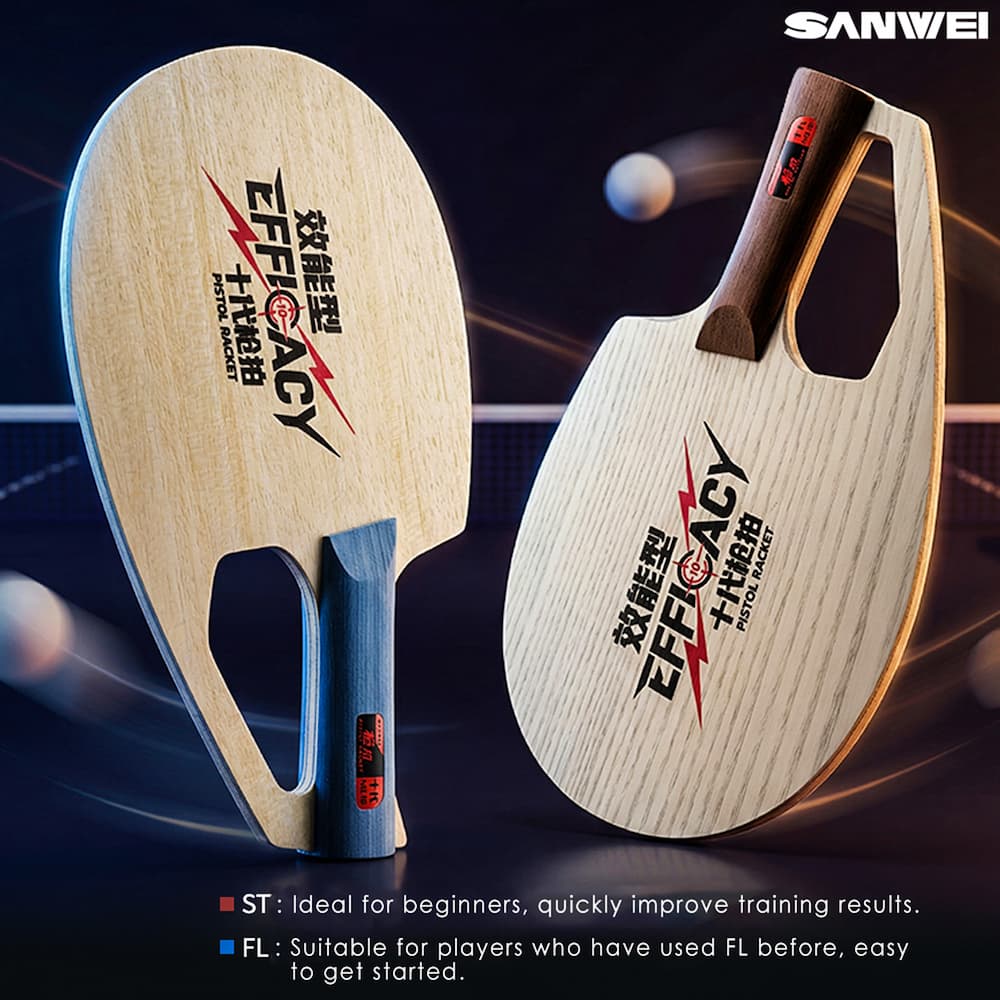
Sanwei Pistol Racket 10th
- ITTF Approved: Fully compliant with ITTF regulations, the Sanwei Pistol Racket is approved for use in any level of table tennis competition, ensuring you stay competitive at all times
- Ergonomic Swing Design: The unique design aligns the hitting point with the natural extension of your arm.
- Dual-Channel Force Guidance: Simplified movements enhance power and speed by up to 15%, giving you a competitive edge
- Anti-Rotation Palm Support: The built-in anti-rotation palm support stabilizes the racket
- Guided Motion for Shortened Training Cycles: The Pistol Racket’s design promotes proper technique and reduces errors during training.
- More structures are available for selection.
- FL/ST handles are available to suit players of varying skill levels.
- Free Shipping Worldwide!
3. A Comfortable Grip Can Help You Avoid Unnecessary Tension
Have you ever noticed that your hand becomes increasingly tight as a rally gets faster?
This is common among amateur players. When the incoming ball becomes more difficult, they may squeeze the handle harder in an attempt to gain control.
Unfortunately, gripping harder does not always produce better control.
Excessive tension can make it more difficult to adjust your fingers and wrist naturally. It may also interfere with the relaxed, coordinated movement needed for effective strokes.
At the same time, holding the racket too loosely can make it feel insecure, especially during fast exchanges.
The goal is not to grip as tightly or as loosely as possible. It is to find a level of grip pressure that gives you sufficient control while allowing your hand and forearm to move naturally.
Handle design may influence how easily a player finds that balance. A shape that fits your hand well may feel secure without requiring constant squeezing.
This is particularly relevant for players who struggle to maintain a comfortable grip during repeated attacking strokes.
However, comfort is individual. A handle that provides a secure feeling for one player may feel restrictive to another. You need to evaluate it through actual practice rather than judging it by appearance alone.
4. Handle Design Can Influence How You Transfer Power
Many players believe that a powerful shot comes mainly from a fast arm swing.
In reality, effective power depends on coordinating the body and racket. Your legs, torso, arm, forearm, and hand all contribute to the movement, while the timing of contact determines how effectively that movement produces the intended shot.
The handle is part of this process because it connects the hand to the racket.
If your grip feels awkward, you may compensate by changing your swing path or adding tension. These adjustments can make it harder to repeat an efficient movement.
A handle that suits your technique may help you hold and guide the racket more naturally, allowing you to focus on timing and coordination rather than constantly correcting your grip.
This idea is part of the design philosophy behind the SANWEI Pistol Racket.
Its ergonomic swing design is intended to bring the hitting point into closer alignment with the natural extension of the forearm. The design also incorporates dual-channel force guidance, which is intended to support efficient power transfer during attacking movements.
For players whose hand and swing mechanics work well with this design, it may offer a different approach to executing the forehand.
But I want to emphasize an important distinction: a handle can support efficient movement, but it cannot generate good technique on its own.
If your timing is poor or your body rotation is inefficient, a different handle will not automatically produce a stronger shot. The real benefit comes when the equipment and the player’s movement work well together.
5. Why Does the Same Racket Feel Different in Different Players’ Hands?
This is something I believe every player should understand before buying new equipment.
Two players can use the same blade and rubbers but produce very different results. They may have different hand sizes, finger positions, grip pressures, swing paths, and technical habits.
The same handle can therefore feel completely different to each player.
One player may feel that a traditional FL handle gives them enough support while allowing excellent wrist freedom. Another may prefer a more defined grip structure because it feels more secure during forehand attacks.
Neither player’s experience is necessarily wrong.
This is also why I do not believe ergonomic design should mean forcing every player into one ideal grip shape. The purpose should be to explore designs that accommodate different needs and playing styles.
For example, the SANWEI Pistol Racket offers an alternative to conventional handle designs, with particular attention to forehand movement and the relationship between the hand and forearm.
Some players may find this approach helpful. Others may prefer their existing handle, especially if their technique is already well established.
The most important thing is to identify what works for your own game.
6. Can a Different Handle Improve Consistency?
For many amateur players, consistency is the real challenge.
They can hit a good forehand during warm-up, but struggle to reproduce it when moving, dealing with spin, or playing under pressure.
There are many possible causes: poor footwork, inconsistent contact points, late preparation, excessive tension, or an unreliable swing path.
Grip-related problems can be another factor.
If your handle makes it difficult to maintain a comfortable racket position, a different design may help you establish a more repeatable feeling during certain strokes. But it is important to distinguish between feeling more stable and actually becoming more consistent.
To evaluate a new handle, I suggest testing it under the same conditions as your current racket.
Start with controlled forehand rallies. Then introduce movement, changes of direction, and forehand-backhand transitions. Finally, test it during match-like situations.
Pay attention to whether you can reproduce your strokes, adjust the racket angle when necessary, and maintain control without excessive tension.
Do not judge the racket only by the speed of your best shot. Look at the quality of your average shot and how reliably you can execute it.
That is a much more useful measure of whether the handle suits you.
7. Should You Change Your Handle If Your Technique Is Already Good?
Not necessarily.
If you already have a comfortable grip, reliable technique, and consistent shot quality, there may be little reason to change your handle.
Equipment changes also require adaptation. Even a design that eventually suits you may initially feel unfamiliar, and that adjustment period can temporarily affect your performance.
On the other hand, if you have identified a specific problem related to grip comfort, racket positioning, or forehand movement, testing an alternative design may be worthwhile.
The key is to change equipment for a reason.
Before switching, ask yourself three questions:
- What specific problem am I trying to solve?
- Does my current handle contribute to that problem, or is the cause mainly technical?
- After practicing with the alternative, can I identify a real improvement in comfort, control, or consistency?
These questions help you avoid the common mistake of changing equipment repeatedly without understanding why your performance has stalled.
Final Thoughts
Why does racket handle design affect table tennis shot quality?
Because the handle is more than a place to hold the racket. It influences how the hand interacts with the racket, how the player controls its angle, and how naturally certain movements can be performed.
A suitable handle may help a player feel more comfortable, manage the racket more consistently, and execute particular strokes with less unnecessary adjustment. But these benefits depend on the individual, and handle design alone cannot guarantee better performance.
This is why I believe equipment development should consider the player as well as the racket itself.
At SANWEI, our work on the Pistol Racket reflects this approach. We wanted to explore a different grip structure that could offer an alternative way to coordinate the hand, forearm, and racket, particularly during attacking movements.
I encourage players to remain open-minded about equipment, but also to be practical. Do not change your handle simply because a new design looks innovative. Identify what you need, test the racket carefully, and judge it by the quality of your actual play.
Ultimately, the best handle is the one that allows you to control the racket naturally and develop your technique with confidence.
Su Zhimin
Founder of SANWEI Sports