Whenever I introduce the Pistol Racket to table tennis players, someone eventually asks me the same question:
“Do you really think this design could become the future of table tennis rackets?”
It is a fair question. The traditional shakehand handle has been used for generations. Players have developed their techniques around it, manufacturers understand how to produce it, and the entire table tennis industry is familiar with its shape.
Changing something so established is never easy.
After years of developing the Pistol Racket, I have my own thoughts on this question. But I would not claim that every player will eventually use it, or that traditional handles will disappear.
I believe the more important question is whether table tennis racket design has reached its limit.
And my answer is no.
1. Why Has Racket Handle Design Changed So Little?
When players discuss racket technology, they usually talk about blade construction, carbon materials, rubber composition, sponge hardness, and weight.
These areas have seen plenty of development. Manufacturers continue to experiment with new materials and structures to change the balance between speed, spin, control, and feel.
But the basic shape of the traditional shakehand handle has remained relatively familiar for a long time.
There is a practical reason for this. The traditional FL and ST handles work well for a huge number of players. They are familiar, versatile, and supported by decades of playing experience.
I have no intention of dismissing that achievement. A design does not remain popular for generations without good reasons.
However, popularity does not necessarily mean that every possible improvement has already been explored.
When developing equipment, we should occasionally step back and ask a simple question: Are we continuing to use a design because it is the best solution for every player, or because it is the solution we already know?
That question led me to explore a different approach to the relationship between the hand, forearm, and racket.
2. What If We Designed the Racket Around the Player’s Movement?
For a long time, table tennis equipment development has focused heavily on what happens when the ball contacts the racket.
That is understandable. The blade and rubber directly influence how the ball responds.
But before the ball reaches the racket, the player must prepare, move, swing, and control the racket face. The quality of that process also matters.
The handle is the connection between the player and the racket. Its design influences how the hand holds the racket and how the player manipulates it during different strokes.
This is where I believe ergonomic design deserves more attention.
Instead of asking only how to make a blade faster or a rubber spinnier, we can also ask how to make the racket work more naturally with the player’s movements.
The SANWEI Pistol Racket is one result of this thinking.
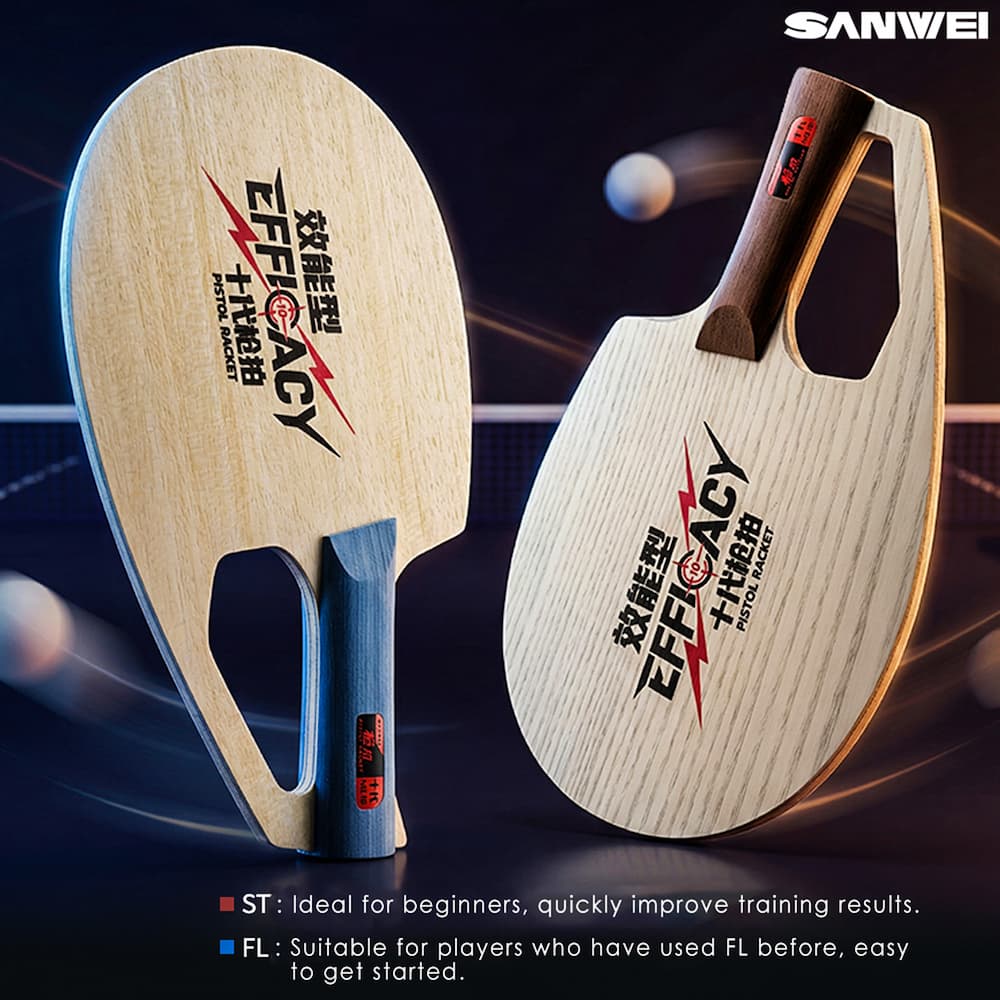
Its distinctive grip structure is designed to bring the hitting point into closer alignment with the natural extension of the forearm. It also incorporates an anti-rotation palm-support structure and a dual-channel force-guidance concept intended to support racket stability and efficient power transfer.
These features represent a different way of approaching racket design.
I do not believe they automatically make the Pistol Racket better for everyone. What interests me is the possibility of designing equipment around the player’s movement rather than treating the handle as a component whose shape should never change.
3. Does That Mean the Traditional FL Handle Will Become Outdated?
Not necessarily.
The traditional FL handle is a successful design, and I expect it to remain an important option for a long time.
Many players have spent years developing their techniques around it. They know how to adjust their grip, change racket angles, and move between forehand and backhand strokes. For these players, the familiar handle may be exactly what they need.
A new design must offer a meaningful benefit to justify changing an established habit.
That is a high standard, and it should be.
The Pistol Racket is not intended to make traditional handles obsolete. It is intended to offer an alternative for players who want to explore a different relationship between the hand and racket, particularly during attacking movements.
Some players may find the design suits them very well. Others may prefer the flexibility and familiarity of a conventional FL handle.
Both outcomes are perfectly reasonable.
In my opinion, the future of equipment should not be about forcing every player to use the same design. It should be about giving players more meaningful choices.
4. Could Ergonomic Design Become a Bigger Part of Table Tennis?
I believe it could.
Players are increasingly interested in understanding how their equipment affects their actual performance, rather than choosing a racket based only on brand reputation or specifications.
Ergonomics offers another way to evaluate equipment.
Instead of looking exclusively at speed, weight, and blade composition, players can also consider how comfortably they hold the racket, how naturally they can execute their strokes, and whether the grip supports their preferred technique.
This is not simply about creating unusual handles.
A successful ergonomic design must solve a real problem. It must be comfortable enough to use, practical to manufacture, suitable for the intended playing style, and capable of delivering a meaningful benefit to the players who choose it.
Research into table tennis handle design is also continuing. For example, a 2026 study published in Scientific Reports described a process for designing a customized handle for an athlete with tetraplegia. Although it was a single-athlete case study and its findings cannot be generalized to all players, it illustrates how handle design can be adapted to individual physical needs.
This is an important direction to explore: not assuming that one handle shape is ideal for everybody, but investigating how equipment can better accommodate the people who use it.
The Pistol Racket represents one approach to this broader idea. It is not the only possible direction for ergonomic development, and future designs may explore entirely different solutions.
That is what makes this area interesting.

Sanwei Pistol Racket 10th
- ITTF Approved: Fully compliant with ITTF regulations, the Sanwei Pistol Racket is approved for use in any level of table tennis competition, ensuring you stay competitive at all times
- Ergonomic Swing Design: The unique design aligns the hitting point with the natural extension of your arm.
- Dual-Channel Force Guidance: Simplified movements enhance power and speed by up to 15%, giving you a competitive edge
- Anti-Rotation Palm Support: The built-in anti-rotation palm support stabilizes the racket
- Guided Motion for Shortened Training Cycles: The Pistol Racket’s design promotes proper technique and reduces errors during training.
- More structures are available for selection.
- FL/ST handles are available to suit players of varying skill levels.
- Free Shipping Worldwide!
5. What Must Happen Before the Pistol Racket Becomes More Widely Accepted?
A different design cannot become widely adopted simply because its inventor believes in it.
Players must have opportunities to try it, understand how it works, and determine whether it suits their own games.
I see several important challenges.
Players Need Time to Adapt
A grip that differs from the traditional FL handle will naturally feel unfamiliar to many players.
Experienced players, in particular, have developed deeply ingrained habits. Even if an alternative design has potential advantages, they may need time to adjust their grip and movements.
This is why first impressions are not always enough. Players need to evaluate the racket through actual training and match-like situations.
At the same time, manufacturers must acknowledge that not every player will adapt successfully. A good design should be evaluated honestly, including its limitations.
The Benefits Must Be Demonstrated Through Playing Experience
Players ultimately judge equipment by how it performs.
Does the grip feel comfortable? Can they control the racket face? Does it suit their forehand and backhand? Can they reproduce their strokes under pressure?
These questions matter more than how innovative a handle looks.
As more players try the Pistol Racket, their experiences can help us understand which playing styles benefit most and where further improvements are needed.
I also believe independent testing and more systematic performance studies are valuable. Product design claims should be treated as hypotheses to investigate, not as proof that every player will improve.
The Design Must Continue to Evolve
No product should be considered finished simply because it has reached the market.
Player feedback can reveal problems that are difficult to identify during the design process. Different hand sizes, grip preferences, and playing styles may expose areas that need refinement.
That is why the Pistol Racket has continued to develop.
The current Pistol Racket 10th range offers different blade structures and both ST and FL handle options, giving players more flexibility in choosing a setup that suits their preferences.
These changes reflect an important principle: innovation is not a single event. It is an ongoing process of testing, learning, and improving.
6. Could the Pistol Racket Change How Players Think About Equipment?
Perhaps its greatest contribution will not be whether it replaces the traditional FL handle.
It may be the questions it encourages players and manufacturers to ask.
For decades, many players have treated the handle as a familiar part of the racket that requires little consideration. They spend hours comparing rubbers and blade materials but may never seriously examine whether their grip design suits their movements.
The Pistol Racket challenges that assumption.
It encourages players to think about the relationship between grip, forearm movement, racket-face control, and power transfer.
Even players who ultimately prefer traditional handles may find value in considering these factors more carefully.
For manufacturers, it presents another opportunity: to investigate how different handle geometries might serve different playing styles and individual needs.
I believe this is a worthwhile direction for the industry, regardless of which particular design becomes popular.
The future does not have to belong to one racket. It can belong to better-informed choices and more thoughtful equipment development.
7. My Vision for the Future of Table Tennis Rackets
After years of working on the Pistol Racket, I have become convinced of one thing: we should not assume that the familiar shape of a racket handle is the only way to design it.
That does not mean I can predict what professional players will use ten or twenty years from now.
Perhaps the Pistol Racket will become a more widely used alternative. Perhaps other manufacturers will develop different ergonomic concepts. Perhaps the most useful future designs will combine familiar handles with new structural ideas.
I cannot say for certain.
What I can do is continue refining the Pistol Racket, listening to players, and testing whether our design decisions solve real problems.
My goal has never been to create something different simply to attract attention. I want to explore whether a different relationship between the player and the racket can make table tennis more comfortable, intuitive, and effective for the people who benefit from it.
If the Pistol Racket encourages the industry to pay more attention to ergonomic design, that would already be a meaningful contribution.
Final Thoughts
Will the Pistol Racket become the future of table tennis racket design?
I believe it has the potential to become an important alternative, but I would not claim that it will replace traditional handles or become the right choice for every player.
The future of equipment should be decided by practical value, player experience, continued development, and evidence—not simply by how unconventional a design looks.
The traditional FL handle has served table tennis remarkably well. There is no reason to abandon it when it works for a player.
But there is also no reason to stop exploring new possibilities.
For me, the Pistol Racket represents a simple idea: the way we hold the racket deserves as much thoughtful design as the materials we use to make it.
Whether this particular design becomes widely adopted is something time will tell.
I will continue working to improve it, and I hope more players will try it with an open mind and judge it through their own experience.
Innovation does not require everyone to change immediately. It requires someone to ask whether there is a better possibility—and then do the work to explore it.
Su Zhimin
Founder of SANWEI Sports