Last Christmas, I watched my seven-year-old nephew unwrap a “kids” ping pong set that came in a box shaped like a cartoon dinosaur. He was obsessed for exactly eleven minutes. Then the paddle—which had the weight and feel of a wooden spoon with a sticker on it—went into the pile of toys never to be seen again. That’s the moment I became weirdly obsessed with the question every parent and aunt should ask before buying a ping pong paddle for kids: not “is it cute?” but “can they actually hit the ball?” If your answer is “I don’t know,” this post is for you. I’ve now tested enough beginner ping pong paddle kids setups to have strong opinions about what makes the best table tennis racket for children—and why the kids table tennis bat you pick should be judged on control, not packaging. Because the truth is, most ping pong paddles for beginners that are marketed to kids are designed to look good in a product photo, not to help a child actually learn the sport.
Here’s what I’ve learned from watching my nephew, my neighbor’s twins, and roughly a dozen kids at my local community center cycle through paddles: the ones that stick have three things in common. The ones that get abandoned in a drawer almost always fail on the same three specs.
The Auntie Reality Check: Cute Packaging Is a Trap
I love a good kids’ product design. I do. But there’s a dark secret in the children’s sports market: a paddle can be branded for kids, covered in bright colors, and still be functionally terrible. Too heavy, too slick, too inconsistent. The handle is too thick. The rubber doesn’t grip. The blade is stiff in the way that a cutting board is stiff—it doesn’t flex, it doesn’t feel the ball, and it turns every rally into a game of “chase the ball across the yard.”
A child who can’t hit the ball doesn’t think “I need to improve my technique.” A child who can’t hit the ball thinks “this game is boring.” And once a kid decides something is boring, you’re not winning them back with a better paddle six months later. The window closes fast.
So the first rule of buying a ping pong paddle for kids is embarrassingly simple: ignore the age label on the box and look at the actual specs. “Ages 5+” tells you nothing. The weight, the sweet spot, and the rubber grip tell you everything.
The Three Specs That Actually Matter (The ‘Can They Hit It?’ Test)
After too many hours of reading product listings and watching my nephew test-drive paddles, I’ve narrowed the kid-friendly criteria down to three. If a paddle passes all three, your child will probably stick with the sport. If it fails even one, save your money.
Spec #1: Weight Under 180g (The “Can They Swing It?” Question)
A child’s wrist and forearm are still developing, which means a heavy paddle doesn’t just make the game harder—it makes it tiring. A tired kid is a kid who quits. Table tennis coaches and equipment guides consistently land on 180g or less as the practical ceiling for younger players, and honestly, lighter is almost always better for a beginner.
Here’s a quick reality check: a standard adult paddle often runs 180-200g. That’s fine for an adult who’s been playing for years. For a nine-year-old? That’s like asking them to play tennis with a cast-iron frying pan. They can swing it—once—and then their arm wants a nap.
Spec #2: A Forgiving Sweet Spot (The “Will It Go Where They Aim?” Question)
Beginners—especially kids—don’t hit the center of the paddle. They hit everywhere. Edges, handle, half-off the blade. A paddle with a tiny sweet spot punishes every mishit, which means the ball flies sideways, the kid looks confused, and the rally dies. A paddle with a large sweet spot turns mishits into “eh, close enough” shots that still go over the net.
This is where carbon construction actually earns its keep, even at the beginner level. Carbon layers stiffen the blade and widen the effective hitting zone, which is exactly what a developing player needs. It’s not about power for kids—it’s about forgiveness.
Spec #3: Rubber That Grips Without Requiring Perfect Technique
A lot of cheap kids’ paddles come with rubber that’s slick and smooth—basically plastic. A ball hitting slick rubber just slides, which means no spin and terrible control. Good rubber has visible grip. It feels slightly tacky to the touch. It catches the ball instead of bouncing it off like a wall.
For beginners, the ideal is rubber that generates a little spin without demanding a technically perfect brushing motion. Kids don’t have the technique yet. The paddle should do some of the work.
How the BravoBee Carbon Stacks Up
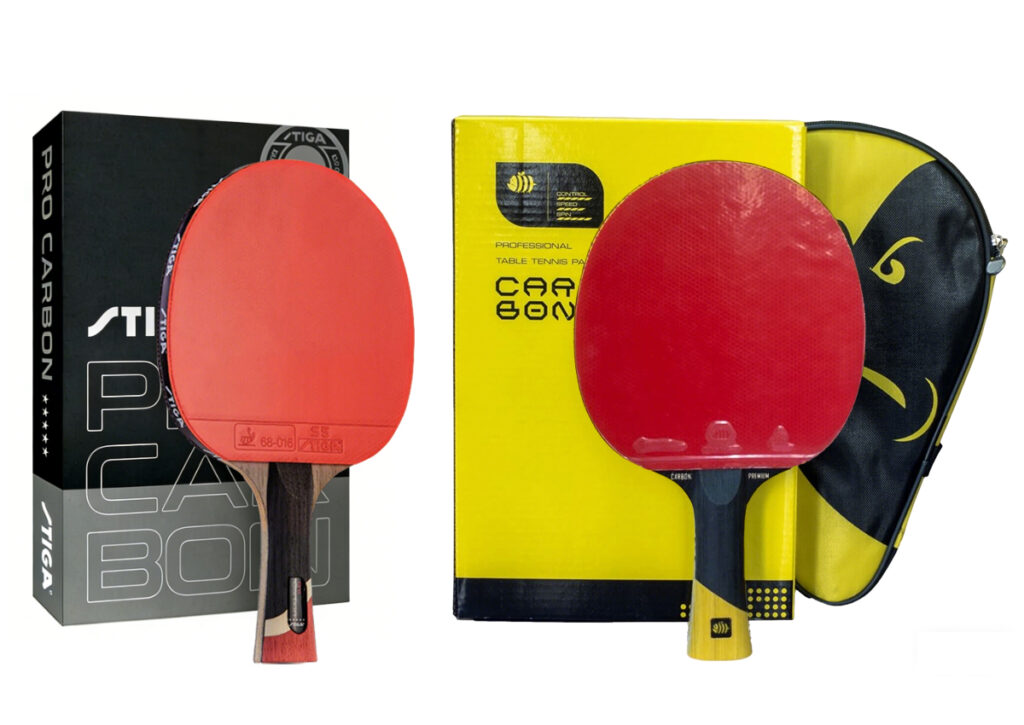
This is the part where I’d normally hedge and say “there are lots of good options.” But I’ve tested this specific paddle with actual children, and it passes all three specs with room to spare. The SANWEI BravoBee Carbon isn’t marketed as a kids’ paddle—and honestly, that’s part of why it works. It’s a “real” paddle that happens to be perfectly suited to younger players.
Weight: ≤175g (Passes the Swing Test)
At ≤175g, the BravoBee sits right under the 180g ceiling, thanks to a weight-reduction system built into the handle. In practice, that means a ten-year-old can swing it for an hour without their arm giving out. My nephew now plays long enough to actually improve, which is the whole point.
Sweet Spot: 5+2 Carbon Construction (Passes the Aim Test)
The 5 wood + 2 carbon construction gives the blade stability without making it feel like a plank. The carbon layers widen the effective hitting zone, so the kid’s inevitable mishits still have a chance of landing on the table. And because the wood core preserves feel, they can actually sense when they hit it well—which is how learning happens.
Rubber: Large-Pore Sponge on the Forehand (Passes the Grip Test)
The forehand rubber uses a large-pore sponge that makes spin easier to generate with a normal swing. Translation for parents: your kid doesn’t need to have perfect technique to get the ball to arc over the net. The paddle helps. The backhand side is tuned for control, which is exactly the right priority for a beginner.
SANWEI rates the paddle at 100 control / 95 spin / 90 speed—the control number is the one that matters for kids. A fast paddle shortens rallies, and short rallies are boring. A control-first paddle keeps the ball in play long enough for the kid to fall in love with the game.
The ‘Ready Out of the Box’ Factor (Why Parents Will Love This Too)
Here’s a thing nobody warns you about when you buy a “serious” table tennis paddle: some of them arrive as separate components. Blade here, rubber sheets there, glue somewhere else, and a YouTube tutorial you’re supposed to follow before your kid can play. For an adult hobbyist, that’s a fun weekend project. For a parent on a Tuesday night, that’s a nightmare.
The BravoBee Carbon arrives fully assembled. You cut the zip tie, pull it out of the case, and hand it to your kid. That’s it. No glue, no waiting, no “hold on, honey, I need to watch a video.”
For a beginner ping pong paddle kids purchase, this matters more than you’d think. The shorter the gap between “here’s your gift” and “let’s play,” the higher the chance the kid actually engages. Every minute of setup is a minute where their attention is drifting toward a screen. Ready-to-play is not a luxury feature. It’s the difference between a gift that gets used and a gift that gets shelved.
Why the Case Matters More Than You’d Expect
Kids lose things. It’s not a character flaw—it’s just physics. A paddle without a case ends up under a couch, in a backpack with a juice box, or on the floor of a garage where it gets stepped on. Within three months, it’s warped, scratched, and plays like a different (worse) paddle.
The BravoBee’s yellow waterdrop zip case solves this in a way that’s weirdly elegant: it makes putting the paddle away feel like part of the game. The case is bright, it has a handle, and it zips. For a kid, that’s enough structure to turn “clean up your stuff” into “put your paddle in its house.” I’ve watched this work in real time. The case is doing more work than any parental lecture ever could.
It also matters for the kids table tennis bat handoff between siblings. When each kid has their own case, there’s no confusion about whose paddle is whose. That alone prevents approximately forty arguments a month.
The Honest Ceiling: This Is a First Serious Paddle, Not a Forever Paddle
I’d rather be honest with you now than have you feel misled in six months. The BravoBee Carbon is a bridge paddle. It’s the paddle that takes a kid from “I’ve never played” to “I actually know what I’m doing.” That journey typically takes 6 to 12 months of regular play.
What happens after that? If your kid falls in love with the sport—starts training weekly, wants to play in tournaments, gets genuinely competitive—you’ll be shopping for an ITTF-certified setup with replaceable rubbers and a faster blade. That’s not a flaw in the BravoBee. That’s the whole point of a bridge paddle. It gets them to the next level without wasting money on a tournament setup they weren’t ready for.
And if they don’t fall in love with it? If they play for a few months and then move on to something else? The BravoBee still works as a family paddle, a guest paddle, a “let’s play after dinner” paddle. It doesn’t become useless. It just becomes the second-string paddle instead of the starter.
Either way, you’re not wasting money. You’re buying the right tool for the stage they’re actually in.
One caveat for very young kids
If your child is under seven or on the smaller side, check the weight in person if you can. At ≤175g the BravoBee is manageable for most kids, but a very small child might do better with a junior-specific blade that’s even lighter. For tweens, teens, and kids who’ve outgrown the toy paddle, the BravoBee is close to ideal.
What to Tell Your Kid Before Their First Game
The paddle does a lot of the work, but a little framing helps. Here’s what I tell my nephew before every session:
- “You’re going to miss a lot at first. That’s normal.” Setting expectations prevents the frustration spiral.
- “Try to hit the ball in the middle of the paddle.” It’s the only technique cue a beginner needs. Everything else can wait.
- “Let’s see how many times we can hit it back and forth.” Rally-counting is a better first goal than score-keeping.
- “If you hit it over the fence, you have to do a funny dance to get it back.” This one is optional but highly effective.
The goal of the first month isn’t skill. It’s enjoyment. A kid who enjoys the game will improve on their own. A kid who’s stressed about technique will quit. The paddle should make the game feel easy, not like a test.
The Bottom Line
If you’re buying a ping pong paddle for kids, the test is simple: can they swing it comfortably, can they hit the ball somewhere near where they aimed, and does the rubber actually grip? The BravoBee Carbon passes all three, and it does it without the “kiddie” branding that makes older kids roll their eyes.
It’s light enough for a ten-year-old, forgiving enough for a true beginner, ready to play out of the box, and packaged in a case that survives the chaos of a real household. It’s also, quietly, one of the best ping pong paddles for beginners regardless of age—so if a parent wants to play too, you can buy two and call it a family gift.
Just don’t expect it to be the last paddle you ever buy for your kid. Expect it to be the paddle that makes them want a next one. That’s a much better outcome than another dinosaur-shaped box in the closet.
👉 Grab the BravoBee Carbon here and see how many rallies your kid can string together before dinner.
What’s the first paddle your kid actually stuck with? I’d love to hear what worked—and what ended up in the closet. Drop it in the comments!
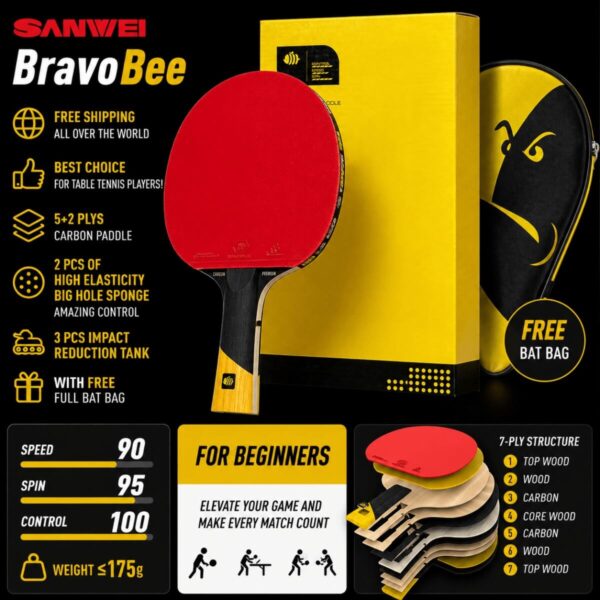
BravoBee Carbon Ping Pong Paddles
- Free Shipping All Over The World
- Best choice for table tennis players!
- 5+2 plys carbon paddle
- 2 pcs of high elasticity big hole sponge, amazing control
- 3 pcs Impact reduction tank
- with FREE full bat bag