When you’re shopping for a ping pong paddle, there’s a lot to consider. Rubber type, sponge thickness, handle shape, blade construction. But there’s one factor that often gets overlooked until you’ve already bought the paddle: weight.
Pick up a paddle that’s too heavy, and your arm will feel like lead after 20 minutes. Pick up one that’s too light, and you might feel like you’re swinging a toy—no stability, no power, no confidence.
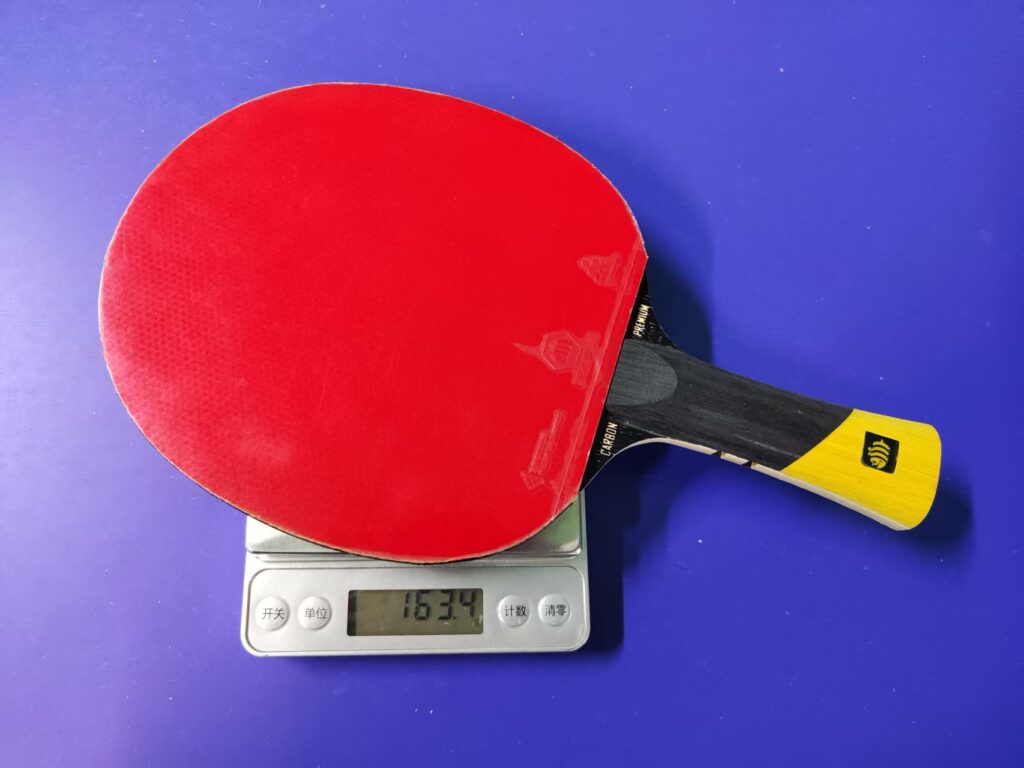
So what’s the right weight? Is heavier better for power? Is lighter better for speed? The answer, as with most things in table tennis, is: it depends on your game. But for the vast majority of amateur players, there’s a sweet spot. And the SANWEI BravoBee Carbon, at ≤175g, hits it perfectly.
The Heavy Paddle (190g+): Power at a Price
Let’s start with the heavyweights. Paddles that weigh 190 grams or more—sometimes pushing 200g—have a certain appeal. That heft feels substantial. When you connect, the ball absolutely flies. There’s a satisfying solidity to heavy shots.
But there’s a catch. Heavy paddles are slower to react. Those quick exchanges at the table? You’ll feel the weight working against you. Fast blocks, quick wrist flicks, rapid adjustments—they all take more effort. The paddle feels less like an extension of your arm and more like something you’re dragging around.
Fatigue is the real issue. After 20-30 minutes of play, your forearm starts to complain. After an hour, your shoulder feels it. That fatigue doesn’t just make you tired—it makes you sloppy. Your technique breaks down. Your shots become less precise. The very power you wanted becomes harder to access because your arm is exhausted.
Heavy paddles have their place. Advanced players with strong arms and consistent technique can handle the weight and use it to generate devastating power. But for amateurs? That extra weight is often more burden than benefit.
The Light Paddle (<170g): Fast but Sometimes Flimsy
At the other end of the spectrum are ultra-light paddles, weighing under 170 grams. These are all about speed and maneuverability. You can whip them around easily, react quickly to fast shots, and play for hours without arm fatigue.
Sounds perfect, right? Not always. The problem with ultra-light paddles is stability. When you hit a hard shot, or when you block a fast ball, a very light paddle can feel flimsy. It may twist in your hand on off-center hits. The ball can feel like it’s getting lost in the blade instead of launching cleanly.
Power also takes a hit. With less mass behind the shot, you have to generate more swing speed to get the same pop. That’s possible, but it requires more precise timing. For developing players, that extra demand can lead to inconsistency.
Ultra-light paddles are great for certain play styles—especially close-to-the-table blocking and quick counter-hitting. But for all-round players who want to attack and defend, they can feel a little… insubstantial.
The Sweet Spot: Why 175g Is Just Right
Here’s where the BravoBee shines. At ≤175g, it sits right in the middle—the Goldilocks zone for amateur all-round play. Not too heavy, not too light. Just right.
What does that feel like in practice?
- Quick enough to react to fast shots and flick the ball with wrist action
- Solid enough to feel stable on blocks and drives
- Powerful enough to finish points without exhausting your arm
- Light enough to play for hours without fatigue
That balance is what makes the BravoBee so versatile. You can play close to the table and counter-hit aggressively. You can step back and loop with power. You can flick and push with touch. The weight doesn’t get in the way—it just supports whatever you’re trying to do.
Why Weight Matters for Amateurs: Learning Both Power and Finesse
For developing players, paddle weight has a hidden influence: it shapes what shots you’re comfortable practicing.
With a heavy paddle, you might naturally gravitate toward power shots. The weight feels good on drives and loops. But you might avoid flicks and quick exchanges because they feel sluggish. Your game becomes one-dimensional without you even realizing it.
With a very light paddle, the opposite can happen. You get good at quick blocks and fast rallies, but you struggle to put the ball away when you need to. Your attacks lack punch, so you end up in long rallies you should have finished.
The BravoBee’s 175g weight allows you to develop a complete game. You can practice power shots without feeling like you’re swinging a sledgehammer. You can practice flicks and quick exchanges without feeling like you’re waving a feather. The weight supports learning across all areas of the game.
That’s what amateur players need most: a paddle that doesn’t push you toward one style, but lets you discover your own.
The Weight Reduction System: How BravoBee Achieves Low Weight
You might wonder: how does the BravoBee get down to 175g while maintaining such solid construction? The answer is the Weight Reduction System.
SANWEI engineers designed the BravoBee’s blade shape and handle to remove unnecessary mass without compromising structural integrity. The 5 wood + 2 carbon layers provide the stability and power you need, while the overall design keeps the weight down.
It’s not about making a flimsy paddle—it’s about making a smart one. Every gram counts, and the BravoBee’s weight is distributed for optimal balance. The paddle feels light in your hand but solid at the point of contact. That’s good engineering.
The result is a paddle that’s easier on your arm without feeling cheap. You get the benefits of lightweight maneuverability with the stability of carbon construction. It’s the best of both worlds.
What the Numbers Mean: ≤175g in Context
Let’s put that 175g in perspective with common benchmarks:
- Ultra-light paddle: Under 165g – Very quick, but can feel unstable on power shots
- Light paddle: 165-175g – Quick and comfortable, still solid
- BravoBee: ≤175g – At the upper end of light, lower end of mid-range
- Mid-weight paddle: 175-185g – Balanced but starting to feel substantial
- Heavy paddle: 185-200g+ – Significant power potential, but can cause fatigue
The BravoBee sits right at the boundary between light and mid-weight. That’s intentional. It gives you the agility of a lighter paddle with the stability of a mid-weight one. It’s a weight that works for almost every amateur play style.
Finding Your Perfect Weight
Everyone’s ideal paddle weight is slightly different. It depends on your strength, your play style, and what feels comfortable in your hand. But here are some guidelines:
- If you play close to the table and focus on blocks and counters, lighter is often better (165-175g)
- If you loop from mid-distance and generate your own power, mid-weight works well (175-185g)
- If you’re a pure attacker with solid technique, you might prefer heavier (185g+)
- If you’re still developing your style, a balanced weight like 175g is ideal
The BravoBee’s ≤175g fits the broadest range of players. It’s light enough for quick exchanges, heavy enough for solid loops, and comfortable enough for long sessions. It’s the weight that lets you explore your game without being forced into a corner.
Don’t Go Too Light or Too Heavy—Go BravoBee
Paddle weight might seem like a small detail, but it affects everything: how you swing, how long you can play, what shots feel natural, how your arm feels after a session. Getting it right matters.
The SANWEI BravoBee Carbon gets it right. At ≤175g with a Weight Reduction System, it hits the sweet spot for amateur all-round play. It’s light enough to be fast and comfortable, solid enough to feel stable and powerful. It’s the weight that lets you focus on your game—not on your equipment.
👉 Get your BravoBee Carbon here and discover what the right weight feels like. Your arm—and your game—will thank you.
What paddle weight do you prefer? Share your experience in the comments—I’d love to hear what works for you!
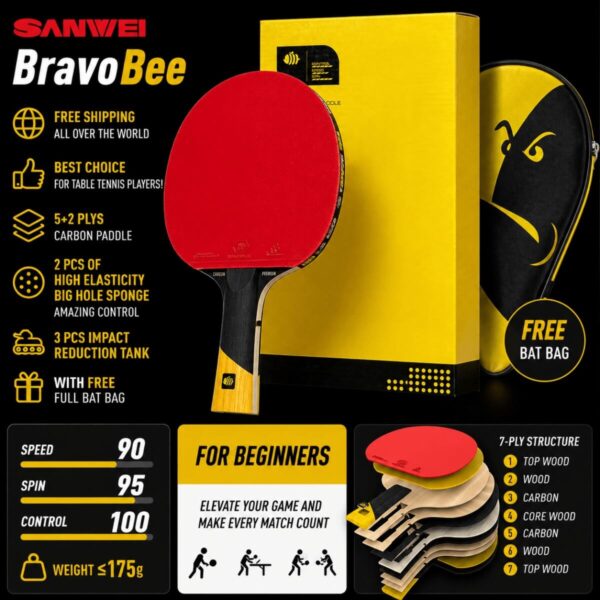
BravoBee Carbon Ping Pong Paddles
- Free Shipping All Over The World
- Best choice for table tennis players!
- 5+2 plys carbon paddle
- 2 pcs of high elasticity big hole sponge, amazing control
- 3 pcs Impact reduction tank
- with FREE full bat bag