You want to get better at ping pong. You’re motivated. You’re ready to put in the work. But there’s one problem: no one to play with. Your regular partner is busy. The club is closed. Your family thinks you’re obsessed (okay, maybe you are).
So what do you do? Sit around and wait for someone to show up? Let your skills stagnate until the next game night?
Absolutely not.
The truth is, some of the most important parts of your game can be practiced alone. In fact, solo practice is how you build the fundamentals that make you dangerous when you do have a partner. You can work on serves, footwork, consistency, and feel—all with just you, your paddle, and a little creativity.
And with the SANWEI BravoBee Carbon, you have the perfect tool for the job. Its feedback, spin potential, and control make solo practice not just possible, but genuinely productive. Let’s get to work.
Method 1: Serve Practice – Target Boxes on the Table
The serve is the only shot in ping pong that you fully control. No opponent, no reaction time pressure. It’s just you, the ball, and the table. And because you can practice it alone, it’s the perfect place to start.
Here’s how to make serve practice effective:
Set Up Targets
Use masking tape or sticky notes to mark target zones on the table. Common targets include:
- The corners (deep and wide)
- The middle (short and low)
- The lines (down the center or down the sideline)
Having specific targets gives you feedback. You’re not just serving—you’re aiming. And aiming is how you improve.
Practice Different Spins
The BravoBee’s 95 spin rating and high-elasticity big hole sponge make it an excellent tool for spin serve practice. Try:
- Backspin serves: Brush under the ball. Watch how it bounces—good backspin will barely rise after bouncing.
- Topspin serves: Brush the top of the ball. The ball should arc and then shoot forward.
- Sidespin serves: Brush across the ball. Watch it curve in the air and kick sideways.
The BravoBee’s 100 control rating helps you place these spinny serves precisely. You’ll be able to hit your targets consistently, which builds confidence for when you’re in a real match.
Record Your Progress
Keep a basket of balls (20-30 balls) so you can serve repeatedly without chasing. Track how many out of 10 land in your target zone. Aim to improve that percentage each session. Solo practice is perfect for this kind of measurable progress.
Method 2: Footwork Drills – Shadow Play
Footwork is the foundation of good table tennis. Without good footwork, your strokes won’t matter—you’ll always be reaching, off-balance, and late. And footwork? You can practice it alone.
Shadow play is exactly what it sounds like: you move as if you’re in a rally, but there’s no ball. It’s a chance to focus purely on your movement.
Basic Footwork Patterns
- Side-to-side shuffle: Start in your ready position. Shuffle to your forehand side, make a shadow stroke, shuffle back to center, shuffle to backhand side, shadow stroke. Repeat.
- In-and-out movement: Practice stepping in for short balls and stepping back for deep balls. This pattern is essential for serving and receiving.
- Pivot steps: For forehand loops from the backhand corner, practice pivoting on your back foot.
How the BravoBee Helps
The BravoBee’s lightweight design (≤175g) means you can practice footwork without your arm tiring. A heavy paddle would fatigue you before you get enough reps. The BravoBee lets you focus on your feet, not your arm.
Add Visualization
As you shadow play, visualize the ball coming to you. Imagine the shot you’re about to play. This mental rehearsal is surprisingly effective—it primes your brain for real-game situations.
Method 3: Ball Machine (If You Have One)
If you’re serious about solo practice, a ball machine (also called a robot) is a game-changer. It feeds balls to you at adjustable speeds, spins, and frequencies, allowing you to practice any stroke you want, for as long as you want.
But even without a machine, you can simulate this:
Progressive Difficulty
Start with simple multi-ball practice. Feed yourself balls by hand, starting with easy ones. As you improve, increase the speed and spin. The BravoBee’s 100 control rating helps you handle these progressively harder feeds without the ball flying everywhere.
Focus on Specific Shots
Use solo time to groove specific strokes. Spend 10 minutes on forehand loops. Then 10 minutes on backhand drives. Then 10 minutes on pushes. The BravoBee’s vibration reduction slots give you clear feedback on each shot, helping you adjust and improve.
The slots dampen harsh vibrations while preserving the feel of good contact. You’ll know when you’ve nailed a shot because the feedback is clean and satisfying. You’ll know when you’ve missed because the feedback tells you where you went wrong. That’s how you learn.
Method 4: Against a Wall – Control Practice
The oldest solo practice method in the book: hitting against a wall. Simple, accessible, and surprisingly effective for developing control and consistency.
Here’s how to make it useful:
Control Practice
Start by hitting the ball against a smooth wall, trying to keep it going as long as possible. Don’t worry about power—focus on clean contact and consistent placement. The BravoBee’s 100 control rating makes this easier than with a cheap paddle.
Add Constraints
Once you can sustain a rally against the wall, add challenges:
- Alternate forehand and backhand
- Hit only forehands
- Hit only backhands
- Try to hit a specific spot on the wall
- Count how many you can do in a row
Spin Practice
Use the wall to practice spin. Brush the ball for topspin and watch how it behaves after the bounce. The BravoBee’s 95 spin rating lets you generate visible rotation even against a wall. You’ll see the ball dip and curve—confirmation that your brushing technique is working.
This is also great for serve practice. Serve against the wall and watch the ball’s bounce. A good backspin serve will die; a good topspin serve will jump forward. The feedback is immediate and clear.
How the BravoBee Helps Your Solo Training
We’ve touched on these features throughout, but let’s pull them together. The BravoBee is uniquely suited for solo practice because:
Feedback from Vibration Slots Helps Solo Training
When you’re practicing alone, you don’t have a coach telling you what you did wrong. The BravoBee’s three impact reduction slots become your silent coach. They give you clear feedback on where you hit the ball and how clean your contact was. A perfect hit feels smooth and solid. An off-center hit is still noticeable, but not punishing. You learn from every swing because the paddle tells you what happened.
Spin 95 Helps You See Serve Effectiveness
When practicing serves alone, you need to see the spin to know if you did it right. The BravoBee’s 95 spin rating makes that visible. Backspin serves will bounce twice or even roll back toward you. Topspin serves will shoot forward aggressively. Sidespin serves will curve. You can see your progress, not just guess.
Control 100 Means Less Frustration
Solo practice can be frustrating if your equipment fights you. With a cheap paddle, balls fly everywhere and you spend more time chasing than practicing. The BravoBee’s 100 control means you’ll hit more consistently, which means you’ll actually enjoy solo practice. And when you enjoy it, you’ll do it more.
Sample Solo Practice Routine (30 Minutes)
Here’s a simple 30-minute routine to get you started:
- 0-5 minutes: Warm-up against the wall. Focus on clean contact and rhythm.
- 5-15 minutes: Serve practice. 10 serves to each target zone, mixing spins.
- 15-20 minutes: Footwork shadow play. Side-to-side, in-and-out, pivot steps.
- 20-25 minutes: Multi-ball (or against wall) with specific stroke focus. Forehand loops today.
- 25-30 minutes: Cool-down. Easy serves and wall hits. Stretch.
Adjust based on what you need most. The key is consistency. Ten minutes a day beats an hour once a week.
Solo Practice = Faster Progress When You Do Play
Here’s the secret: the players who improve fastest aren’t necessarily the ones who play the most matches. They’re the ones who practice the fundamentals when no one is watching.
Solo practice lets you focus on what you need, at your own pace, without pressure. You can repeat a serve 50 times until it’s perfect. You can groove your footwork without worrying about the ball. You can experiment with spin and feel what works.
And when you finally do play with a partner, all that solo work pays off. Your serves are weapons. Your footwork is automatic. Your control is consistent. You’re not just playing—you’re winning.
So don’t wait for a partner. Grab your SANWEI BravoBee Carbon, find a wall, set up some targets, and get to work. Your future self—the one who dominates every rally—will thank you.
👉 Get your BravoBee Carbon here and start practicing alone today. Your progress starts now.
What’s your favorite solo practice drill? Share it in the comments—I’m always looking for new ideas to add to my routine!
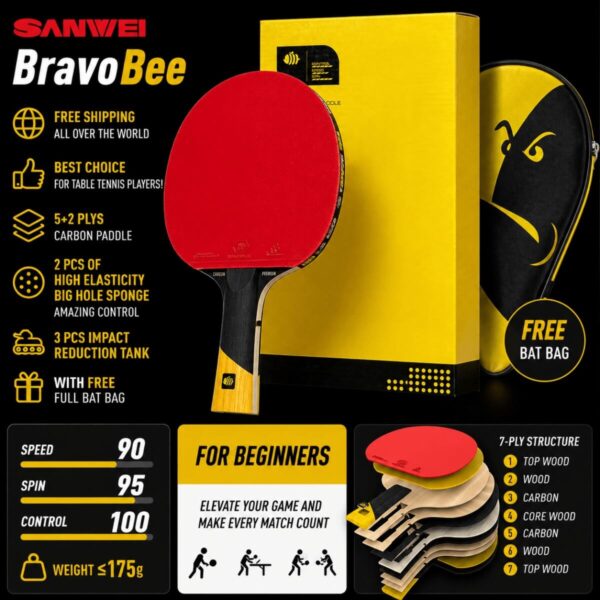
BravoBee Carbon Ping Pong Paddles
- Free Shipping All Over The World
- Best choice for table tennis players!
- 5+2 plys carbon paddle
- 2 pcs of high elasticity big hole sponge, amazing control
- 3 pcs Impact reduction tank
- with FREE full bat bag