If you’ve ever shopped for ping pong equipment, you’ve seen the numbers: 1.8mm, 2.0mm, 2.1mm, 2.2mm. They’re printed on almost every rubber package, but what do they actually mean? And does that millimeter or two really make that much difference?
Spoiler: it does. Rubber thickness is one of the most important factors in how a paddle plays. It affects everything—speed, spin, control, even how the ball feels when it hits your paddle. Choose wrong, and you’ll be fighting your equipment. Choose right, and everything just… clicks.
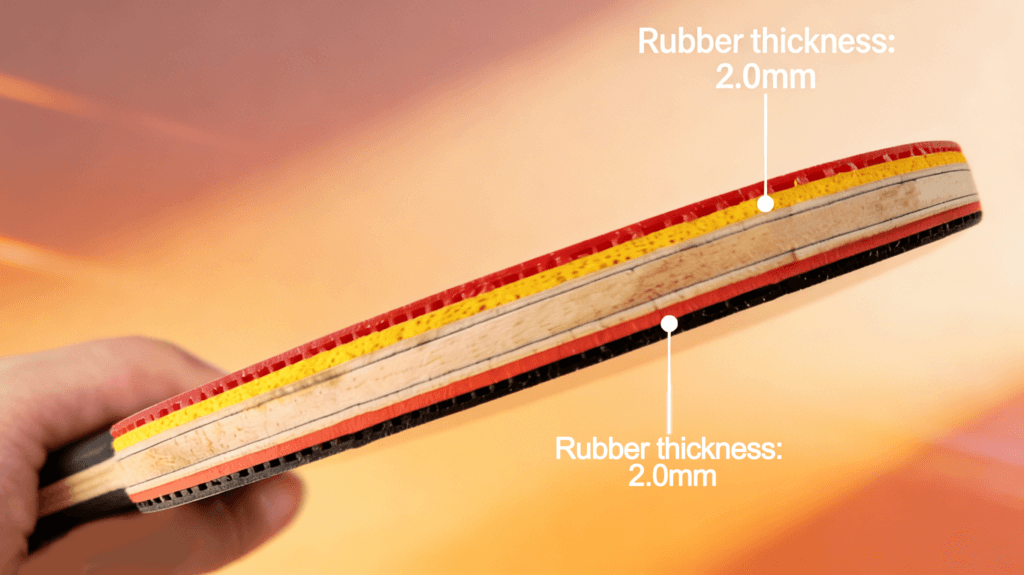
The SANWEI BravoBee Carbon features a 2.00mm sponge on both sides. That’s not an accident. It’s a deliberate choice designed to give amateur players the perfect balance of spin, speed, and control. Let’s break down why that thickness is the sweet spot.
Rubber Thickness 101: What Does It Actually Do?
Under the rubber surface of every ping pong paddle is a layer of sponge. That sponge compresses when the ball hits it, then rebounds, launching the ball forward. The thickness of that sponge determines how the ball behaves.
Think of it like a mattress. A thin mattress is firm and responsive—you feel every bump, and there’s no “give.” A thick mattress is soft and plush—it absorbs energy and gives you a deeper feeling. The same principle applies to ping pong rubber.
The thickness affects three key things:
- Spin: Thicker sponge allows the ball to sink in deeper, giving the rubber more surface area to grip and rotate the ball
- Speed: Thicker sponge stores more energy, launching the ball faster
- Control: Thinner sponge gives you more direct feedback and predictability
There’s no “right” thickness for everyone. It depends on your skill level, play style, and what feels comfortable. But for amateur players, there’s definitely a range that works best.
Thin Rubbers (<1.8mm): Maximum Control, Less Pop
Rubbers thinner than 1.8mm are often called “control rubbers.” They’re designed for players who prioritize placement over power.
What they’re good for:
- Beginners learning basic strokes
- Defensive players who want precise placement
- Players who struggle with keeping the ball on the table
The trade-offs:
- Less spin generation
- Less power on loops and drives
- Less “dwell time”—the ball comes off quickly, which can feel harsh
If you’re brand new to ping pong, a thin rubber can be helpful. It gives you the control you need to learn basic strokes without the ball flying off unpredictably. But as you improve, you’ll likely want more spin and power. That’s where thicker rubbers come in.
Thick Rubbers (>2.1mm): Maximum Spin and Speed, Less Control
At the other end of the spectrum are thick rubbers—2.1mm, 2.2mm, and sometimes even thicker. These are the weapons of advanced and professional players.
What they’re good for:
- Heavy topspin loops
- Powerful drives and smashes
- Players with consistent technique who can handle the extra speed
The trade-offs:
- Less control on delicate shots
- Harder to block and push accurately
- Requires good technique to use effectively
For advanced players, thick rubbers are essential. They provide the spin and power needed to play at a high level. But for amateurs, they can be frustrating. The ball shoots off the paddle before you’re ready, and the increased sensitivity to spin can make returns unpredictable. You need solid fundamentals to make thick rubbers work for you.
The Goldilocks Zone: Why 2.00mm Is Just Right
So where does that leave the average amateur player? The sweet spot is right in the middle: 2.00mm. And that’s exactly what the BravoBee uses.
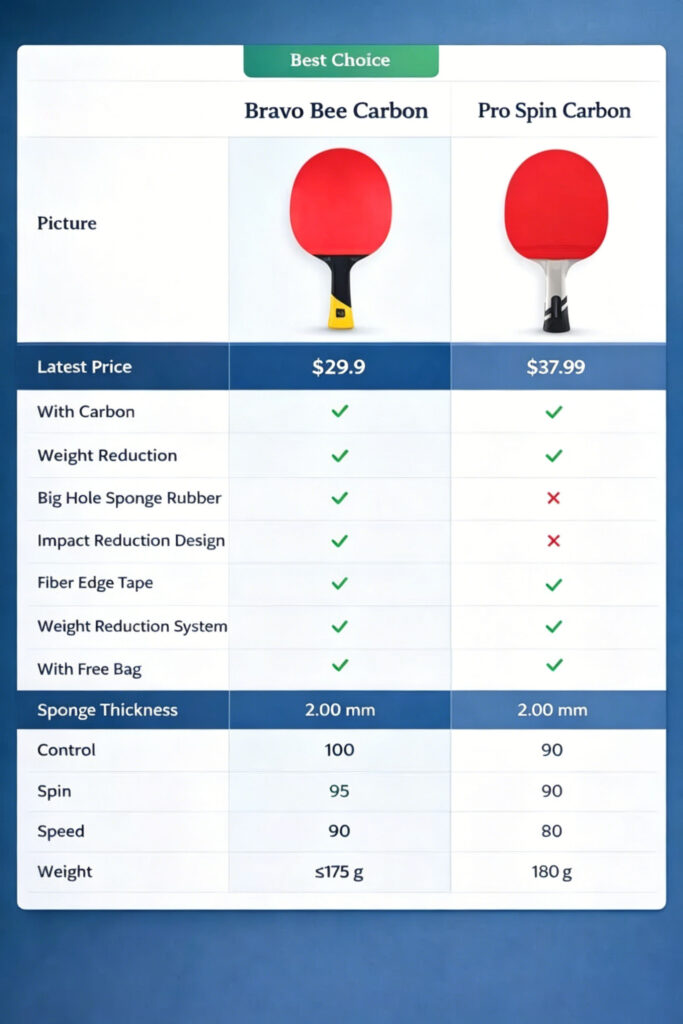
At 2.00mm, you get the best of both worlds. Enough sponge to generate serious spin—the BravoBee’s 95 spin rating proves that—but not so much that you lose control. The ball sinks in enough to grip and rotate, but you still get clear feedback and predictable behavior.
For the vast majority of amateur players, 2.00mm is the ideal thickness. It’s thick enough to develop your spin game, but not so thick that it punishes imperfect technique. It’s fast enough to finish points, but not so fast that you can’t control your placement.
The BravoBee’s 100 control rating pairs perfectly with the 2.00mm sponge. You get spin when you want it, control when you need it. It’s the kind of balance that lets you focus on your game instead of fighting your equipment.
What 2.00mm Means in Real Life: The BravoBee Experience
Let’s get practical. What does 2.00mm actually feel like when you’re playing with the BravoBee?
Enough Sponge to Generate 95 Spin
The BravoBee’s high-elasticity, big hole sponge at 2.00mm gives you serious spin potential. When you brush the ball for a loop or a serve, you’ll feel it sink in and release with heavy rotation. Those dipping curves and biting serves aren’t just possible—they’re achievable for players who are still developing their technique.
But because the sponge isn’t overly thick, you don’t lose the ability to hit flat shots. When you need to drive the ball or block a fast return, the sponge is responsive without being mushy. It’s the best of both worlds.
Still Controlled: Feel the Ball Without It Shooting Off
The 2.00mm thickness preserves feedback. You can feel where you hit the ball, whether you brushed cleanly or made a slightly off contact. That feedback is essential for learning and improvement. With a thicker sponge, that feedback can be muted. With a thinner sponge, the feel can be harsh. At 2.00mm, it’s just right.
Forgiving Enough for Learning
When you’re learning, you’re going to hit the ball imperfectly. That’s part of the process. A 2.00mm sponge forgives those imperfections better than a thicker sponge. The ball still goes roughly where you aimed, and you get useful feedback instead of a jarring shock. That’s how you improve—by making adjustments based on clear feedback, not by getting punished for every mistake.
How the 2.00mm Sponge Helps You Learn
Let’s look at specific ways the BravoBee’s 2.00mm thickness supports your development:
Learning Spin
Spin requires brushing the ball—grazing it rather than hitting it square. A 2.00mm sponge gives you the dwell time to feel that brushing action. You’ll know when you did it right because the ball will grip and release with satisfying rotation. You’ll know when you did it wrong because the ball will behave differently. That feedback is how you learn to spin.
Developing Consistency
Consistency comes from repetition. If your equipment is too demanding, you can’t get enough repetitions because every error is punished. The BravoBee’s 2.00mm sponge lets you get those reps in. You can practice loops, pushes, blocks, and serves without the ball flying off unpredictably. More practice = better consistency.
Building Confidence
Confidence is everything in table tennis. When you know your paddle will do what you expect, you swing freely. The BravoBee’s balanced 2.00mm sponge gives you that confidence. You can go for shots without second-guessing your equipment.
What About 1.8mm or 2.1mm? Who Should Choose Those?
While 2.00mm is ideal for most amateurs, there are situations where other thicknesses make sense:
1.8mm might be better if:
- You’re a complete beginner who needs maximum control
- You play a purely defensive style focused on placement
- You have joint issues and want the softest possible feel
2.1mm or thicker might be better if:
- You’re an advanced player with solid technique
- You play a heavy topspin-oriented game
- You compete at a high level and need maximum spin potential
For everyone else—the vast majority of amateur players who want to improve and enjoy the game—2.00mm is the sweet spot. And the BravoBee delivers it beautifully.
Don’t Overthink It: 2.00mm on BravoBee Just Works
Choosing rubber thickness can feel overwhelming. There are so many options, so many opinions. But here’s the truth: for the average amateur player, 2.00mm is the thickness that works. It’s thick enough to generate real spin, thin enough to stay controlled, forgiving enough to support learning, and capable enough to grow with you.
The SANWEI BravoBee Carbon comes with 2.00mm sponge on both sides, paired with a 95 spin rating and 100 control rating. It’s a combination that’s been carefully engineered for players like you—players who want to improve, have fun, and play a complete game.
So don’t overthink it. The right thickness is already on the paddle. The BravoBee just works.
👉 Get your BravoBee Carbon here and experience why 2.00mm is the Goldilocks zone for amateur players. Your spin game awaits.
What rubber thickness do you currently use? Share your experience in the comments—I’d love to hear what works for you!
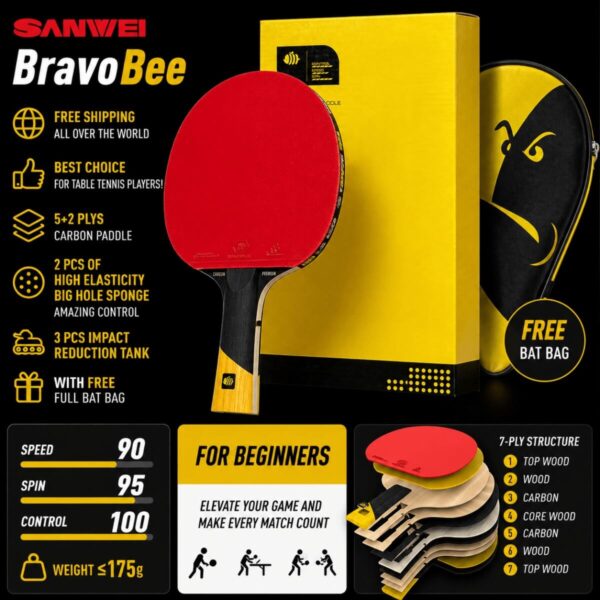
BravoBee Carbon Ping Pong Paddles
- Free Shipping All Over The World
- Best choice for table tennis players!
- 5+2 plys carbon paddle
- 2 pcs of high elasticity big hole sponge, amazing control
- 3 pcs Impact reduction tank
- with FREE full bat bag