You’ve been there. Your opponent serves, the ball floats over the net, you reach for it confidently – and it squirts off your paddle sideways or dies into the net. You just got fooled by spin. It’s embarrassing, frustrating, and it costs you points. But here’s the good news: spin isn’t magic. You can learn to see it coming. With a few simple read ping pong spin techniques, you’ll start how to receive serve like a pro. In this guide, I’ll share three visual clues that give away spin every time. Plus, I’ll show you how the SANWEI BravoBee Carbon paddle – with its vibration reduction slots – helps you confirm your read through contact point reading. These BravoBee serve return tips will turn you from a guesser into a reader. Let’s dive into these spin reading tips.
Why Reading Spin Matters (And Why We Struggle)
Spin is the great equalizer. A player with moderate skill but heavy spin can dominate a player with better basics but poor reading ability. The serve is where spin is most dangerous because you have the least time to react. However, the ball doesn’t lie. The way your opponent contacts the ball, the ball’s flight, and even the sound give away the type of rotation. You just need to train your eyes and ears. Let’s start with the most important clue: the contact point.
Clue 1: Watch the Contact Point (Not the Ball)
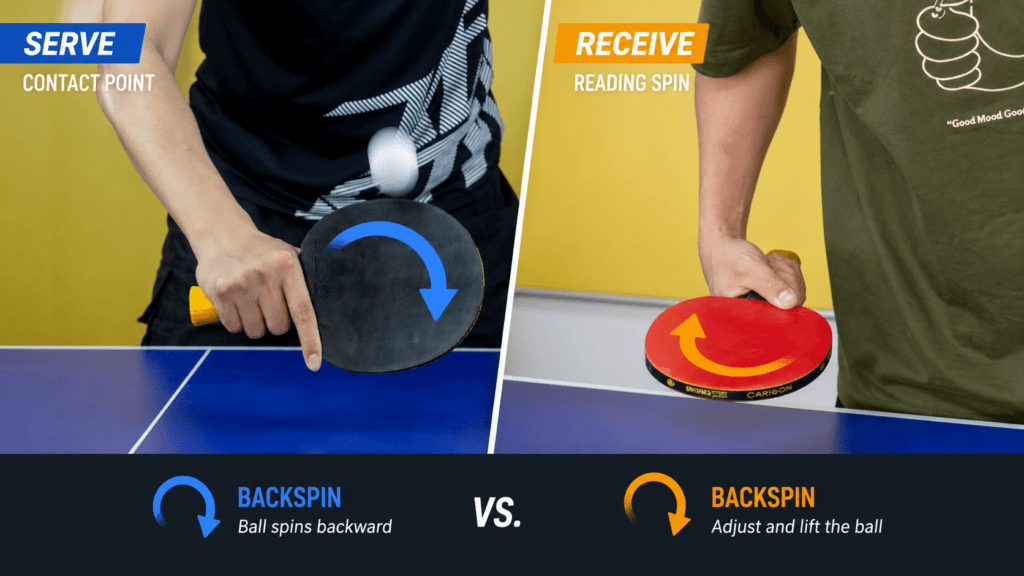
Most beginners watch the ball after it’s already in the air. That’s too late. The secret to how to receive serve is to watch your opponent’s racket at the moment of contact. The angle and motion tell you everything:
- For topspin: The racket face will be closed (tilted downward) and the player will brush the top of the ball with an upward motion.
- For backspin: The racket face will be open (tilted upward) and the player will slice under the ball with a downward chop.
- For sidespin: The racket will move sideways, either left to right or right to left, brushing the side of the ball.
- For no spin: The racket will hit the ball squarely with little to no brushing motion.
Practice contact point reading by watching slow‑motion videos of serves. Then, in real games, force yourself to look at the racket, not the ball. The BravoBee’s vibration reduction slots also help: after you hit, you’ll feel if you mis‑read the spin. That feedback trains your eye for the next time.
Clue 2: Track the Ball’s Trajectory
If you miss the contact point (it happens), the ball’s flight path gives a second clue. Here’s what to look for:
- Topspin: The ball arcs upward, then dips sharply. It may also kick forward after the bounce.
- Backspin: The ball floats, seems to slow down in the air, and bounces with a low, “dead” trajectory. Often it will bounce twice or even roll back.
- Sidespin: The ball curves in the air, like a banana. After the bounce, it may kick sideways.
- No spin: The ball travels on a fairly straight, predictable path.
The trajectory is especially useful when you can’t clearly see the contact (e.g., when your opponent hides it slightly – which is illegal but happens). Train yourself to watch the ball’s arc from the moment it leaves the racket. Over time, you’ll be able to read ping pong spin from the flight alone. The BravoBee’s 100 control rating helps because even if you misread slightly, the paddle’s forgiveness keeps the ball on the table, giving you a second chance.
Clue 3: Listen to the Sound
Yes, you can hear spin. It’s subtle, but it’s real. A ball struck with heavy backspin or no spin often produces a “dead” thud. A ball hit with topspin or a hard fast serve makes a crisper, snappier sound. And a ball with heavy sidespin might sound slightly off because of the glancing contact.
To develop your ear, play a game with a partner where you close your eyes (safely) and listen to serves. Have them call out the spin type. Then open your eyes to see if the sound matched. You’ll start noticing patterns. The BravoBee’s vibration reduction slots also give you tactile feedback – a clean topspin contact feels different from a backspin push. Use that sensation to complement what you hear.
How to Use This with the BravoBee: Feedback Loop
The BravoBee is not just a tool for hitting; it’s a tool for learning. Its impact reduction slots deliver clear, comfortable feedback on every shot. When you receive a serve, pay attention to two things:
- Your read: Did you predict topspin or backspin?
- The actual result: How did the ball behave off your paddle? Did it go up, down, or sideways?
- What you felt: Did the contact feel clean or jarring?
After the point, compare your read to the feedback. For example, if you expected backspin but the ball shot upward, it was probably topspin. The BravoBee’s 100 control means that even if you misread, your return will still likely land on the table, allowing you to stay in the rally and adjust for the next point. This feedback loop is the fastest way to improve your spin reading tips.
Practice Drill: The “Call the Spin” Drill
Here’s a simple drill to train your eyes, ears, and paddle feel:
- Get a partner to serve to you (just serves, no rally).
- Before the ball bounces on your side, call out the spin type: “Topspin,” “Backspin,” “Sidespin,” or “No spin.”
- Then try to return the serve using the BravoBee.
- After each point, your partner confirms if you were correct.
Start with slow serves, then increase speed. Do this for 10 minutes per session. Within a few weeks, you’ll be surprised how often you’re right. The BravoBee’s 95 spin rating also allows you to experiment with returning different spins – you can push backspin or loop topspin, giving you active training.
Common Mistakes When Reading Spin
Even with good clues, beginners make errors. Avoid these pitfalls:
- Watching the ball too late: Look at the racket contact, not the ball after it’s gone.
- Ignoring the bounce: The bounce can confirm your read. A backspin ball barely rises; a topspin ball jumps forward.
- Guessing instead of reading: Don’t default to “backspin” because that’s the most common serve. Train yourself to see the clues.
- Not adjusting the paddle angle: Against backspin, open your paddle; against topspin, close it. The BravoBee’s control helps you change angles smoothly.
The more you practice, the more automatic it becomes. The BravoBee’s vibration reduction slots will alert you when you’ve guessed wrong (a jarring feel means you probably had the wrong angle). Use that painless feedback to correct yourself for the next serve.
Putting It All Together: Your Serve‑Reading Routine
Next time you step up to receive, follow this mental routine:
- Watch the contact point: Racket angle and motion.
- Observe the trajectory: Does it dip, float, or curve?
- Listen to the sound: Dead thud or crisp snap?
- Adjust your paddle angle and stroke accordingly.
- After the return, feel the BravoBee’s feedback.
Within a few points, you’ll start seeing patterns. Eventually, you’ll be able to read spin almost instantly. That’s when you go from a defensive receiver to a proactive point‑starter.
The BravoBee Carbon is your perfect training partner because its forgiving nature gives you room to make a few mistakes while you learn. Its vibration slots educate your hand, and its spin rating lets you practice active returns. So next time you face a tricky server, don’t get frustrated. Use these three clues, trust your paddle, and start reading spin like a pro.
👉 Get your BravoBee Carbon here and start mastering your serve receive today.
What’s the trickiest serve you’ve ever faced? Share your story in the comments – I’d love to hear how you dealt with it!
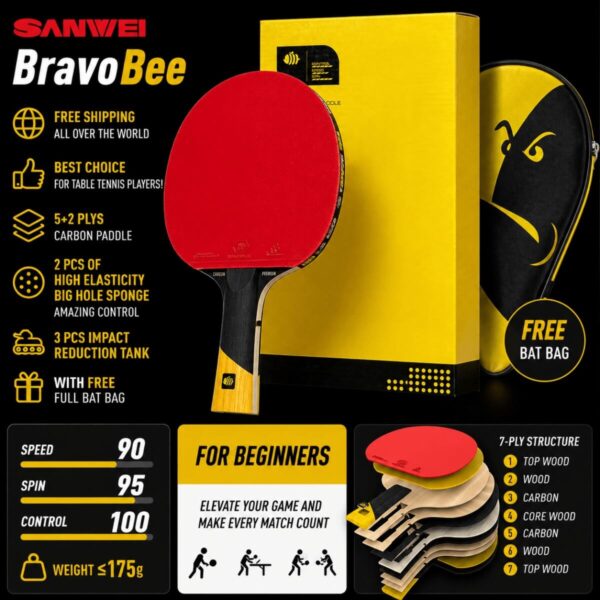
BravoBee Carbon Ping Pong Paddles
- Free Shipping All Over The World
- Best choice for table tennis players!
- 5+2 plys carbon paddle
- 2 pcs of high elasticity big hole sponge, amazing control
- 3 pcs Impact reduction tank
- with FREE full bat bag