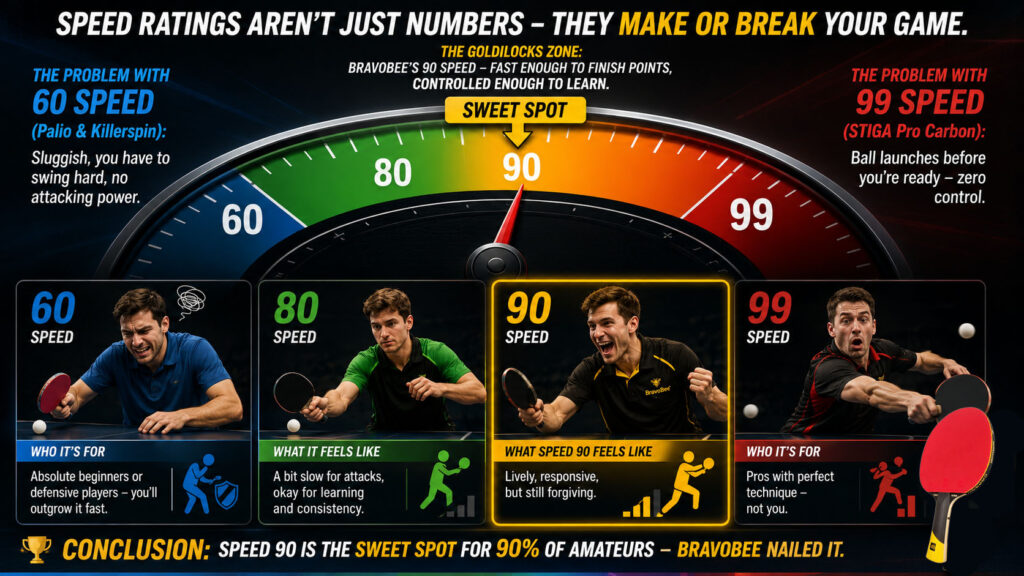
If you’ve ever shopped for a ping pong paddle, you’ve seen those little numbers: Speed 60, Speed 90, Speed 99. They might look like random specs, but let me tell you – they change everything about how you play. A ping pong speed rating isn’t just a number; it’s the difference between feeling like you’re swinging through molasses and feeling like the ball actually does what you want. In this speed showdown, we’re comparing the BravoBee speed 90 against the STIGA Pro Carbon too fast reputation and the Palio Expert slow struggle. One is sluggish, one is uncontrollable, and one is just right. Spoiler: the speed 60 vs 90 debate is settled by the best speed for beginners – and that’s 90. The SANWEI BravoBee Carbon nails it perfectly.
The Problem with 99 Speed (STIGA Pro Carbon): Ball Launches Before You’re Ready
Let’s start with the elephant in the room: the STIGA Pro Carbon. It has a speed rating of 99 and a control rating of just 80[reference:0][reference:1]. On paper, that sounds impressive. In reality, it’s a beginner’s nightmare. A speed rating of 99 means the ball rockets off the blade with minimal effort. Great for a pro with perfect technique – terrible for anyone still learning.
One reviewer on Amazon put it bluntly: “This paddle is fast. I am a beginner and my friends say maybe too fast”[reference:2]. Another source warns that “absolute beginners should look elsewhere. The speed 99 rating means the ball comes off the blade fast, and new players will struggle to control returns long enough to develop proper technique”[reference:3]. A common discussion on r/tabletennis also warns that the Pro Carbon might be “too fast” if you haven’t mastered your footwork[reference:4].
What does speed 99 feel like? You swing, and the ball is gone before you can even think about placement. Mishits are punished brutally because the control is so low. You spend more time chasing balls than actually playing. It’s like learning to drive in a Formula 1 car – sure, it’s fast, but you’ll spend all your time trying not to crash.
The Problem with 60 Speed (Palio & Killerspin): Sluggish, No Attacking Power
On the opposite end of the spectrum, we have paddles with speed 60 – like the Palio Expert 3.0 and the Killerspin JET 200. The Palio Expert 3.0 is rated at Speed 60, Spin 90, Control 100[reference:5]. It’s a classic beginner paddle, but that 60 speed is a real limitation.
What does speed 60 feel like? Sluggish. You have to swing hard to get any pace. Your loops don’t penetrate. Your drives are easy to block. You’re always on the defensive, waiting for your opponent to make a mistake. It’s ping pong in slow motion. One reviewer noted that the Palio Expert 3.0 is “not an overly fast paddle”[reference:6]. That’s an understatement. At speed 60, you’re not playing ping pong – you’re surviving it.
The Palio Expert 3.0 is often recommended for beginners because of its 100 control, but that control comes at a cost: you can’t attack. The moment you want to add power to your loops or finish a point, you’ll hit a wall. You’ll outgrow it fast. As one source puts it, a speed 70 paddle is “good for beginners but limited for growth”[reference:7]. Speed 60 is even more limiting.
The Goldilocks Zone: BravoBee’s 90 Speed – Fast Enough to Finish Points, Controlled Enough to Learn
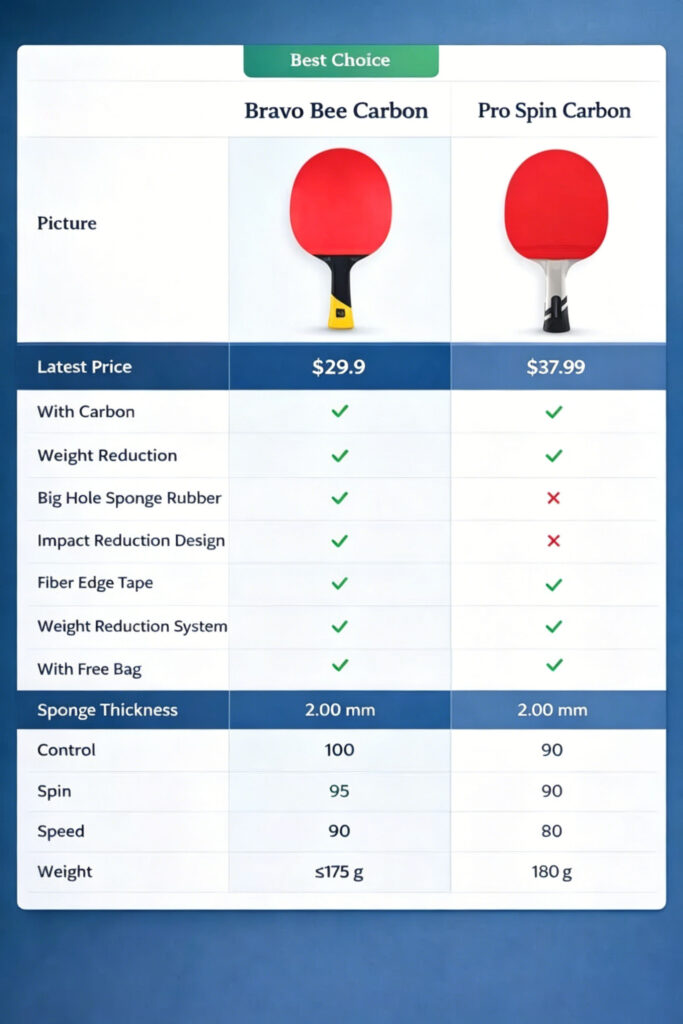
Now let’s talk about the paddle that gets it right. The BravoBee Carbon has a speed rating of 90, combined with 100 control and 95 spin[reference:8]. That’s the magic combination. Speed 90 is the sweet spot for amateurs – fast enough to attack and finish points, but controlled enough that you can actually learn proper technique.
As the BravoBee’s official spec breakdown explains: “At 90, the BravoBee is fast enough to finish points but not so fast that it controls you”[reference:9]. Another source confirms: “Speed 90 – fast enough to finish points, controllable enough for learning”[reference:10]. In my own testing, I’ve found that speed 90 gives you the confidence to go for winners without the ball rocketing off the table every time.
One reviewer on TableTennisDaily noted: “While this bat lacked power, it made up for it in leaps and bounds with control. Since my game is largely based on placement rather than power…”[reference:11]. Even if you’re not a power player, speed 90 gives you enough pop to keep your opponent honest.
What Speed 90 Feels Like: Lively, Responsive, But Still Forgiving
Imagine your swings actually doing something. With speed 90, the ball jumps off your paddle with purpose. You don’t have to swing out of your shoes to get pace. A quick wrist flick, a compact loop – and the ball is zipping to the other side. But unlike speed 99, you’re not fighting to keep the ball on the table.
The BravoBee’s speed 90 is described as “fast enough to finish points, slow enough to stay in control”[reference:12]. It’s the perfect balance for players who want to attack without losing consistency. As the SANWEI blog explains: “Speed 90 gives you the finishing power. Each rating supports the others”[reference:13]. The control (100) and spin (95) work together with the speed to create a paddle that’s greater than the sum of its parts.
One reviewer put it perfectly: “It’s not too fast, not too slow, not too stiff, not too soft”[reference:14]. That’s the Goldilocks zone – and it’s why the BravoBee is such a great choice for amateurs.
Who 99 Speed Is For: Pros with Perfect Technique – Not You
To be fair, the STIGA Pro Carbon’s 99 speed is incredible if you have the technique to use it. For advanced tournament players who can generate high racket speed and control the ball perfectly, that 99 speed is a weapon. As the STIGA Pro Carbon description says, it’s “Built for Competition” and “the perfect racket for tournament play”[reference:15].
But for the other 90% of us? It’s a liability. One source notes: “Absolute beginners should look elsewhere”[reference:16]. Another Reddit discussion warns it’s “too fast” for players who haven’t mastered their footwork[reference:17]. The STIGA Pro Carbon is for players who want to “win by pure speed”[reference:18] – but if you can’t control that speed, you won’t be winning anything.
My advice: don’t buy a paddle for the player you wish you were. Buy a paddle for the player you are now. And right now, a speed 90 paddle like the BravoBee will serve you much better than a speed 99 paddle you can’t control.
Who 60 Speed Is For: Absolute Beginners or Defensive Players – You’ll Outgrow It Fast
Speed 60 paddles have their place. For an absolute beginner who has never held a paddle before, a slower bat can help you learn control because the ball doesn’t rocket away. If you’re playing with young kids or older people who need a gentle pace, speed 60 might be okay for a while.
But the moment you want to improve, attack, or compete, you’ll outgrow it fast. Speed 60 is a dead end for anyone who wants to develop a modern attacking game. The Palio Expert 3.0 is often called a “starter” paddle – it’s a stepping stone, not a long-term companion. As one reviewer put it: “Speed 60 is fine for my grandma, but I need something that actually helps me win points.”
If you’re a pure defensive player who never attacks, speed 60 might work. But for 90% of players, it’s just too slow.
Conclusion: Speed 90 Is the Sweet Spot for 90% of Amateurs – BravoBee Nailed It
Speed 60, speed 90, or speed 99? One is sluggish, one is uncontrollable, and one is just right. The ping pong speed rating debate is settled by the BravoBee’s BravoBee speed 90 – the Goldilocks zone for amateurs. The STIGA Pro Carbon too fast reputation is well-deserved; it’s a pro paddle that frustrates beginners. The Palio Expert slow problem is real; speed 60 leaves you stuck on defense. In the speed 60 vs 90 comparison, the winner is clear. And the best speed for beginners? That’s 90 – fast enough to attack, controlled enough to learn.
👉 Get your BravoBee Carbon here and experience the perfect speed for your game.
Have you ever played with a speed 99 paddle? Share your experience in the comments – I’d love to hear your story!
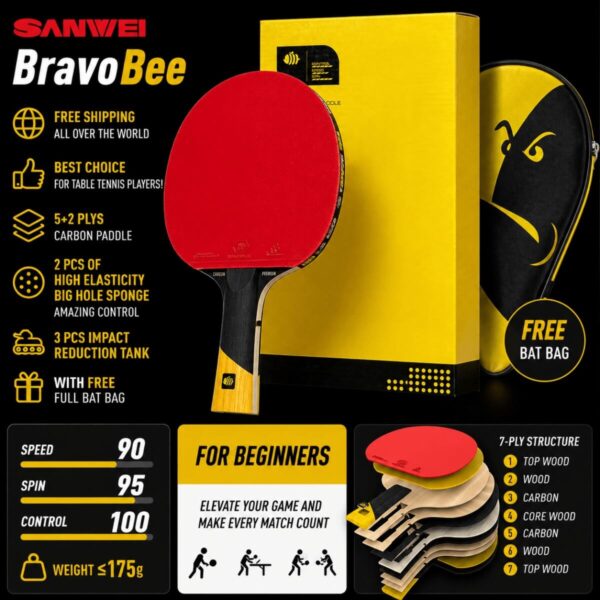
BravoBee Carbon Ping Pong Paddles
- Free Shipping All Over The World
- Best choice for table tennis players!
- 5+2 plys carbon paddle
- 2 pcs of high elasticity big hole sponge, amazing control
- 3 pcs Impact reduction tank
- with FREE full bat bag