
You’ve seen the buzzword everywhere: “carbon fiber.” It’s on every paddle box, every product page, and every forum discussion. But is carbon paddle vs wood just marketing hype, or does it actually change how you play? The answer is a resounding “yes” – and the Killerspin JET 200 no carbon construction is living proof of what you’re missing. In this breakdown, we’ll look at why the BravoBee carbon layers (5+2) and the STIGA Pro Carbon’s integrated carbon give you a bigger sweet spot and more stability, while the JET 200’s all‑wood blade leaves you with less forgiveness and more twisting. If you’re choosing between a table tennis carbon blade and a carbon vs non-carbon paddle, this is the comparison you need to read.
What Carbon Actually Does: Bigger Sweet Spot, More Stability, Less Twisting
Let’s start with the basics. Carbon fiber isn’t just a fancy material – it changes the fundamental behavior of your paddle. According to SANWEI’s own analysis, carbon adds stiffness, which creates a larger sweet spot and resists twisting on off‑center hits[reference:0]. That means even when you don’t hit the exact center of the blade, the ball still goes roughly where you intended.
Think of it like this: a pure wood paddle flexes and twists when you hit off‑center. That twisting sends the ball in unpredictable directions. Carbon stiffens the blade, reducing that flex and keeping the ball on a straighter path. The result? More consistency, more forgiveness, and more confidence – exactly what amateurs need.
As one source explains, carbon layers also improve rigidity and response, which translates to increased speed and power without sacrificing control[reference:1][reference:2]. It’s the best of both worlds.
BravoBee (5+2 Carbon) and STIGA Pro Carbon: They Have It
Both the BravoBee Carbon and the STIGA Pro Carbon feature 5 wood layers + 2 carbon layers (5+2 ply) construction. The BravoBee’s structure is described as “5 layers of wood + 2 layers of carbon (5+2 ply) — balanced stability and rebound”[reference:3]. The STIGA Pro Carbon similarly boasts “5 layers of lightweight balsa wood and 2 layers of high-performance, integrated carbon fiber”[reference:4].
What does that mean for you? A larger sweet spot, meaning more off‑center hits still land on the table. More stability, meaning the blade doesn’t twist on hard shots. And better power transfer, meaning your energy goes into the ball instead of being absorbed by the blade.
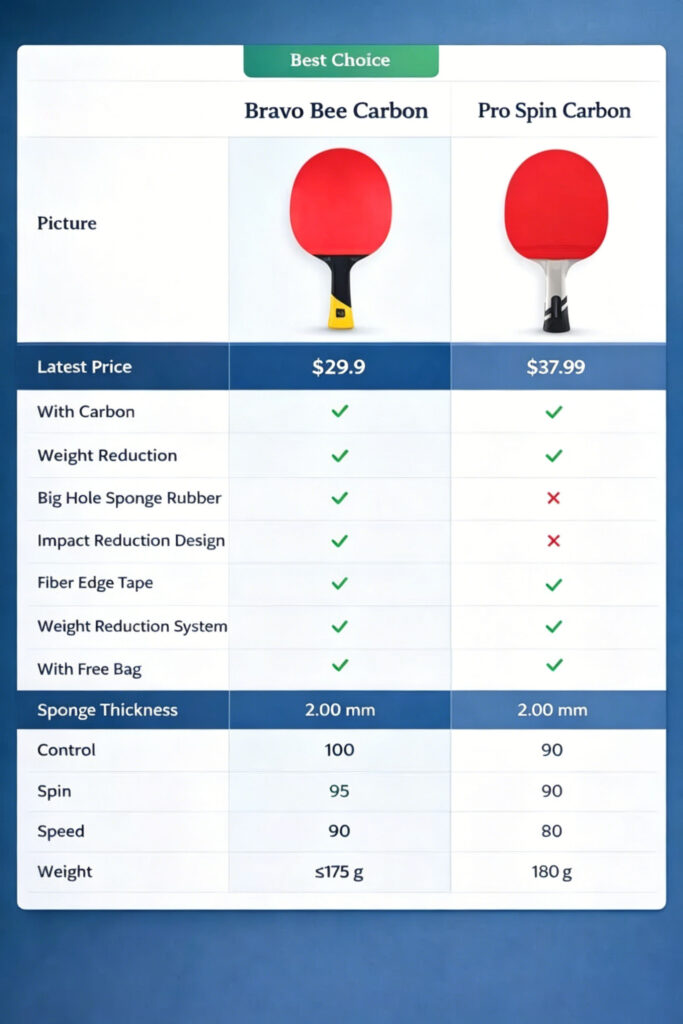
The BravoBee’s carbon construction is designed specifically for beginners and intermediates who need forgiveness while they learn[reference:5]. The STIGA Pro Carbon, on the other hand, is built for advanced offensive players who want maximum speed and spin[reference:6]. Both use carbon – but they tune it for different audiences.
Killerspin JET 200: No Carbon – It’s All‑Wood, Less Stable
Now let’s look at the Killerspin JET 200 no carbon situation. The JET 200 features a 5‑layer wood blade with no carbon layers at all[reference:7][reference:8]. It’s a solid, beginner‑friendly paddle, but it’s all‑wood. That means:
- Smaller sweet spot – you have to hit the exact center to get good results.
- More twisting – off‑center hits send the ball wild.
- Less power – you have to swing harder to get pace.
- Less stability – the blade flexes more, making blocks and drives less predictable.
One reviewer noted that the JET 200 has a “balanced feel”[reference:9], but that balance comes from its 5‑ply wood construction – not from carbon reinforcement. Some sources even list the JET 200’s blade composition as “5‑ply wood with a carbon inner layer”[reference:10], but most product descriptions clearly state it’s 5 layers of wood with no carbon[reference:11][reference:12].
The JET 200 is a decent beginner paddle – but it’s missing the stability and forgiveness that carbon provides.
What No Carbon Means: Smaller Sweet Spot, More Twisting, Less Power
Let’s get specific about what you lose without carbon. A pure wood paddle like the Killerspin JET 200 has a smaller effective sweet spot. When you hit off‑center, the blade twists in your hand, sending the ball offline. That’s frustrating for beginners who are still developing consistent technique.
Without carbon, the blade also absorbs more energy on impact. That means less power transfer – you have to swing harder to get the same pace. And because the blade flexes more, blocks and drives are less stable, especially against hard‑hit balls.
The JET 200’s ratings reflect this: Speed 6.0, Spin 7.0, Control 8.5 (out of 10)[reference:13][reference:14]. Those are decent numbers, but they’re noticeably lower than what you get with a carbon paddle. The BravoBee, for comparison, has Control 100, Spin 95, Speed 90 – and that carbon construction is a big reason why.
Why Carbon Matters for Amateurs: Forgiveness on Off‑Center Hits
Here’s the key takeaway: carbon matters most for amateurs. Beginners hit off‑center a lot. That’s just part of learning. A paddle with carbon layers forgives those mistakes by resisting twisting and keeping the ball on a straighter path. A pure wood paddle punishes those mistakes by sending the ball wild.
As one source notes, carbon “expands the sweet spot, ensuring more consistent performance across the racket face”[reference:15]. That consistency is exactly what developing players need to build confidence and improve.
The BravoBee’s carbon construction is a perfect example of this philosophy in action. It’s “balanced stability and rebound”[reference:16], giving you the forgiveness you need without sacrificing performance. The STIGA Pro Carbon’s carbon is more aggressive, tuned for speed and power – but it still gives you that larger sweet spot and stability.
The Killerspin JET 200, on the other hand, is stuck in the past. Without carbon, it’s less forgiving, less stable, and less powerful than carbon‑reinforced alternatives. If you’re a beginner or intermediate player, that’s a significant disadvantage.
What About the Confusion? Some Listings Say Carbon
One quick note: some listings for the Killerspin JET 200 mention “carbon construction”[reference:17] or “5‑ply wood with a carbon inner layer”[reference:18]. This appears to be either outdated information or confusion with other Killerspin models. The vast majority of product descriptions and spec sheets confirm the JET 200 is 5 layers of wood with no carbon[reference:19][reference:20]. Don’t be fooled by the occasional carbon reference – the JET 200 is an all‑wood paddle.
If you want carbon, you need to look at the BravoBee Carbon or the STIGA Pro Carbon – both of which have clear, verified 5+2 carbon construction.
Conclusion: If You’re Choosing Between Carbon and No Carbon, Go Carbon
The carbon paddle vs wood debate is settled: carbon gives you a bigger sweet spot, more stability, and less twisting. The Killerspin JET 200 no carbon design means you’re missing out on those benefits. The BravoBee carbon layers (5+2) and the STIGA Pro Carbon’s integrated carbon are proof that carbon makes a difference. When you’re comparing a table tennis carbon blade to a carbon vs non-carbon paddle, the choice is clear: if you want forgiveness, consistency, and power, go with carbon. The BravoBee Carbon gives you all of that – plus a price that won’t break the bank.
👉 Get your BravoBee Carbon here – the carbon paddle that actually helps you improve. Your game will thank you.
Have you tried a carbon paddle vs a wood one? Share your experience in the comments – I’d love to hear your take!
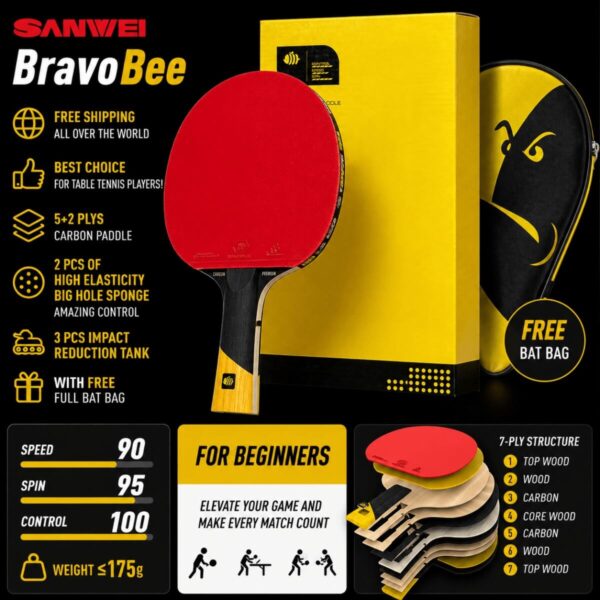
BravoBee Carbon Ping Pong Paddles
- Free Shipping All Over The World
- Best choice for table tennis players!
- 5+2 plys carbon paddle
- 2 pcs of high elasticity big hole sponge, amazing control
- 3 pcs Impact reduction tank
- with FREE full bat bag