One question I hear quite often from players is:
“I can hit my forehand hard, so why can’t I finish the point?”
In many cases, the problem is not that you are too weak.
The real problem is that your forehand power is not being used in a stable and repeatable way.
After many years of working with table tennis players and equipment, I have found that when a player’s forehand cannot produce enough quality to finish the point, we should first look at the hitting posture and movement, rather than simply trying to swing harder.
Power Starts with Your Hitting Position
A powerful forehand is not simply about moving your arm faster.
Before the racket even accelerates, your body needs to be in a position where it can support the stroke.
Your feet, legs, waist, shoulder, forearm, and racket should work together. More importantly, the position at contact needs to be stable and repeatable.
If your hitting posture changes from one shot to another, your power will also change.
Sometimes you contact the ball too close to your body. Sometimes the contact point is too far forward. Sometimes your elbow is in a different position, or your upper body is already moving away from the ball.
You may still hit the ball hard, but the power becomes difficult to control and reproduce.
That is why some players can make one spectacular forehand in training, but struggle to produce the same quality when the match becomes faster.

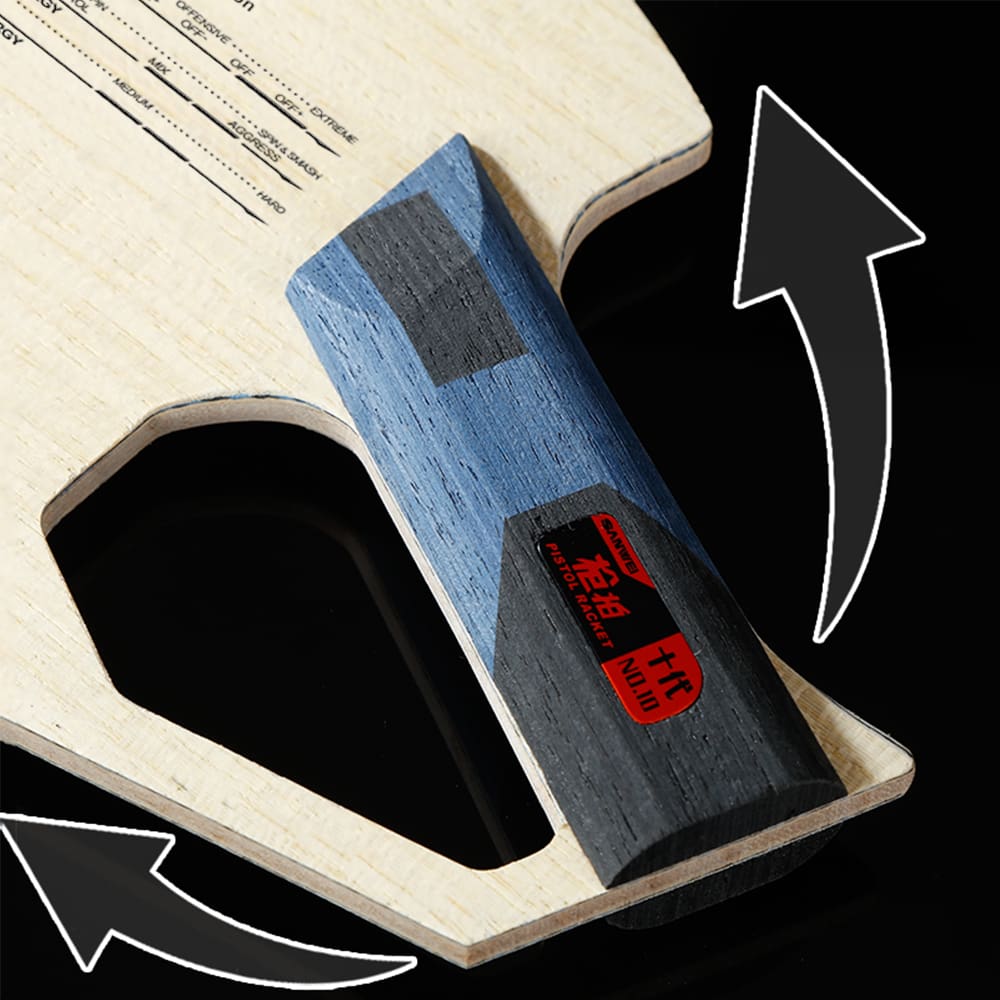
Sanwei Pistol Racket 10th
- ITTF Approved: Fully compliant with ITTF regulations, the Sanwei Pistol Racket is approved for use in any level of table tennis competition, ensuring you stay competitive at all times
- Ergonomic Swing Design: The unique design aligns the hitting point with the natural extension of your arm.
- Dual-Channel Force Guidance: Simplified movements enhance power and speed by up to 15%, giving you a competitive edge
- Anti-Rotation Palm Support: The built-in anti-rotation palm support stabilizes the racket
- Guided Motion for Shortened Training Cycles: The Pistol Racket’s design promotes proper technique and reduces errors during training.
- More structures are available for selection.
- FL/ST handles are available to suit players of varying skill levels.
- Free Shipping Worldwide!
A Hard Swing Doesn’t Always Mean a Powerful Forehand
This is a common misunderstanding.
Many players feel that if the ball is not fast enough, they simply need to use more arm strength.
So they tighten their grip, swing harder, and try to accelerate the racket with the arm.
The result can actually be worse.
When you are too tense, your movement becomes smaller and less fluid. The timing becomes more difficult, and the energy generated by your legs and body cannot be transferred efficiently into the racket.
A good forehand should feel more like a coordinated movement than a fight between your arm and the ball.
You want your body to create the power and your racket to release it at the right moment.
Build a Standard Forehand Before Trying to Hit Harder
If your forehand lacks finishing power, I would suggest going back to the basics.
Don’t start by trying to hit the ball harder.
Instead, practice making the same movement again and again.
Pay attention to three things:
1. Prepare early
Get your body and racket into position before the ball reaches your hitting zone. A late preparation often forces you to use your arm to compensate.
2. Find a consistent contact point
Try to contact the ball in front of your body at a comfortable distance. A consistent contact point makes it much easier to reproduce the same racket acceleration.
3. Keep your body involved
Your forehand should not be an isolated arm movement. Let your legs, waist, shoulder, forearm, and wrist work together naturally.
Once this movement becomes familiar, you can gradually increase your acceleration.
That is when your power becomes much more useful.
Your Grip Also Matters
There is another detail that players sometimes overlook: how they hold the racket.
Your grip should provide enough stability to control the racket, but it should not become excessively tight.
If your grip changes during the stroke, the racket angle can change as well. That makes your contact less predictable and can cause you to lose energy at impact.
I often tell players:
First make the racket stable. Then make it fast.
Speed without stability is difficult to turn into effective attacking power.
Can Equipment Help Your Forehand Become More Stable?
This is also where racket design can make a difference.
The SANWEI Pistol Racket was developed around the idea that the racket should work more naturally with the player’s hand and forearm.
Its non-traditional handle design is intended to place the racket in a more natural relationship with the extension of the forearm. This can make the grip and hitting position feel more intuitive, especially during forehand movements.
For players who have difficulty maintaining a consistent forehand position, this can be useful.
Instead of constantly making small adjustments with the wrist or hand, the goal is to make the racket feel more like a natural extension of the arm.
This also works together with the Pistol Racket’s dual-channel power transmission design. The idea is not simply to create more force, but to provide a more efficient path for the force generated by the body and forearm to reach the racket.
When the grip, hitting position, and body movement are working together, you can spend less effort correcting the racket and more effort accelerating it.
Don’t Chase the “Killing Ball”
One final piece of advice: don’t make every forehand a finishing shot.
During training, practice producing a stable, high-quality forehand repeatedly before trying to hit maximum power.
For example, start with 70–80% power and focus on:
- the same preparation
- the same contact point
- the same body rotation
- a relaxed grip
- a complete follow-through
Once you can repeat that movement comfortably, increase the acceleration.
You may find that your maximum power actually becomes easier to produce.
Because real finishing power doesn’t come from suddenly using 100% of your strength.
It comes from being able to use the right movement, at the right time, with very little wasted motion.
Final Thoughts
If your forehand often fails to finish the point, don’t immediately assume that you need more strength.
First ask yourself:
Is my forehand posture stable?
Is my contact point consistent?
Am I using my whole body, or just my arm?
Can I repeat the same movement when the ball comes faster?
A powerful forehand is built on a stable foundation.
Once your posture becomes reliable, your timing becomes more consistent, and your grip and racket work naturally with your arm, the power you already have can become much more effective.
That is the approach I have always believed in: don’t simply try to hit harder—learn to transfer your existing power more efficiently.
Su Zhimin
Founder of SANWEI Sports