A common problem I see with attacking players is this:
The first forehand is excellent. The second one is still good. But after three or four consecutive attacks, the movement starts to change.
The racket angle changes. The contact point moves. The arm becomes tense. The body starts rushing.
And suddenly, the forehand that looked so powerful a moment ago becomes much less reliable.
So how can you make your forehand attacks more consistent?
In my experience, the key is not simply to swing harder. You need to be able to maintain a stable hitting posture from one stroke to the next.
Consistency Comes from Repeating the Same Movement
When you attack continuously, the ball rarely comes back exactly the same way.
One ball may be slightly higher. Another may be lower. One may have more spin, while the next one comes faster.
Your body naturally needs to make small adjustments.
But there is an important difference between adjusting to the ball and changing your entire hitting posture.
Good players can adjust the stroke while keeping the basic structure of the movement stable.
The preparation, grip, contact relationship, and follow-through remain familiar.
This gives you a reliable foundation for the next ball.
If your basic posture keeps changing, however, every new shot becomes a new calculation.
That is when consecutive attacks become difficult.
Why Does Your Forehand Posture Change During Continuous Attacks?
There are several common reasons.
First, players often become increasingly tense as the rally gets faster. They grip the racket harder and try to create more power with the arm.
Second, after each stroke, they don’t return to a comfortable and repeatable position. The racket may finish in a different place every time.
Third, the relationship between the hand, forearm, and racket may not feel completely natural. When the player needs to make constant small corrections, those corrections become more obvious during a fast rally.
This is why I believe a stable racket position is just as important as a powerful swing.

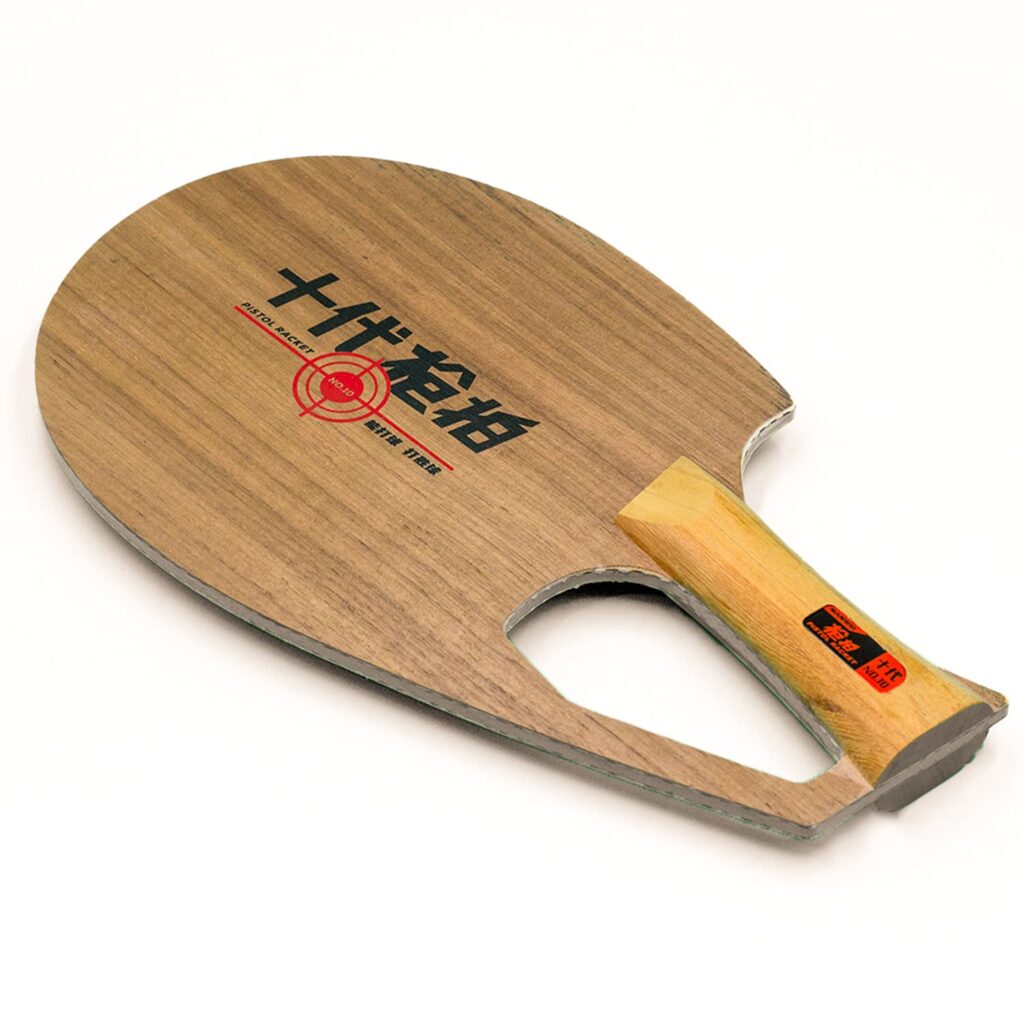
Sanwei Pistol Racket 10th
- ITTF Approved: Fully compliant with ITTF regulations, the Sanwei Pistol Racket is approved for use in any level of table tennis competition, ensuring you stay competitive at all times
- Ergonomic Swing Design: The unique design aligns the hitting point with the natural extension of your arm.
- Dual-Channel Force Guidance: Simplified movements enhance power and speed by up to 15%, giving you a competitive edge
- Anti-Rotation Palm Support: The built-in anti-rotation palm support stabilizes the racket
- Guided Motion for Shortened Training Cycles: The Pistol Racket’s design promotes proper technique and reduces errors during training.
- More structures are available for selection.
- FL/ST handles are available to suit players of varying skill levels.
- Free Shipping Worldwide!
The Pistol Racket: Designed to Help You Keep Your Position
This is one of the ideas behind the SANWEI Pistol Racket.
The Pistol Racket uses a non-traditional handle design that is intended to make the racket and forearm work together in a more natural way.
Instead of constantly adjusting your wrist and hand to find the right racket position, the design encourages a more consistent relationship between your grip, forearm, and racket.
This becomes particularly noticeable during continuous forehand attacks.
When the next ball arrives, you don’t want to completely rebuild your stroke.
You want your body to recognize the movement and repeat it.
Same basic grip.
Same basic hitting position.
Same familiar swing path.
Of course, you still need to adjust for the height, speed, and spin of each ball. The goal isn’t to make every stroke identical.
The goal is to keep your basic posture stable while making those necessary adjustments.
Stable Does Not Mean Stiff
There is one important point I always remind players about.
Keeping your posture stable does not mean keeping your entire body rigid.
A good continuous attack should still be relaxed.
Your legs need to move. Your waist needs to rotate. Your shoulder and forearm need to accelerate naturally. Your grip should remain secure without becoming excessively tight.
Think of it this way:
Your structure should be stable, but your movement should remain flexible.
This is especially important when you are playing several forehands in a row. If you become too tense after the first or second shot, your swing will gradually become smaller and your timing will deteriorate.
Practice the Recovery, Not Just the Swing
Here is a simple training method I recommend.
When practicing continuous forehand attacks, don’t only pay attention to whether the ball lands on the table.
After every stroke, check:
- Is my grip still comfortable?
- Has my racket returned to a familiar position?
- Is my body balanced?
- Am I ready for the next ball?
- Did I use the same basic hitting posture?
You can even reduce your power to 60–70% at first.
The purpose is to teach your body to recover into the same basic position after every stroke.
Once this becomes automatic, increase the speed and power gradually.
You will often find that consistency improves before maximum power does.
And that is a good thing.
When Your Position Is Stable, Power Becomes Easier
A stable hitting position also makes power transfer more predictable.
This is another reason the Pistol Racket focuses on the relationship between the hand and forearm rather than simply making the handle more conventional.
Its design incorporates a dual-channel power transmission concept, helping the force generated by your body and forearm transfer more efficiently into the racket.
When the racket is consistently positioned, you don’t have to waste as much movement correcting the racket during each stroke.
More of your movement can go toward accelerating the ball.
That is especially valuable during continuous attacks, because the quality of the third, fourth, and fifth forehand matters just as much as the first one.
Don’t Try to Win the Rally with Every Ball
One last piece of advice.
Continuous attack is not the same as hitting every ball at maximum power.
If you try to kill every ball, your posture will usually become more difficult to maintain.
Instead, build the rally progressively.
Start with a comfortable attacking ball. Maintain your position. Recover. Attack the next ball. Then increase the speed when the opportunity appears.
The strongest attacking player is not necessarily the one who can hit one incredibly hard forehand.
It is often the player who can produce high-quality forehands again and again without losing their structure.
Final Thoughts
If your forehand becomes unstable during continuous attacks, don’t immediately look for more strength.
First look at your posture.
Can you hold the same basic position from one stroke to the next?
Can your racket return to a familiar position after every shot?
Can you stay relaxed while maintaining control?
These are the foundations of consistent attacking.
The SANWEI Pistol Racket is designed around this idea: making the relationship between your hand, forearm, and racket more natural, so that during continuous attacking, it is easier to maintain a consistent basic hitting posture.
Don’t just make one great forehand.
Build a forehand you can repeat.
That is where real attacking consistency begins.
Su Zhimin
Founder of SANWEI Sports