When a player tells me, “I know the technique, but my racket face always seems to change at the last moment,” I usually don’t tell them to simply move their wrist less.
The first thing I want to know is:
Why does the racket face need so much adjustment in the first place?
Good racket face control is not just about the wrist. It comes from having a stable relationship between your hand, forearm, racket, and body throughout the stroke.
When that relationship is natural and repeatable, controlling the racket face becomes much easier.
Why Is Racket Face Control So Difficult?
During a fast rally, the racket face may need to change slightly depending on the ball’s height, speed, and spin.
That is normal.
The problem is when the racket face changes unintentionally.
For example, you may prepare with a good racket angle, but as you accelerate, your wrist suddenly turns. Or you may grip the racket tightly because you are afraid of missing the ball, which changes the angle at contact.
These small changes can make a big difference.
A racket face that is only slightly too open can send the ball long. A slightly closed face can send it into the net.
This is why I believe racket face control starts with stability, not simply with learning how to manipulate the wrist.
Don’t Use Your Wrist to Fix Everything
One habit I often see in developing players is using the wrist to correct every problem.
The ball is going long? Close the wrist.
The ball is going into the net? Open it.
The racket feels unstable? Grip it harder.
This can work occasionally, but it is difficult to maintain during fast, continuous play.
Your wrist should have freedom, but it should not be responsible for constantly rescuing an unstable grip.
A better approach is to first establish a stable basic relationship between your hand and the racket.
Then your wrist can make the small adjustments that are actually needed.

Sanwei Pistol Racket 10th
- ITTF Approved: Fully compliant with ITTF regulations, the Sanwei Pistol Racket is approved for use in any level of table tennis competition, ensuring you stay competitive at all times
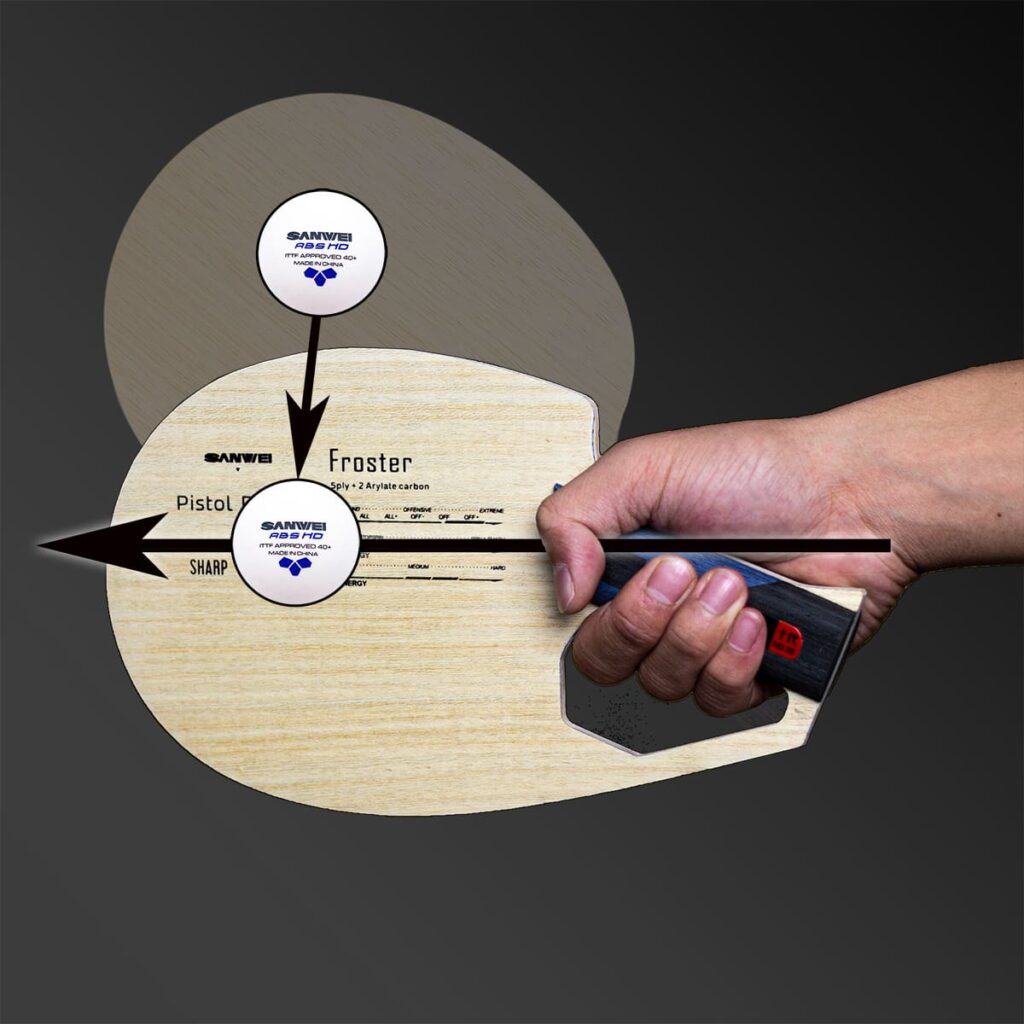
- Ergonomic Swing Design: The unique design aligns the hitting point with the natural extension of your arm.
- Dual-Channel Force Guidance: Simplified movements enhance power and speed by up to 15%, giving you a competitive edge
- Anti-Rotation Palm Support: The built-in anti-rotation palm support stabilizes the racket
- Guided Motion for Shortened Training Cycles: The Pistol Racket’s design promotes proper technique and reduces errors during training.
- More structures are available for selection.
- FL/ST handles are available to suit players of varying skill levels.
- Free Shipping Worldwide!
This Is Where the Pistol Racket Can Help
The SANWEI Pistol Racket was developed with this idea in mind.
Its non-traditional handle is designed to make the racket’s orientation feel more natural in relation to the forearm.
When the racket follows the natural extension of your forearm, the hand does not need to make as many unnecessary compensations simply to keep the racket in position.
This can be particularly useful for forehand strokes.
Instead of thinking constantly about:
“Is my racket face correct?”
you can focus more on:
“Am I moving naturally toward the ball?”
The racket is designed to make that relationship more intuitive, which can help players maintain a more consistent racket face during repeated strokes.
Stability Doesn’t Mean Keeping the Racket Completely Fixed
There is an important distinction here.
Good racket face control does not mean keeping the racket at exactly the same angle for every shot.
Different balls require different adjustments.
A heavy topspin ball, a light opening ball, and a fast counterattack obviously cannot all be played with exactly the same racket angle.
The goal is to make your adjustments intentional rather than accidental.
Think of your basic racket position as the foundation.
You can make small changes from that foundation, but you don’t want the whole structure to change every time you swing.
A Simple Way to Practice
Try this during your next forehand training session.
Start at around 60–70% power rather than maximum speed.
Focus on three things:
- Keep your grip comfortable and stable.
- Keep the racket and forearm working together naturally.
- Pay attention to whether the racket face changes because you chose to change it or because your hand lost control.
Don’t worry too much about how hard you hit.
If you can produce ten or twenty consecutive forehands with a similar basic racket orientation, gradually increase the speed.
This is much more useful than simply trying to hit harder and hoping your racket face will somehow become more stable.
Let the Racket Work With Your Body
A good racket should not feel like something you are constantly fighting with.
Your legs and body create movement. Your arm and forearm transfer that movement. Your hand provides the connection to the racket.
The more naturally these parts work together, the easier it becomes to control the racket face.
This is also connected to the Pistol Racket’s dual-channel power transmission concept. Its design aims to provide a more efficient connection between the hand, forearm, and racket, so that the force generated during the stroke can be transferred without relying on excessive wrist compensation.
For an attacking player, this relationship can be especially important.
When you are playing one forehand after another, you don’t have time to consciously correct the racket face before every ball.
You need a setup that your body can recognize and repeat.
Final Thoughts
If you want better racket face control, don’t immediately focus on making your wrist stronger or trying to hold the racket more tightly.
Start with the foundation:
A stable grip.
A natural forearm-racket relationship.
A repeatable hitting position.
And a relaxed, controlled movement.
The SANWEI Pistol Racket is designed around this principle. By creating a more natural relationship between the racket and forearm, it can help players maintain a more consistent racket orientation and reduce unnecessary adjustments during their strokes.
When your racket face becomes more predictable, your shots become more predictable too.
And when you no longer have to think about controlling the racket at every moment, you can put your attention where it belongs—on the ball, the opponent, and the next shot.
Su Zhimin
Founder of SANWEI Sports