If you feel that you are making too many unforced errors in table tennis, the first thing I would look at is not your racket or rubber.
I would look at how you swing the racket.
Many players have enough strength and enough speed, but their shots are still inconsistent. One ball goes perfectly, the next one goes into the net, flies long, or misses the target completely.
In my experience, this often comes back to one basic problem: the swing posture is not stable or correct enough.
Your Swing Determines the Quality of Your Shot
A good shot is not simply about hitting the ball hard.
Before the ball reaches your racket, your body has already prepared a series of movements—your feet adjust your position, your body turns, your arm moves into the correct position, and finally the racket contacts the ball.
If this movement changes too much from one shot to the next, the quality of your contact will also change.
For example, if your elbow is sometimes too close to your body and sometimes too far away, or your contact point changes constantly, you may find that your racket face is difficult to control.
You might still hit some excellent shots, but you cannot reproduce them consistently.
That is where many players become frustrated.
A Stable Swing Creates More Predictable Contact
When I teach players to improve consistency, I often tell them to first find a repeatable basic hitting position.
You don’t need to make every stroke exactly identical. Table tennis is too dynamic for that.
But the important parts of the movement should remain relatively stable:
- Your body should be properly positioned behind the ball.
- Your hitting point should be predictable.
- Your arm should have a clear and natural swing path.
- Your racket face should not change unnecessarily during the swing.
- Your body should be able to recover quickly for the next ball.
When these elements become more consistent, the ball usually becomes more predictable as well.
This is why sometimes slowing down your training can actually help you improve faster.
Instead of trying to hit every ball harder, try hitting 20 or 30 balls with the same basic movement. Pay attention to whether your body position and contact point remain similar.
Don’t Use Your Wrist to Fix Every Mistake
Another common problem is trying to correct a poor swing with the wrist.
The ball is going long, so the player closes the racket face.
The next ball goes into the net, so they open it again.
After a few shots, the racket face is constantly changing.
Your wrist is an important part of table tennis, but it should not have to compensate for an unstable basic swing on every ball.
The better approach is to first establish a stable relationship between your body, forearm, hand, and racket. Once that foundation is reliable, the wrist can make smaller adjustments when necessary.
This usually makes the stroke feel much more natural.

Sanwei Pistol Racket 10th
- ITTF Approved: Fully compliant with ITTF regulations, the Sanwei Pistol Racket is approved for use in any level of table tennis competition, ensuring you stay competitive at all times
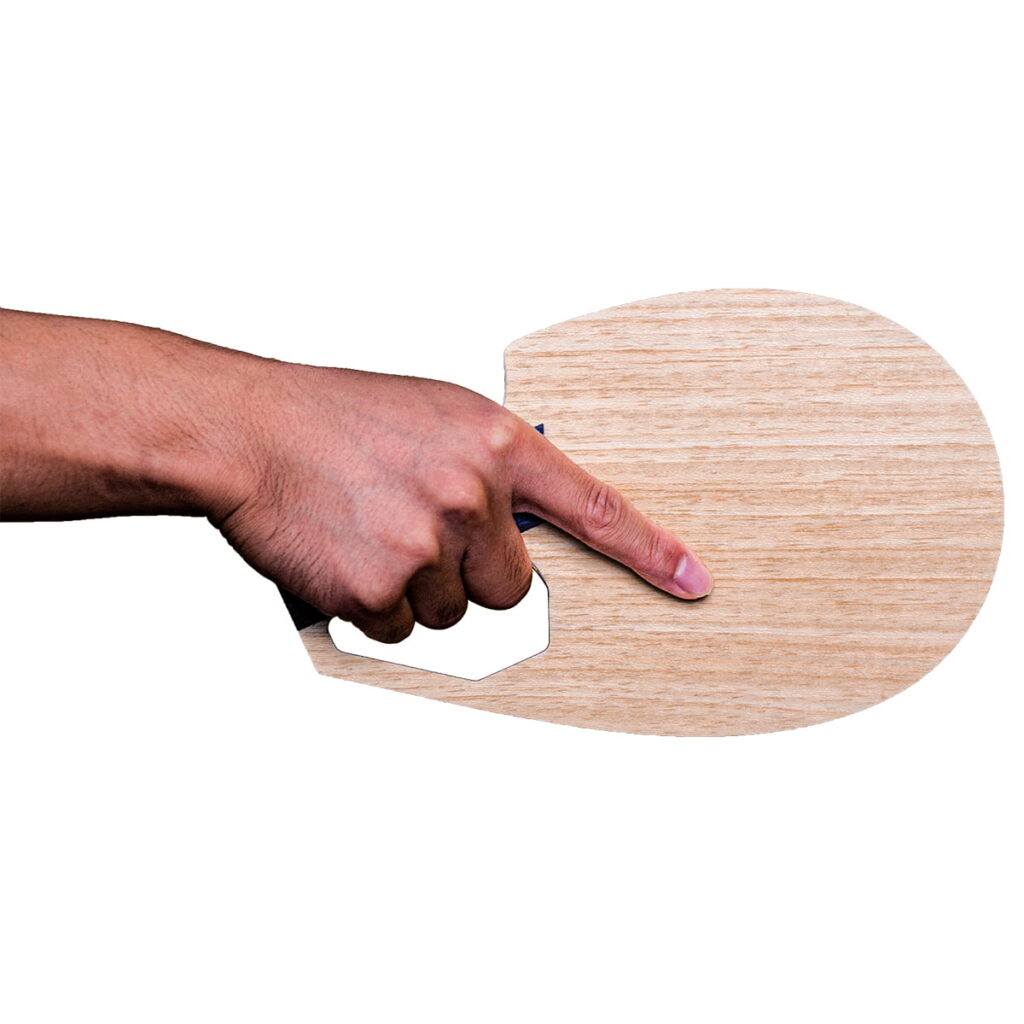
- Ergonomic Swing Design: The unique design aligns the hitting point with the natural extension of your arm.
- Dual-Channel Force Guidance: Simplified movements enhance power and speed by up to 15%, giving you a competitive edge
- Anti-Rotation Palm Support: The built-in anti-rotation palm support stabilizes the racket
- Guided Motion for Shortened Training Cycles: The Pistol Racket’s design promotes proper technique and reduces errors during training.
- More structures are available for selection.
- FL/ST handles are available to suit players of varying skill levels.
- Free Shipping Worldwide!
The Racket Should Follow Your Natural Movement
This is also one of the reasons I developed the Pistol Racket.
Traditional shakehand handles work very well for many players, but I found that some players naturally have to make small adjustments with their hand and wrist to find a comfortable hitting position.
The Pistol Racket was designed around a different idea.
Its handle and hitting position are intended to follow the natural extension of the forearm, helping the racket feel more naturally connected to the hand and arm.
For players who struggle with inconsistent forehand posture, this can make it easier to establish a repeatable swing.
The design also focuses on dual-channel power transmission, so the force generated by the body and forearm can be transferred into the racket more efficiently.
The goal is not simply to make you swing harder.
The goal is to make your movement more natural, stable, and repeatable.
Consistency Comes From Repetition
Even with a more suitable racket, technique still needs to be trained.
One exercise I recommend is very simple.
Start with controlled forehand drives at moderate speed. Don’t try to finish the point. Instead, focus on three things:
Position → Contact → Recovery
First, make sure you are in a good position before the ball arrives.
Second, make your contact point as consistent as possible.
Third, recover immediately after the stroke instead of admiring your shot.
Once you can maintain this pattern for many consecutive balls, gradually increase the speed and intensity.
This is how a good swing becomes an automatic movement rather than something you have to think about every time.
Relaxation Is Also Part of Good Technique
There is another small detail that I think players often underestimate: relaxation.
When players are worried about making mistakes, they often grip the racket too tightly.
A tight grip can make the arm stiff, reduce the natural movement of the forearm, and make fine adjustments more difficult.
Try keeping your hand secure but relaxed, especially during the preparation and early part of the swing.
You want the racket to be controlled—not squeezed.
When the body is relaxed and the swing is stable, the racket can do its job much more naturally.
Don’t Judge Your Technique by One Great Shot
One of the biggest traps in training is thinking, “I just hit a fantastic forehand, so my technique must be correct.”
Not necessarily.
A good technique is not the one that produces one perfect shot.
It is the one that allows you to produce many good shots in a row.
If you can hit one powerful forehand but make an error every second or third ball, there is still something to improve.
When your basic posture becomes more stable, your contact point becomes more predictable, and your racket movement becomes more natural, your error rate can gradually come down.
That is the kind of improvement I value most.
Final Thoughts
A high error rate is often not because you lack power or talent.
Sometimes the problem is much simpler: your swing posture is not stable enough to give you consistent contact.
Before trying to hit harder, try to make your movement cleaner.
Build a repeatable hitting position. Keep your racket connected naturally to your forearm. Avoid using excessive wrist movement to compensate for poor positioning. And practice the same basic stroke repeatedly until it becomes automatic.
This is one of the ideas behind the Pistol Racket: helping players establish a more natural relationship between the hand, forearm, and racket so that their swing can become more stable and repeatable.
In table tennis, fewer mistakes do not always come from playing safer.
Very often, they come from building a better movement.
Su Zhimin
Founder of SANWEI Sports