Yes, I believe it can.
But I want to make one thing clear first: a racket cannot replace good technique.
If your footwork is poor, your timing is late, or you are always trying to hit the ball too hard, changing your racket will not suddenly solve everything.
What I have found, however, is that the relationship between your hand, forearm, and racket can have a real influence on how naturally and consistently you swing.
This is one of the main ideas behind the Pistol Racket.
Stability Starts With Your Swinging Posture
When a player makes too many mistakes, they often think the problem is their timing or their reaction.
Sometimes it is.
But very often, the deeper problem is that the basic swinging posture is changing from one shot to the next.
Your elbow moves differently.
Your contact point changes.
Your wrist compensates for the racket position.
Your body finishes in a different position every time.
When the movement itself is unstable, it is difficult for the racket to produce a stable ball.
Think about throwing a ball.
If you use a natural, repeatable throwing motion, you can usually control the direction quite well. But if you change your arm position and wrist angle every time you throw, even your strongest throw will become unpredictable.
Table tennis is similar.
A stable stroke comes from a stable movement.

Sanwei Pistol Racket 10th
- ITTF Approved: Fully compliant with ITTF regulations, the Sanwei Pistol Racket is approved for use in any level of table tennis competition, ensuring you stay competitive at all times
- Ergonomic Swing Design: The unique design aligns the hitting point with the natural extension of your arm.
- Dual-Channel Force Guidance: Simplified movements enhance power and speed by up to 15%, giving you a competitive edge
- Anti-Rotation Palm Support: The built-in anti-rotation palm support stabilizes the racket
- Guided Motion for Shortened Training Cycles: The Pistol Racket’s design promotes proper technique and reduces errors during training.
- More structures are available for selection.
- FL/ST handles are available to suit players of varying skill levels.
- Free Shipping Worldwide!
Why Did We Develop the Pistol Racket?
When designing the Pistol Racket, I wanted to address something very simple:
Can the racket follow the player’s natural movement instead of forcing the player to constantly adjust to the racket?
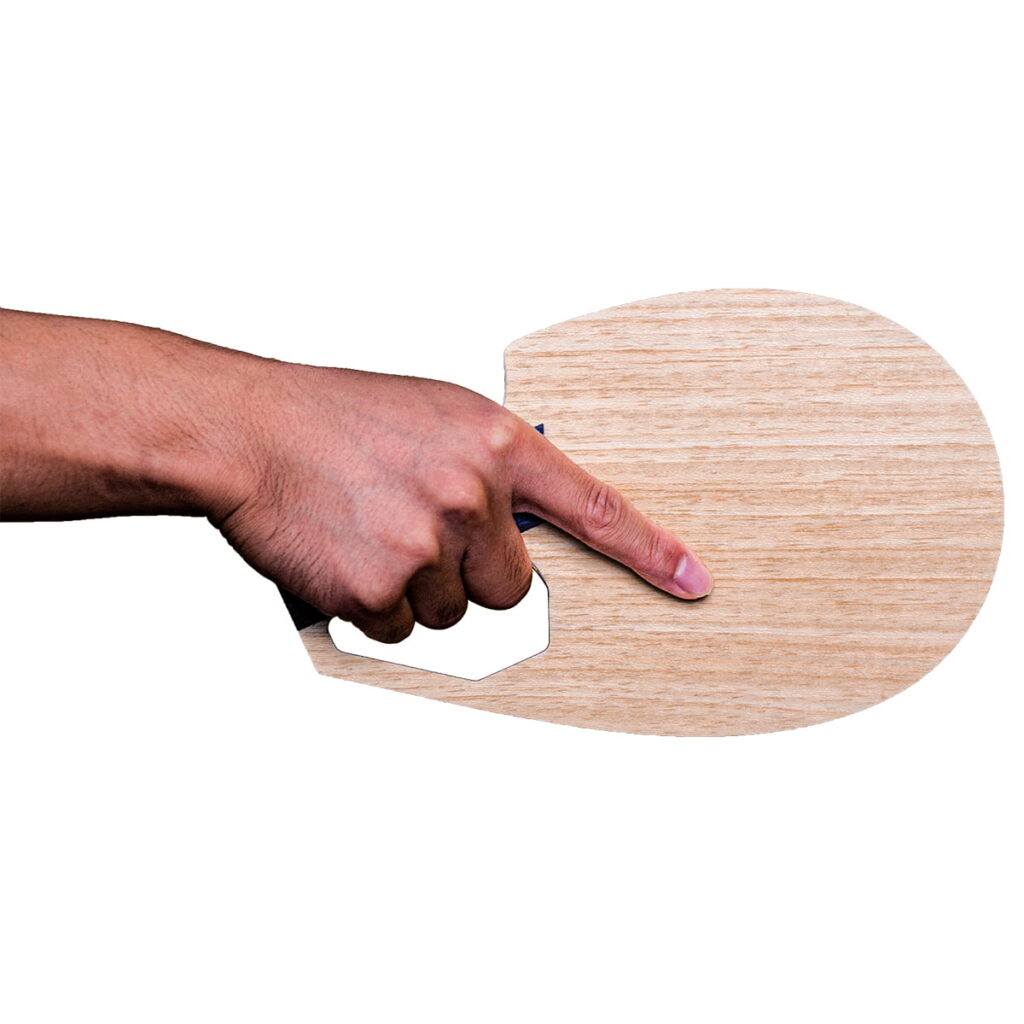
The Pistol Racket uses a different handle concept from a traditional FL shakehand racket.
The hitting position is designed to follow the natural extension of the forearm. This allows the hand, forearm, and racket to work together in a more intuitive relationship.
For many players, this can make it easier to establish a consistent basic posture.
And when your basic posture becomes more repeatable, your contact point and racket-face control can also become more predictable.
That is where the improvement in stability comes from.
Stability Does Not Mean Holding the Racket Rigidly
There is an important misunderstanding about stability.
Some players think a stable stroke means keeping the wrist completely fixed and holding the racket tightly.
I don’t agree with that.
A good stroke should still be dynamic.
Your forearm needs to move. Your wrist can make adjustments. Your body needs to rotate and recover.
The difference is that these movements should happen as part of a coordinated stroke rather than as emergency corrections.
The Pistol Racket is designed to make that basic relationship more natural, so you don’t have to constantly fight against the position of the handle.
Better Stability Also Helps With Power
Another reason I consider stability important is that power and stability are not opposites.
Some players become more stable by slowing everything down and making their stroke very small. That may reduce errors, but it also limits their development.
What we want is different.
We want to maintain a stable basic posture while allowing the body to generate more speed.
This is also connected with the Pistol Racket’s dual-channel power transmission concept.
Instead of thinking only about how hard your arm can swing, think about how efficiently the force generated through your movement reaches the racket.
When the racket and forearm relationship feels natural, you can focus more on the actual stroke instead of constantly correcting the position of the racket.
That can help you develop both consistency and power.
Try This Simple Test
If you already use a Pistol Racket—or if you are considering trying one—I recommend a very simple training test.
Don’t start by hitting as hard as possible.
Instead, hit 50 controlled forehands.
Pay attention to:
- Where you contact the ball
- Whether your elbow stays in a comfortable position
- Whether your racket face changes unnecessarily
- Whether you can maintain the same basic posture
- Whether you can recover naturally after each stroke
Then gradually increase your speed.
The goal is not to make every stroke identical.
The goal is to see whether your movement remains comfortable and repeatable as the intensity increases.
That is the kind of stability that matters in a real match.
Give Your Body Time to Adapt
Of course, any new racket design will feel different at first.
Your hand has learned a particular grip and your body has built habits around it.
When you change the relationship between your hand and racket, there will be a short adaptation period.
My advice is not to judge the racket after hitting five balls.
Give yourself some proper training time.
Start with simple forehand drives, then blocks, then topspin, and gradually bring the racket into match situations.
Many players find that because the Pistol Racket follows a relatively natural forearm movement, the adaptation process can be quite intuitive.
But every player is different, and technique still matters.
The Real Goal: Fewer Unnecessary Adjustments
After more than three decades working with table tennis equipment and players, I have come to believe that good equipment should not make the player think more.
It should help the player move naturally.
This is what we were trying to achieve with the Pistol Racket.
The purpose is not to create a racket that magically corrects every technical problem.
It is to create a handle and hitting relationship that can help players maintain a more natural and repeatable posture.
When your movement becomes more consistent, your contact becomes more predictable.
And when your contact becomes more predictable, your confidence during continuous attacking can change as well.
Final Thoughts
So, can the Pistol Racket really improve stroke stability?
Yes.
But the reason is not simply that the racket is “more stable.”
The more important point is that its design is intended to help the racket follow the natural extension of the forearm, making the relationship between your hand, arm, and racket more intuitive.
Good technique still comes first.
But when your equipment works naturally with your movement, you may find it easier to maintain your posture, repeat your swing, control the racket face, and transfer power from one stroke to the next.
For me, that is what real stability means in table tennis:
not holding the racket still, but being able to make the right movement again and again.
Su Zhimin
Founder of SANWEI Sports