Have you ever noticed something frustrating during table tennis practice?
You make what feels like the same forehand topspin twice. The first ball is fast, heavy, and full of spin. The second one comes off your racket much more slowly, with less spin and a completely different trajectory.
Your swing looks almost identical, so what went wrong?
In my experience, this is a common problem for players at many levels. They assume that if their arm moves in the same way, the ball should behave the same way.
But the quality of a shot depends not only on how you swing, but also on how consistently your racket meets the ball and transfers energy into it.
Let’s look at the reasons behind this problem.
1. Your Contact Point May Be Changing
The first thing I would check is the contact point.
Even when your swing looks similar, you may be contacting the ball slightly earlier or later than usual. You might hit the ball closer to your body on one shot and farther in front on the next.
These small differences can affect the racket’s angle, the direction of your swing, and the way the ball leaves the racket.
For a forehand topspin, contacting the ball in a comfortable position in front of your body generally makes it easier to coordinate your body rotation, arm movement, and racket acceleration.
If the contact point moves too far behind you, you may struggle to generate the same speed and spin. If you reach too far forward, you may lose control of the racket face.
My advice is to pay attention to where you contact the ball, not just how your arm moves.
During practice, try hitting a series of controlled forehands and notice whether the contact point remains consistent. You may discover that what feels like an identical swing is actually producing quite different contact conditions.
2. Your Racket Face May Be Changing Slightly
Another important factor is the racket face.
A small change in racket angle can make a noticeable difference to the ball’s trajectory. The effect becomes even more apparent when you are trying to produce topspin at high speed.
Some players try to compensate for inconsistent contact by making last-second adjustments with their wrist. One shot is slightly closed, the next is more open, and the resulting balls have different heights, speeds, and spin.
The problem is not that the wrist should never move. Wrist movement can be useful, particularly in advanced strokes.
The problem is relying on unpredictable adjustments instead of building a stable basic movement.
Try to keep your grip relaxed and your racket control natural. Let your forearm, wrist, and body work together rather than forcing your wrist to correct every small mistake.
Over time, a more repeatable racket position can help you produce more predictable shots.

Sanwei Pistol Racket 10th
- ITTF Approved: Fully compliant with ITTF regulations, the Sanwei Pistol Racket is approved for use in any level of table tennis competition, ensuring you stay competitive at all times
- Ergonomic Swing Design: The unique design aligns the hitting point with the natural extension of your arm.
- Dual-Channel Force Guidance: Simplified movements enhance power and speed by up to 15%, giving you a competitive edge
- Anti-Rotation Palm Support: The built-in anti-rotation palm support stabilizes the racket
- Guided Motion for Shortened Training Cycles: The Pistol Racket’s design promotes proper technique and reduces errors during training.
- More structures are available for selection.
- FL/ST handles are available to suit players of varying skill levels.
- Free Shipping Worldwide!
3. You May Be Losing Power During the Swing
Many players believe that a powerful shot comes from swinging the arm harder.
But power is not simply about how much force you generate. It also depends on how efficiently that force reaches the ball.
Your legs, body rotation, shoulder, forearm, and racket all contribute to the stroke. If these movements are poorly coordinated, some of your effort may not translate into useful racket speed at contact.
This explains why two shots can feel equally strong but produce different results.
On one shot, your body and arm work together, and the racket accelerates naturally into contact. On another, your timing is slightly off, your arm becomes tense, or your body rotation finishes too early.
You may feel that you are swinging just as hard, but the actual racket speed and contact quality can be different.
This is why I encourage players to focus on efficient power transfer rather than simply increasing their effort.
A well-coordinated stroke often produces a better ball with less unnecessary tension.
4. Your Grip Can Influence the Consistency of Your Stroke
The relationship between your hand, forearm, and racket is another factor worth considering.
If your grip feels uncomfortable or forces you to make small adjustments during the swing, it may become more difficult to reproduce the same racket position every time.
This is one of the ideas that influenced my development of the Pistol Racket.
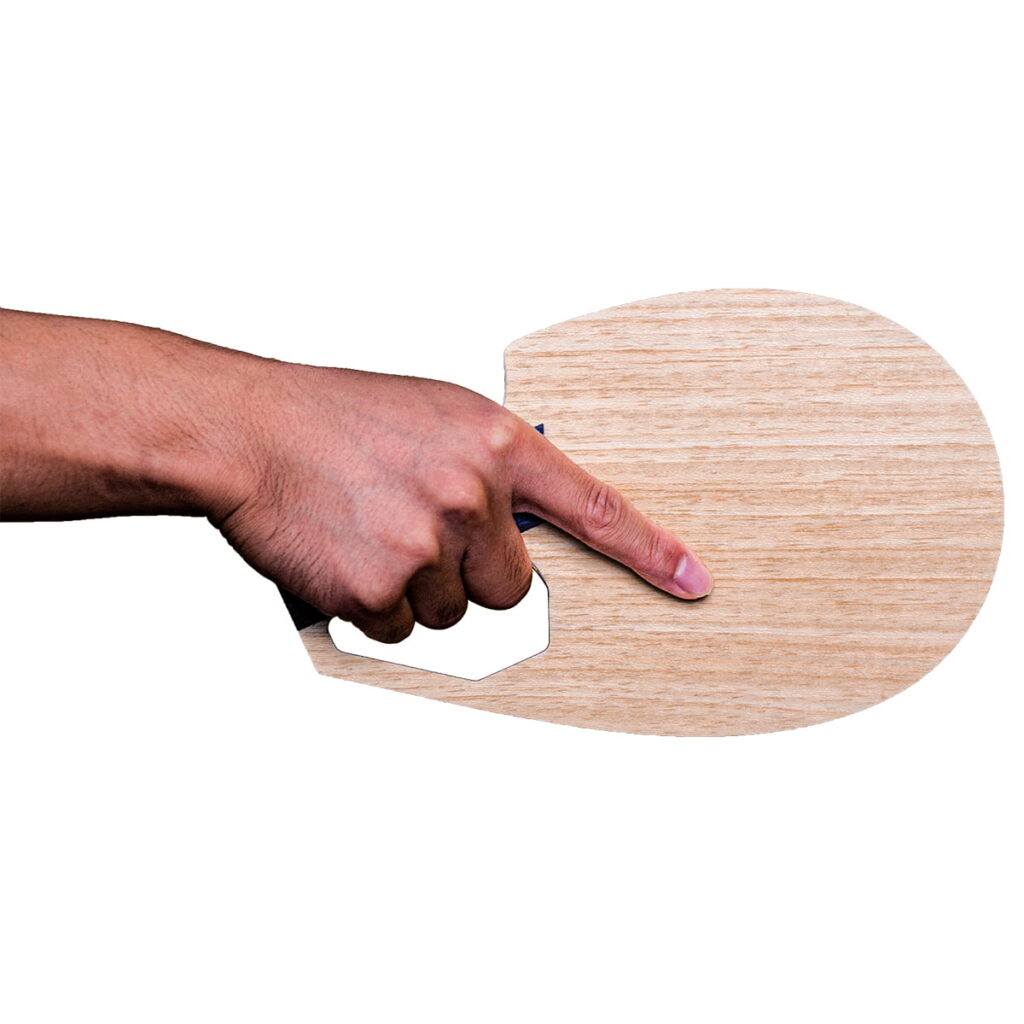
Compared with a traditional FL shakehand handle, the Pistol Racket uses a different handle design intended to align the hitting position more naturally with the extension of the forearm.
The idea is straightforward: when the racket feels more naturally connected to your hand and forearm, it may be easier to establish a comfortable, repeatable basic posture.
The Pistol Racket also incorporates our concept of dual-channel power transmission, focusing on how efficiently force can be transferred through the stroke.
These design ideas aim to help players develop more consistent movement and more efficient power transfer, particularly during forehand attacks.
Of course, a racket cannot eliminate differences in timing or contact point. But if your current grip makes it difficult to maintain a natural and repeatable swing, exploring a different handle design may be worthwhile.
5. Your Body Position May Be Different Even When Your Swing Looks the Same
There is another detail that players often overlook: the position of the body before the racket starts moving.
Imagine hitting a forehand while balanced and positioned behind the ball. Now imagine hitting the same forehand while reaching sideways, leaning backward, or recovering from the previous shot.
Your arm may follow a similar path in both situations, but your balance and ability to generate force are not the same.
When your body is poorly positioned, you may rely too much on your arm. This can make the shot weaker, less accurate, or more difficult to repeat.
That is why good footwork matters even when you are focusing on stroke technique.
Before thinking about how to swing, ask yourself whether you are in a position that allows you to swing naturally.
Sometimes the best way to improve your forehand is not to change the forehand itself. It is to arrive at the ball in a better position.
6. How Can You Make Your Shots More Consistent?
Rather than changing several things at once, I recommend a simple training method.
Step 1: Reduce your speed.
Start with controlled forehand drives or topspins. Use a speed that allows you to maintain balance and observe your contact.
Step 2: Check three things.
Pay attention to your body position, the contact point, and the racket face. These are often more useful clues than judging the shot by how powerful it feels.
Step 3: Repeat the same stroke.
Try hitting 20 consecutive balls while maintaining a comfortable, repeatable movement. Don’t worry about hitting winners.
Step 4: Increase the intensity gradually.
Once your contact becomes more consistent, increase the speed or spin. If the quality of your shots begins to vary significantly, slow down and identify what has changed.
This process helps you understand whether your inconsistency comes from positioning, timing, racket control, or power transfer.
The goal is not to force every ball to look identical. It is to make your technique reliable enough that small changes in the incoming ball do not completely change the quality of your response.
Final Thoughts
Why can two shots produced by the same stroke have such different quality?
Because what looks like the same movement does not always produce the same contact point, racket angle, body balance, or transfer of power.
If you want more consistent shots, don’t focus only on swinging your arm in the same way. Pay attention to your entire movement, from positioning your body to making contact with the ball.
At SANWEI, this is also how I think about racket design. The Pistol Racket was developed to create a more natural relationship between the hand, forearm, and racket, while its dual-channel power transmission concept focuses on efficient power transfer.
Good equipment should support good technique, not replace it.
When your position becomes more reliable, your contact becomes more predictable, and your power transfer becomes more efficient, you give yourself a much better chance of producing high-quality shots again and again.
The real goal is not to hit one perfect ball. It is to understand what made that ball good—and learn how to repeat it.
Su Zhimin
Founder of SANWEI Sports