Have you ever watched a professional table tennis player rally and wondered how they can repeat the same stroke over and over again?
Their forehands look effortless. Their racket seems to move along a familiar path, and even when the ball comes at different speeds, their technique remains remarkably stable.
Now compare that with a typical amateur player. One forehand is excellent, the next is awkward, and the third goes straight into the net.
Why is it so difficult for amateur players to maintain consistent strokes?
In my experience, the problem is rarely just a lack of strength or talent. More often, it comes down to how the player moves, how they hold the racket, and how much time they have spent developing reliable habits.
1. Many Amateur Players Have Never Built a Stable Basic Stroke
One of the biggest differences between experienced players and beginners is not necessarily how hard they hit the ball. It is how repeatable their technique has become.
Many amateur players learn by watching others, copying movements, and experimenting during practice. This is a natural way to begin, but it can also lead to inconsistent habits.
For example, a player might use their whole body for one forehand, rely mostly on their arm for the next, and change their wrist position when they feel under pressure.
All three shots may look like forehands, but the movements behind them are quite different.
When the basic stroke has not been properly established, the player must make too many adjustments on every ball.
That makes consistency difficult.
My advice is to simplify your technique before trying to make it more powerful. Develop a comfortable starting position, a repeatable contact point, and a natural swing path. Once these elements become familiar, you can gradually increase your speed and spin.
A reliable stroke is built through repetition, not improvisation.
2. Poor Footwork Makes Good Technique Difficult
Another common problem is that amateur players often focus too much on their arms and not enough on their feet.
Imagine trying to perform a perfect forehand while the ball is too close to your body. On the next shot, you are reaching sideways. On the one after that, you are still recovering from your previous stroke.
Even if you understand the correct forehand technique, it becomes difficult to reproduce it when your body is in a different position every time.
This is why footwork and stroke consistency are closely connected.
You don’t need professional-level footwork to improve. Start by learning to adjust your position early, maintain your balance, and recover after each shot.
A useful training habit is to pay attention to your position before every forehand. Ask yourself: Am I balanced? Is the ball at a comfortable distance? Can I swing naturally without reaching?
Sometimes, improving the movement before the stroke makes a bigger difference than changing the stroke itself.

Sanwei Pistol Racket 10th
- ITTF Approved: Fully compliant with ITTF regulations, the Sanwei Pistol Racket is approved for use in any level of table tennis competition, ensuring you stay competitive at all times
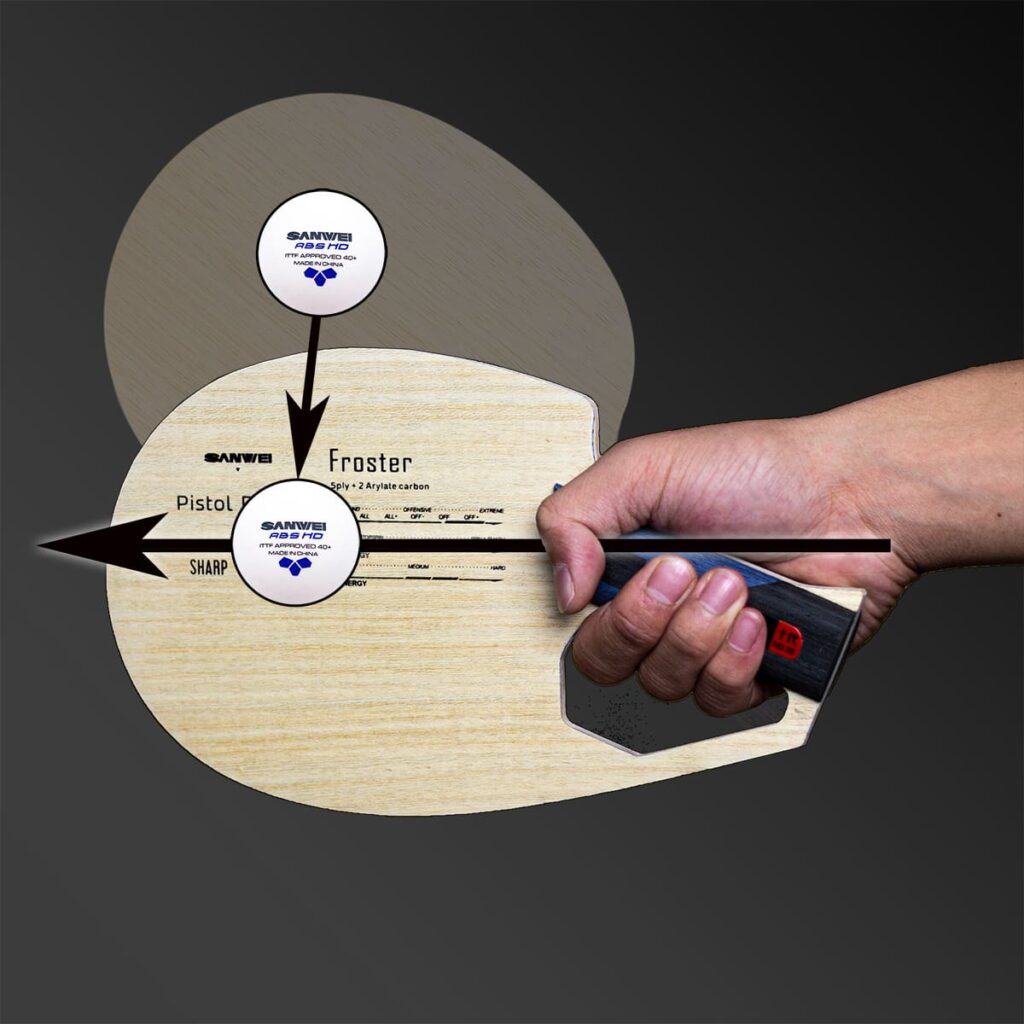
- Ergonomic Swing Design: The unique design aligns the hitting point with the natural extension of your arm.
- Dual-Channel Force Guidance: Simplified movements enhance power and speed by up to 15%, giving you a competitive edge
- Anti-Rotation Palm Support: The built-in anti-rotation palm support stabilizes the racket
- Guided Motion for Shortened Training Cycles: The Pistol Racket’s design promotes proper technique and reduces errors during training.
- More structures are available for selection.
- FL/ST handles are available to suit players of varying skill levels.
- Free Shipping Worldwide!
3. Amateur Players Often Use Too Much Arm Strength
When players want to hit harder, their first instinct is often to swing their arms faster and grip the racket more tightly.
Unfortunately, this can make their movements less consistent.
Excessive tension can restrict the natural movement of the forearm and wrist. It can also make it harder to coordinate body rotation with the racket’s acceleration.
As a result, one shot may be powerful, while the next loses speed or control.
Good power comes from coordination. Your legs, body, arm, and racket need to work together rather than compete with one another.
Try practicing at around 60–70% of your maximum effort. Focus on smooth acceleration, clean contact, and balance after the stroke. Once the movement becomes reliable, increase the intensity gradually.
You may discover that a relaxed, well-coordinated swing produces better results than simply trying to hit harder.
4. Your Grip May Be Making Consistency More Difficult
This is another factor I pay close attention to when thinking about table tennis equipment.
The racket is the final connection between your body and the ball. If your grip feels uncomfortable or forces you to make small corrections during the swing, it may be harder to maintain a consistent racket position.
Traditional FL shakehand handles work well for many players. However, not every player feels equally comfortable with the same handle design.
This was one of the reasons behind my development of the Pistol Racket.
Its handle uses a different design intended to align the hitting position more naturally with the extension of the forearm. The idea is to create a more intuitive relationship between the hand, forearm, and racket.
For some players, this may make it easier to find a comfortable forehand position and repeat the same basic movement without constantly adjusting their grip.
The Pistol Racket also incorporates our concept of dual-channel power transmission, which focuses on transferring force efficiently through the stroke.
These design ideas are intended to support both repeatable movement and effective power transfer.
Of course, a different handle cannot automatically correct poor footwork or replace proper training. But if your current grip makes it difficult to find a natural and comfortable position, the way you hold your racket is worth examining.
5. Amateur Players Often Practice the Result Instead of the Movement
When amateur players practice, they naturally pay attention to whether the ball lands on the table.
That matters, of course. But if you focus only on the result, you may overlook the movement that produced it.
A ball can land on the table even when your posture is poor. Likewise, a technically good stroke can occasionally miss because of timing or placement.
If you judge every stroke only by its outcome, it becomes difficult to identify which habits are helping you and which ones are holding you back.
I recommend dividing your practice into two stages.
First, train the movement. Use controlled strokes and pay attention to your balance, contact point, racket angle, and recovery.
Then, train the result. Increase the speed, vary the placement, and introduce more realistic rally situations.
This approach helps you develop technique that works beyond predictable practice conditions.
6. Why Does Your Technique Fall Apart During Matches?
Even players who have a reasonably good basic stroke can become inconsistent during competition.
The reason is that matches demand more than technique. You must read the opponent, move into position, make decisions quickly, and manage the pressure of the score.
When you become nervous, you may grip the racket more tightly, rush your swing, or try to finish the point too early.
These changes can disrupt movements that normally feel comfortable.
One solution is to make your training progressively more challenging. Begin with predictable rallies, move to random placements, and then practice short games with score pressure.
Develop a simple reminder for difficult moments, such as “get into position early” or “relax and finish the stroke.”
The more often you practice your technique under varied conditions, the easier it becomes to rely on it during a match.
Final Thoughts
Why is it so difficult for amateur players to maintain consistent strokes?
Usually, several factors are involved: an unstable basic technique, insufficient footwork, excessive muscle tension, an uncomfortable grip, or training that focuses too heavily on whether the ball lands on the table.
The solution is not to change everything at once.
Start with a comfortable, repeatable movement. Improve your positioning, learn to transfer power efficiently, and practice until your basic stroke becomes familiar enough to use without overthinking every detail.
Equipment can play a supporting role, too. The Pistol Racket was developed around the idea that a more natural relationship between the hand, forearm, and racket may help players establish a more repeatable swing.
After decades of working with table tennis equipment, I believe that the best improvements often come from making the fundamentals simpler and more reliable.
You don’t need to make every shot more complicated.
You need to make your good shots easier to repeat.
Su Zhimin
Founder of SANWEI Sports