Have you ever tried to hit the opponent’s wide forehand, only to send the ball straight into the middle of the table?
Or perhaps you see an open space and try to place the ball there, but your shot goes long or lands in the net.
This is a common frustration among amateur table tennis players. You know where you want the ball to go, but getting it there consistently is another matter.
After years of working with table tennis players and equipment, I have found that good placement is not simply about having a good feel for the ball. It starts with controlling your racket and repeating your movement.
Let’s look at how you can improve it.
1. Control Your Racket Before You Try to Control the Ball
Many players think placement is mainly about aiming. They look at an open area of the table and try to direct the ball toward it.
But the ball does not respond to your intention. It responds to the racket at the moment of contact.
Your racket angle, swing direction, contact point, and racket speed all influence the ball’s trajectory. Spin adds another layer, changing how the ball curves through the air and bounces on the table.
If these elements change unpredictably, your placement will change too—even if you are aiming at exactly the same spot.
That is why I recommend building a reliable basic stroke first.
Before trying to hit the extreme corners, practice directing the ball to a larger target area. Focus on making clean contact with a stable racket face and a repeatable swing.
Once you can consistently reach that area, gradually make the target smaller.
Accurate placement begins with predictable contact.
2. Your Contact Point Matters More Than You Think
One of the most common reasons for inconsistent placement is a changing contact point.
Imagine hitting a forehand topspin slightly in front of your body. Now imagine making the same swing when the ball has moved closer to your body or dropped lower than expected.
Even if your arm follows a similar path, the angle and direction of contact may be different.
When you contact the ball in a comfortable position, you generally have more room to coordinate your body rotation, forearm movement, and racket angle.
When you are late or reaching awkwardly, you may compensate with your wrist or change the direction of your swing at the last moment.
This makes accurate placement much harder.
My advice is simple: pay attention to your positioning before focusing on your aim. Move your feet early, maintain your balance, and try to contact the ball at a point where you can swing naturally.
You cannot expect the same level of control from a well-balanced stroke and a desperate recovery shot.
3. Learn to Adjust Direction Without Changing Everything
When players want to hit a different area of the table, some change their entire swing.
They may rotate their body too much, alter their racket angle dramatically, or force their wrist to redirect the ball.
This can work occasionally, but it often makes the stroke less predictable.
Instead, learn to make controlled adjustments.
For example, when practicing forehand topspin, pay attention to how your contact direction and racket angle influence the ball’s destination. Keep your basic movement familiar while making small, deliberate changes.
You should also remember that placement is connected to speed and spin. A faster shot with heavy topspin behaves differently from a slower shot with less spin, even when both are directed toward the same area.
Train these variables progressively rather than changing speed, spin, and direction all at once.
The more clearly you understand how each adjustment affects the ball, the easier it becomes to place your shots intentionally.
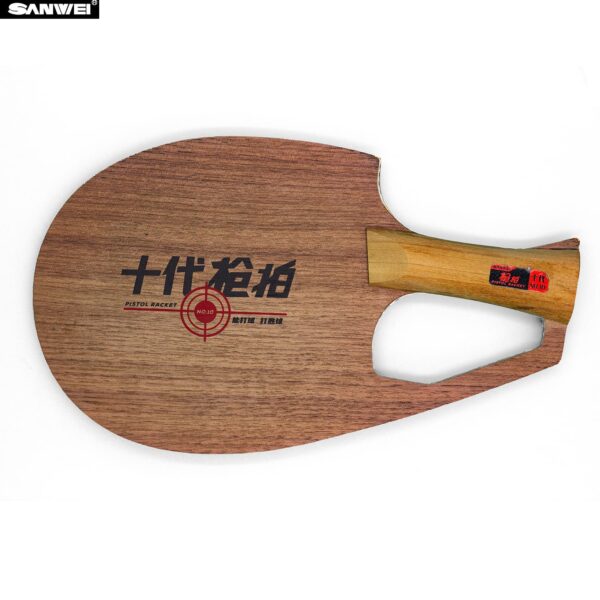
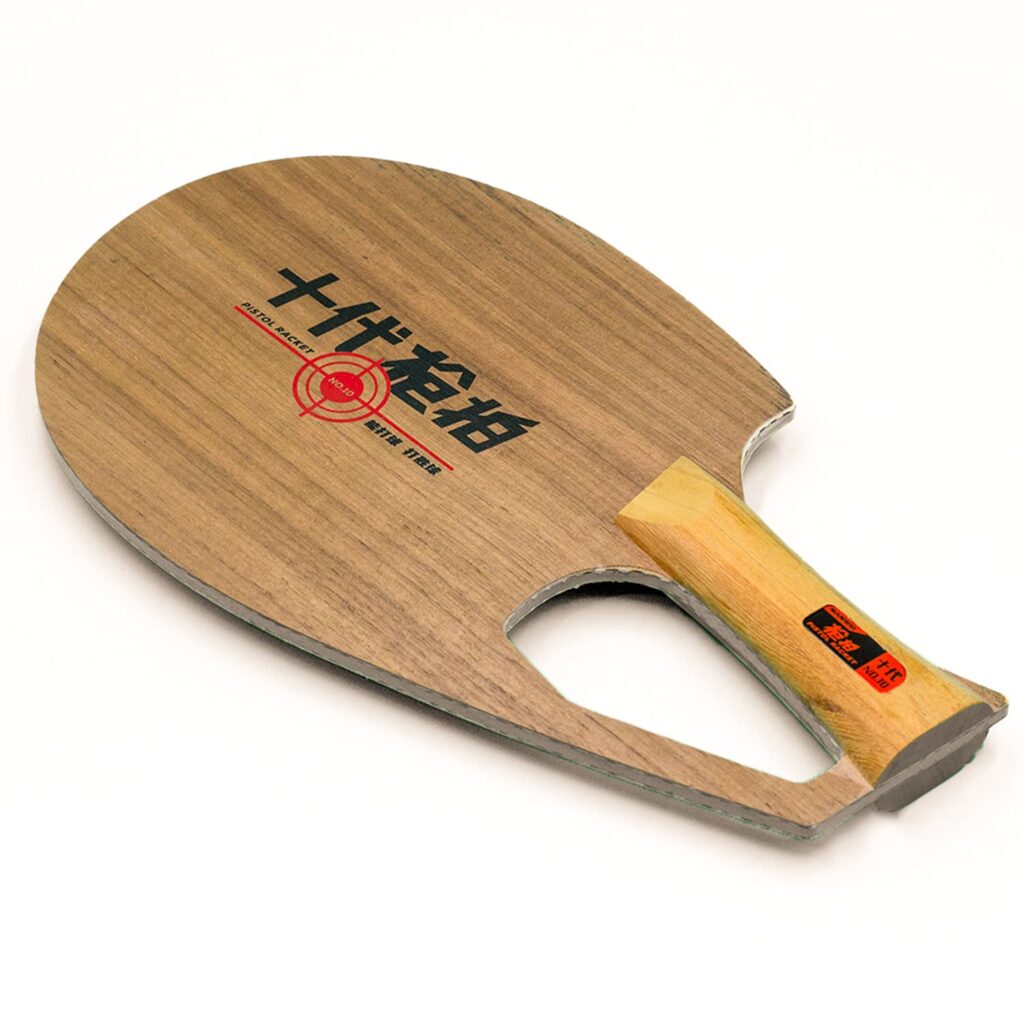
Pistol Racket 10th JTTA Approved
- ITTF Approved: Fully compliant with ITTF regulations, the Sanwei Pistol Racket is approved for use in any level of table tennis competition, ensuring you stay competitive at all times
- Officially Approved by JTTA, It can be used in competitions in Japan.
- Ergonomic Swing Design: The unique design aligns the hitting point with the natural extension of your arm.
- Dual-Channel Force Guidance: Simplified movements enhance power and speed by up to 15%, giving you a competitive edge
- Anti-Rotation Palm Support: The built-in anti-rotation palm support stabilizes the racket
- Guided Motion for Shortened Training Cycles: The Pistol Racket’s design promotes proper technique and reduces errors during training.
- Free Shipping Worldwide!
4. A Stable Grip Helps You Control the Racket Face
This is another important point.
If your grip is uncomfortable or your hand keeps making unnecessary adjustments during the swing, it can be difficult to maintain a predictable racket face.
Some players try to solve this by gripping the racket more tightly. But excessive tension can make the forearm stiff and interfere with the natural movement of the wrist.
You need a grip that is secure enough to control the racket but relaxed enough to allow the stroke to flow naturally.
This is one of the ideas behind my development of the Pistol Racket.
Unlike a traditional FL shakehand handle, the Pistol Racket uses a different handle design intended to align the hitting position more naturally with the extension of the forearm.
The goal is to create a more intuitive relationship between the hand, forearm, and racket, helping players establish a comfortable and repeatable basic hitting position.
For players who struggle with inconsistent forehand control, this design may make it easier to maintain their basic posture and avoid unnecessary adjustments during the swing.
The Pistol Racket also incorporates our concept of dual-channel power transmission, focusing on efficient force transfer through the stroke.
Of course, placement still depends on technique, timing, and practice. No handle design can automatically send every ball to the desired location. But equipment that feels natural in your hand can be a useful part of building more consistent control.
5. Don’t Confuse Placement With Playing Slowly
There is a common misconception that accurate players must hit the ball gently.
That is not true.
Good placement means being able to direct the ball where you want it to go while choosing an appropriate level of speed and spin.
Sometimes, a controlled shot to the opponent’s elbow is more effective than a powerful shot toward the corner. At other times, a fast, wide-angle topspin is exactly what you need.
The important thing is to choose your target according to the situation.
For beginners, I recommend prioritizing control before adding more power. For more experienced players, the next step is to maintain placement accuracy while increasing speed and spin.
You want your technique to remain reliable as the difficulty increases—not just when you are hitting comfortable balls.
6. Three Exercises to Improve Your Placement
Here are three practical exercises you can incorporate into your regular training.
Exercise 1: Large-target forehands
Choose the left half or right half of your opponent’s side of the table. Hit 20 forehands toward your chosen area without trying to hit the lines.
Focus on your contact point and racket angle. Once you can consistently reach the target area, make the target smaller.
Exercise 2: Alternate two locations
Ask your partner to block the ball back to your forehand. Alternate between a cross-court target and a down-the-line target.
Don’t rush. Try to maintain a similar preparation and basic swing while adjusting your direction deliberately.
Exercise 3: Placement under pressure
Play a short game in which you earn an extra point for placing a controlled attack into a chosen target area.
This encourages you to think about placement during realistic rallies instead of only during repetitive drills.
One final tip: don’t judge your progress by a single perfect shot. Look at how many balls you can direct toward your target over a series of attempts.
Consistency is a much better measure of improvement than occasional accuracy.
Final Thoughts
How can you improve your placement control in table tennis?
Start by making your contact more predictable. Improve your footwork, establish a stable racket face, and learn to adjust the direction of your stroke without disrupting your entire movement.
Then practice progressively: large targets first, smaller targets later, and finally placement under match pressure.
At SANWEI, this practical approach also guides the development of the Pistol Racket. Its handle design aims to create a more natural relationship between the hand, forearm, and racket, helping players work toward a more repeatable stroke.
But remember, good placement is not about forcing the ball toward a target. It is about developing enough control that you can choose your target and trust your technique to execute the shot.
When your contact becomes predictable, placement becomes a skill you can train—not a matter of luck.
Su Zhimin
Founder of SANWEI Sports