
Have you been playing table tennis for years, but feel that your level is no longer improving?
You practice regularly, play matches every week, and have developed a reasonably strong forehand. Yet you keep making the same mistakes, struggle against the same opponents, and find it difficult to take your game to the next level.
I have met many players in this situation.
The good news is that reaching a plateau does not necessarily mean you have reached your limit. In many cases, it means that the habits and training methods that helped you improve in the beginning are no longer enough.
After decades of working with table tennis equipment and players, I believe that breaking through a plateau requires more than practicing harder. You need to identify what is holding you back and make your training more effective.
Here are six things I recommend.
1. Find the Real Reason You Keep Losing Points
The first step is to stop trying to improve everything at once.
When a player feels stuck, it is tempting to work on a new serve, learn a different topspin technique, change the grip, and practice more powerful attacks—all at the same time.
But this makes it difficult to identify the real problem.
Instead, look at your recent matches and ask yourself where you lose the most points.
Is your first attack too inconsistent? Do you struggle against heavy backspin? Does your forehand break down when you have to move? Or do you make too many unforced errors when the score is close?
These are very different problems, and each requires a different solution.
For example, if your forehand is powerful but inconsistent, simply practicing harder forehands may reinforce the same mistakes. You may need to work on your contact point, body position, and racket-face control instead.
Choose one major weakness and focus on it for several weeks.
The fastest way forward is often to solve the problem that costs you the most points.
2. Rebuild Your Fundamentals Instead of Adding More Complexity
As players gain experience, they often assume that improvement means learning more advanced techniques.
Sometimes it does. But more often, the next breakthrough comes from improving the fundamentals they already have.
Consider the forehand topspin.
You may already know how to generate speed and spin. But can you maintain the same basic hitting position when the ball arrives slightly wider? Can you produce a reliable attack when you are moving? Can you recover quickly enough to attack the next ball?
If the answer is no, your technique may not yet be stable enough for more advanced play.
Return to controlled drills and examine the details:
- Is your body balanced before you swing?
- Is your contact point consistent?
- Does your racket follow a natural swing path?
- Are you generating power through coordinated movement rather than arm strength alone?
- Can you recover immediately after the shot?
These details may seem basic, but they determine how reliably you can use your technique during a match.
You do not need to rebuild your entire game. You need to make your existing strengths more dependable.
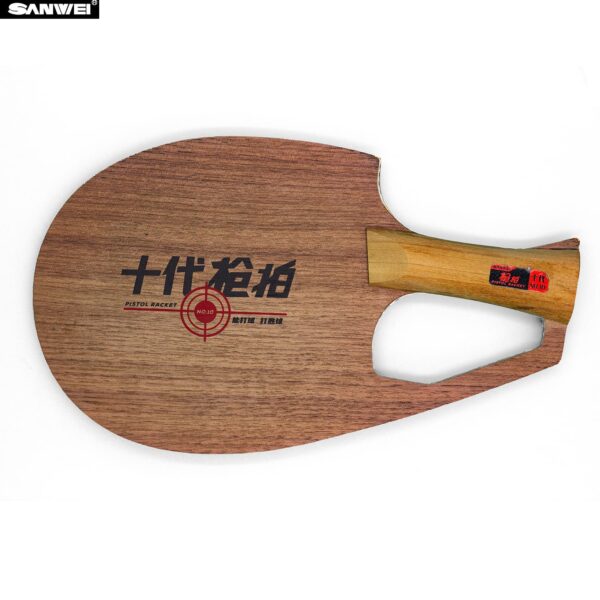
Pistol Racket 10th JTTA Approved
- ITTF Approved: Fully compliant with ITTF regulations, the Sanwei Pistol Racket is approved for use in any level of table tennis competition, ensuring you stay competitive at all times
- Officially Approved by JTTA, It can be used in competitions in Japan.
- Ergonomic Swing Design: The unique design aligns the hitting point with the natural extension of your arm.
- Dual-Channel Force Guidance: Simplified movements enhance power and speed by up to 15%, giving you a competitive edge
- Anti-Rotation Palm Support: The built-in anti-rotation palm support stabilizes the racket
- Guided Motion for Shortened Training Cycles: The Pistol Racket’s design promotes proper technique and reduces errors during training.
- Free Shipping Worldwide!
3. Train the Shots You Need in Matches, Not Just the Shots You Enjoy
There is a big difference between practicing a stroke and learning to use it effectively in competition.
During regular practice, you may hit hundreds of comfortable forehands. But in a match, your opponent will deliberately move you away from your preferred position, vary the spin, and force you to make decisions under pressure.
If your training does not reflect these situations, your improvement may remain limited to predictable rallies.
Try progressing through three stages.
Stage 1: Controlled repetition
Practice the movement at a comfortable speed. Focus on clean contact and a repeatable basic posture.
Stage 2: Variable conditions
Introduce different placements, speeds, and spins. Learn to adjust your positioning without losing control of your stroke.
Stage 3: Match situations
Practice realistic patterns, such as serve, third-ball attack, and recovery for the next shot. Play short games with a specific tactical objective.
This progression helps connect technical ability with actual match performance.
The goal is not simply to hit a better ball when everything is comfortable. It is to maintain your technique when the situation becomes difficult.
4. Improve Your Power Transfer, Not Just Your Swing Speed
One of the most common limitations I see in developing players is the tendency to equate power with effort.
They swing harder, tighten their grip, and try to accelerate their arm as much as possible.
But a powerful shot depends on how efficiently the body and racket work together.
Your legs help establish a stable position. Your body rotation contributes to the stroke. Your arm and forearm accelerate the racket, and the racket transfers energy to the ball at contact.
If these movements are poorly coordinated, additional effort may produce little improvement in the quality of your shot.
Instead of asking, “How can I swing harder?”, try asking, “How can I transfer my power more efficiently?”
Practice smooth acceleration, maintain a comfortable grip, and focus on making solid contact. Increase your speed gradually while preserving your basic movement.
This is also one of the principles behind the Pistol Racket.
Its handle design aims to align the hitting position more naturally with the extension of the forearm, creating a more intuitive relationship between the hand, forearm, and racket. The design also incorporates our concept of dual-channel power transmission, focusing on efficient force transfer through the stroke.
For players whose forehand movement feels awkward or difficult to repeat, this different handle design may offer a useful alternative.
The objective is not to create power through equipment alone. It is to help the player work toward a more natural and repeatable movement.
5. Examine Whether Your Equipment Supports Your Technique
Most players spend a great deal of time thinking about rubber hardness, blade speed, and spin potential.
These factors matter, but I would also encourage you to consider something more fundamental: does your equipment feel natural in your hand?
If you constantly adjust your grip, struggle to maintain your preferred hitting position, or feel that your wrist has to compensate for the racket’s position, your equipment may not be the best match for your technique.
This does not mean a traditional shakehand racket is unsuitable. Many excellent players use traditional FL handles very successfully.
However, different handle designs can create different relationships between the hand, forearm, and racket.
The Pistol Racket was developed to explore that relationship. Its design is intended to make the racket’s position feel more naturally connected to the forearm, particularly for players who rely on forehand attacks.
If you are considering a change, identify the problem you want to solve first. Then test the new setup through controlled drills and match situations rather than judging it after a few shots.
A different racket may help address a specific limitation, but it should complement your training—not replace it.
6. Learn to Measure Improvement Properly
Another reason players feel stuck is that they judge their progress too generally.
They might say, “My forehand still isn’t good enough,” without identifying what that actually means.
A better approach is to measure a specific skill.
For example, you could track:
- The percentage of first attacks that land on the table.
- The number of controlled forehands you can hit consecutively.
- How well you maintain your technique during random-placement drills.
- The number of unforced errors you make in a short match.
- Your success rate against a particular type of serve or opponent.
You do not need complicated equipment or professional statistics. A notebook and a simple record of your training results can be enough.
Review your progress every few weeks. If a particular exercise is not improving the skill you are targeting, change the exercise rather than repeating it indefinitely.
This gives your training a clear purpose and helps you recognize small improvements that might otherwise go unnoticed.
7. Be Patient Enough to Let New Habits Become Natural
There is one final point I want to emphasize.
When players try to change their technique, they often expect immediate results. If the new movement feels uncomfortable or their performance temporarily drops, they quickly return to their old habits.
But a movement that has been repeated for years will not disappear overnight.
When making a technical adjustment, begin at a manageable speed. Practice until you can reproduce the movement comfortably, then gradually introduce more difficult conditions.
Avoid changing several major elements of your technique simultaneously. Give each adjustment enough time to become familiar before evaluating its effectiveness.
Progress is rarely a straight line. Some training sessions will feel excellent, while others may seem disappointing.
What matters is whether your underlying technique and decision-making are becoming more reliable over time.
Final Thoughts
How can amateur table tennis players break through their performance plateau?
Start by identifying the weakness that costs you the most points. Strengthen your fundamentals, practice under realistic conditions, improve your power transfer, and measure your progress instead of relying on general impressions.
Also, make sure your equipment supports the way you want to play. The Pistol Racket is one option for players looking for a more natural relationship between the hand, forearm, and racket, particularly when developing a repeatable forehand attack.
But remember: no single training method, technical adjustment, or racket can guarantee a breakthrough.
After more than three decades in table tennis, I believe the most important question is not how much more you can practice. It is whether you are practicing the right thing.
You break through a plateau when you stop repeating the same habits and start improving the specific details that limit your game.
Identify the problem. Work on it systematically. Give yourself time to adapt.
Your next improvement may be closer than you think.
Su Zhimin
Founder of SANWEI Sports