Have you ever bought a new table tennis blade because you wanted more power, changed your rubber because you wanted more spin, and then switched to another setup because your control still wasn’t good enough?
At first, the new equipment feels exciting. Your shots may feel faster, the ball may grip differently, and you start imagining how much better you could play.
But after a few weeks, something familiar happens. Your mistakes return, your results remain roughly the same, and you begin wondering whether you need to try another blade or rubber.
I have seen this happen to many amateur players.
My view is straightforward: equipment can influence your performance, but changing equipment cannot automatically solve a technical problem.
If you have tried many setups without making meaningful progress, it may be time to look beyond your racket.
1. You May Be Trying to Solve a Technical Problem With Equipment
Every blade and rubber has its own characteristics. Some setups provide a more direct response, while others offer a softer feel or a different balance between speed, spin, and control.
These differences matter.
However, imagine that your forehand contact point changes on every shot. Sometimes you contact the ball too close to your body, sometimes too far in front, and sometimes you are still moving when you hit it.
Changing to a faster blade will not correct those problems. In fact, the extra speed may make your errors more obvious.
The same applies to spin. If your brushing contact is inconsistent, a different rubber may change the feeling of the ball, but it will not automatically give you a reliable topspin technique.
Before changing equipment, ask yourself a simple question:
What specific problem am I trying to solve?
If you cannot clearly identify the problem, it will be difficult to know whether a new setup is actually helping.
2. Every Equipment Change Requires Adaptation
Even when a new racket suits your playing style, you still need time to adapt.
A different blade may have a different weight, balance, flex, or response at contact. A new rubber may grip the ball differently or respond differently to incoming spin.
Your old technique was developed around the equipment you used before. When you change your setup, the timing and feel you are accustomed to may no longer work exactly the same way.
If you switch equipment every few weeks, you may never give yourself enough time to understand the new setup.
You end up spending more time adapting than improving.
My advice is to avoid judging a new racket after only a few training sessions. Give yourself a reasonable adaptation period and evaluate it in a consistent set of drills and match situations.
Unless the equipment has a clear problem, resist the temptation to switch again just because the first few sessions feel unfamiliar.
3. Faster Equipment Does Not Necessarily Mean Better Performance
One of the most common mistakes I see is choosing equipment based on maximum speed or spin.
Players often believe that if they can make the ball faster, they will become more dangerous opponents.
But table tennis is not a competition to see who can hit the fastest ball.
A powerful shot is useful only when you can control its direction, trajectory, and timing.
If a fast blade makes your forehand difficult to control, a setup with a more manageable response may help you play more effectively. Likewise, a very hard or demanding rubber may not be the best choice if you struggle to generate consistent contact.
The right equipment depends on your technique, physical abilities, playing style, and current level.
For some players, the best upgrade is not more speed. It is a setup that allows them to execute their existing strokes more consistently.
4. You May Be Changing Equipment Instead of Fixing Your Weaknesses
There is also a psychological side to equipment changes.
When your game stops improving, buying something new feels like taking action. You have a new blade to test, a different rubber to understand, and a fresh reason to feel motivated.
There is nothing wrong with enjoying equipment. Table tennis equipment is part of the fun, and finding a setup you love can make training more enjoyable.
The problem begins when testing equipment replaces purposeful practice.
If your backhand receive is weak, changing your forehand rubber may not help. If you lose points because your footwork is slow, a more expensive blade will not solve the underlying issue.
Instead, review your recent matches and identify where you are losing points.
Choose one weakness, design a training exercise around it, and track your results over several weeks.
You may find that this produces more improvement than another equipment change.
5. The Right Handle Can Matter More Than You Expect
Although I have emphasized the limits of equipment changes, I do not believe equipment is unimportant.
The right design can make a genuine difference to how naturally you hold the racket and execute your strokes.
For example, some players have difficulty maintaining a comfortable, repeatable forehand position with their existing handle. They may make unnecessary adjustments with their hand or wrist, especially when attacking repeatedly.
This was one of the considerations behind my development of the Pistol Racket.
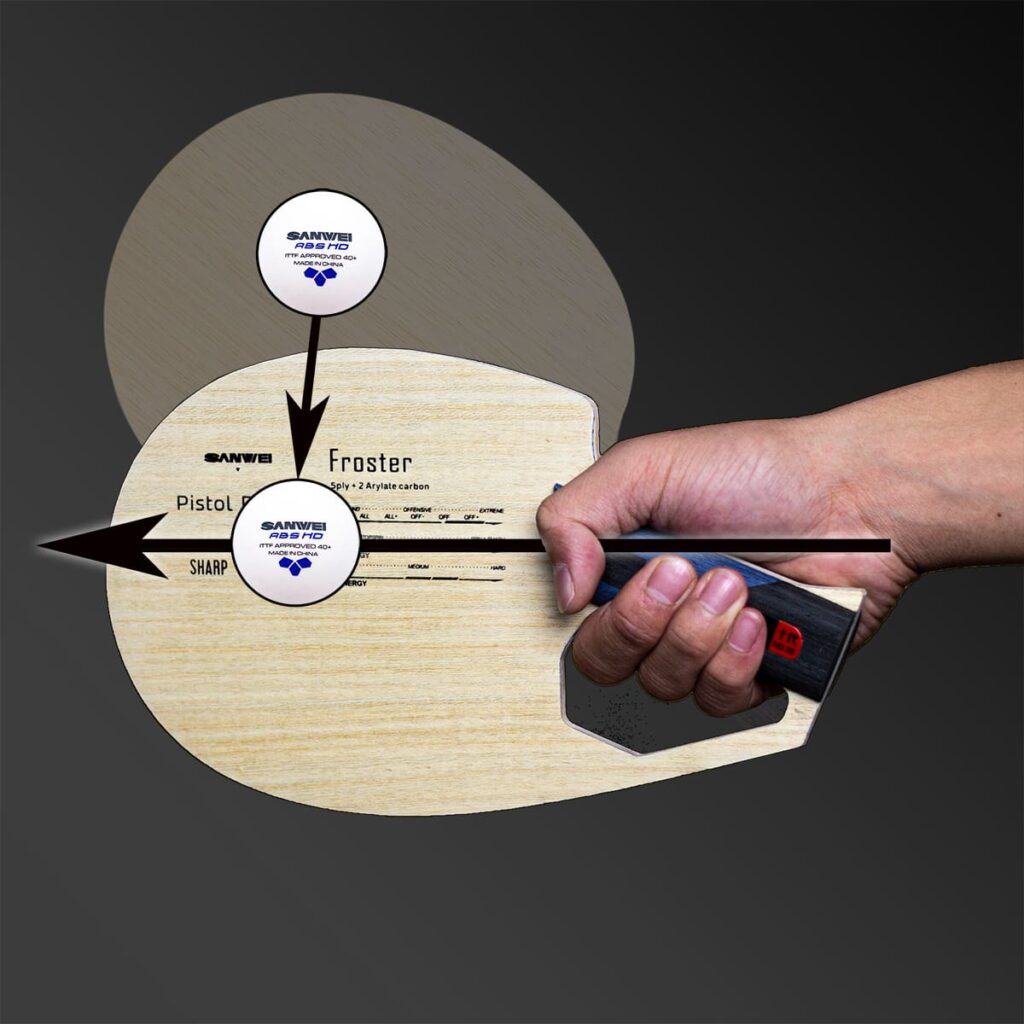
Unlike a traditional FL shakehand handle, the Pistol Racket uses a different handle design intended to align the hitting position more naturally with the extension of the forearm.
The goal is to create a more intuitive relationship between the hand, forearm, and racket, potentially helping players establish a more repeatable basic hitting posture.
The design also incorporates our concept of dual-channel power transmission, which focuses on transferring force efficiently through the stroke.
For a player whose main limitation is an uncomfortable grip or difficulty maintaining a natural forehand position, this different design may be worth exploring.
But if your main problem is poor footwork, inconsistent timing, or a lack of structured training, changing to the Pistol Racket will not automatically remove those limitations.
Good equipment should support the improvement you are working toward—not become a substitute for it.

Sanwei Pistol Racket 10th
- ITTF Approved: Fully compliant with ITTF regulations, the Sanwei Pistol Racket is approved for use in any level of table tennis competition, ensuring you stay competitive at all times
- Ergonomic Swing Design: The unique design aligns the hitting point with the natural extension of your arm.
- Dual-Channel Force Guidance: Simplified movements enhance power and speed by up to 15%, giving you a competitive edge
- Anti-Rotation Palm Support: The built-in anti-rotation palm support stabilizes the racket
- Guided Motion for Shortened Training Cycles: The Pistol Racket’s design promotes proper technique and reduces errors during training.
- More structures are available for selection.
- FL/ST handles are available to suit players of varying skill levels.
- Free Shipping Worldwide!
6. How Should You Evaluate a New Racket Properly?
If you genuinely believe your equipment is holding you back, I recommend using a more systematic approach.
Step 1: Identify one specific limitation.
For example, you may struggle to control your forehand when increasing speed, or you may find that your current setup feels uncomfortable during continuous attacks.
Step 2: Change as little as possible.
If you change your blade, rubber, thickness, and grip style simultaneously, it becomes difficult to determine which change made a difference.
Step 3: Use the same training exercises.
Test your setup with repeatable drills, such as controlled forehands, blocks, random placements, and match-like situations.
Step 4: Evaluate performance, not just first impressions.
A racket that feels exciting during the first ten minutes is not necessarily the one that helps you perform best over an entire match.
Look at your consistency, control, comfort, and ability to execute your normal game.
Step 5: Give yourself time to adapt.
A suitable setup should be evaluated after sufficient practice, not after a handful of shots.
This approach makes equipment selection more rational and helps you avoid spending money on changes that do not address your actual needs.
Final Thoughts
Why haven’t you improved despite trying so much table tennis equipment?
Perhaps the equipment was not right for your playing style. Perhaps you did not give yourself enough time to adapt. Or perhaps the biggest limitation was never your racket in the first place.
After more than three decades in table tennis, I believe that equipment and technique should work together.
At SANWEI, we develop products with the goal of helping players perform more naturally and effectively. The Pistol Racket, for example, explores how handle design can support a more intuitive forehand movement and efficient power transfer.
But no blade, rubber, or handle can replace consistent practice, good footwork, sound technique, and thoughtful match analysis.
Before buying your next racket, take a moment to identify what you really need to improve.
Sometimes, a different setup is the right decision.
Other times, the best investment you can make is another month of focused training.
Don’t keep searching for equipment that will magically improve your game. Find equipment that supports the game you are learning to build.
Su Zhimin
Founder of SANWEI Sports