Over the years, I’ve met many table tennis players who train several times a week but struggle to see meaningful improvement. Some spend hours practicing their forehand, others buy new blades and rubbers, and some constantly try to copy the techniques of professional players.
Yet their results remain almost the same.
Why does this happen?
In my experience, the fastest way to improve your table tennis skills is not simply to practice more. It is to identify the weaknesses that limit your performance, work on them systematically, and make sure your training translates into real matches.
Let me share a few principles that I believe can help players improve more efficiently.
1. Find Your Biggest Weakness First
One of the most common mistakes amateur players make is trying to improve everything at once.
They practice forehand loops, backhand attacks, serves, receives, footwork, and different tactical combinations—all without knowing which area is actually costing them the most points.
If your forehand is powerful but your backhand consistently breaks down under pressure, spending another hour perfecting your forehand may not make much difference to your match results.
Instead, ask yourself three questions:
- Which shots do I miss most often?
- Which situations make me uncomfortable during a match?
- What does my opponent repeatedly exploit against me?
Your answers will help you identify where your training time should go.
For some players, the biggest problem is an unstable contact point. For others, it is poor footwork, an unreliable serve receive, or an inability to handle fast attacks.
The quickest improvement often comes from fixing the weakness that costs you the most points—not from polishing the shot you already do best.
2. Build a Repeatable Technique Before Chasing More Power
Many players want to hit the ball harder, spin it more, or finish points with spectacular attacks. These are understandable goals, but power without consistency can become a liability.
A good stroke should be repeatable. You should be able to reproduce a similar movement, contact the ball at a similar position, and maintain reasonable control over the racket face.
Pay attention to the entire movement:
- Footwork: Get into position before the ball arrives.
- Body coordination: Use your legs and torso instead of relying entirely on your arm.
- Contact point: Strike the ball at a position that allows you to swing naturally.
- Racket angle: Make deliberate adjustments instead of constantly correcting the racket at the last moment.
- Recovery: Return to a balanced position after each stroke.
When these elements become more consistent, power and placement usually become easier to manage.
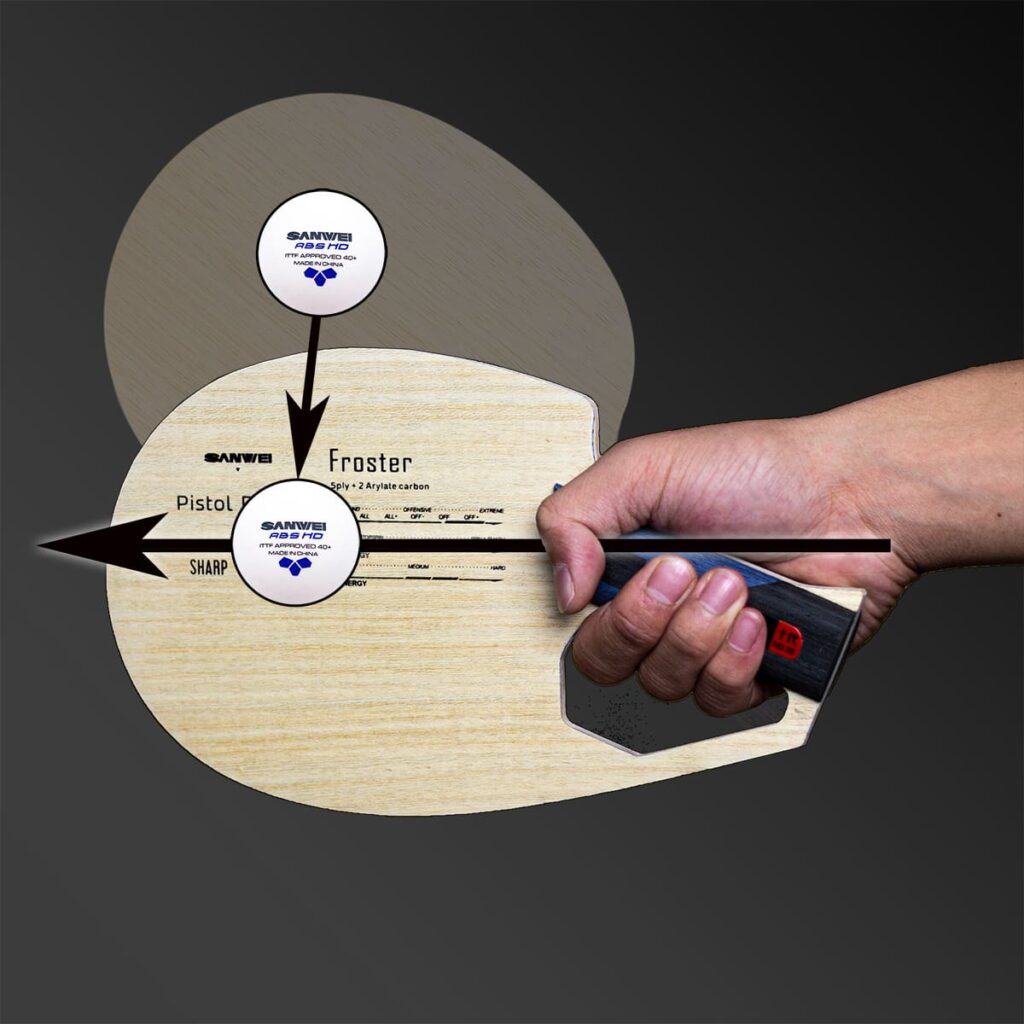
This is also why I believe racket design deserves attention. At SANWEI, we developed the Pistol Racket around the relationship between the hand, forearm, and racket. Its handle design is intended to make the racket feel more like a natural extension of the forearm, helping players develop a more repeatable stroke and transfer power more efficiently.
Of course, no racket can replace proper technique. But suitable equipment can make it easier to build good habits rather than constantly fighting against your own grip.
3. Practice With a Clear Purpose
There is a big difference between hitting hundreds of balls and deliberately improving a specific skill.
Suppose you want to improve your forehand attack. Simply looping the ball repeatedly may help you warm up, but it does not necessarily prepare you for match conditions.
A more effective session might look like this:
First, establish consistency. Practice the same forehand movement against a predictable ball, focusing on contact quality and balance.
Next, introduce movement. Alternate between two placements so you must adjust your feet and timing.
Then, add uncertainty. Ask your partner to vary the placement or depth of the ball.
Finally, practice the decision. Instead of attacking every ball, learn to recognize which balls are suitable for an aggressive shot and which require a controlled return.
This progression develops more than stroke mechanics. It trains you to use your technique under increasingly realistic conditions.
You do not need complicated drills to make progress. You need drills that target a specific weakness and become gradually more challenging as you improve.
4. Spend More Time Practicing the Situations That Decide Matches
A player can look excellent during a cooperative rally and still struggle badly in competition.
That is because matches introduce pressure, uncertainty, tactical decisions, and unfamiliar ball placement.
If you want to improve quickly, practice the situations that frequently determine your results.
For example:
- If you lose points after serving, practice the third-ball attack.
- If opponents repeatedly attack your receive, work on short receives, placement, and variation.
- If you make too many errors when moving sideways, train your footwork and recovery.
- If you become passive when rallies get difficult, practice transitioning from controlled shots to attacks.
- If you lose confidence when leading or trailing, play practice games with specific score-based challenges.
During practice matches, do not focus only on whether you win. Pay attention to why you win or lose points.
After each session, write down one or two recurring problems. Work on those problems in your next training session.
This simple habit can make your training much more focused.
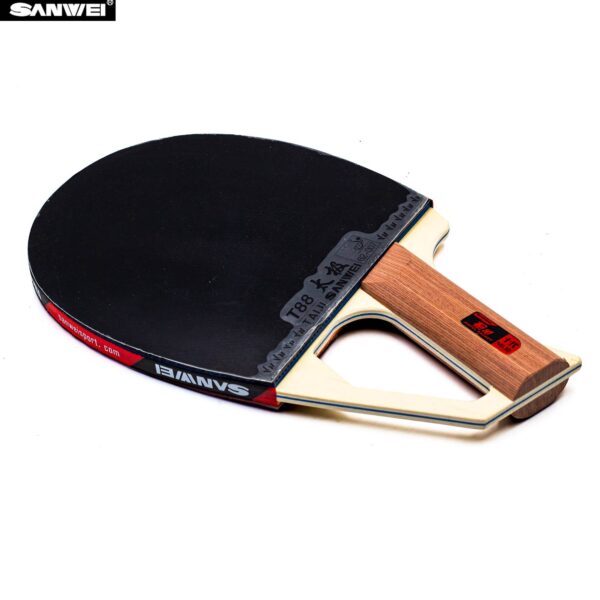
Sanwei Pistol Racket 10th Pre-Assemble Bat
- ITTF Approved: Fully compliant with ITTF regulations, the Sanwei Pistol Racket is approved for use in any level of table tennis competition, ensuring you stay competitive at all times
- Ergonomic Swing Design: The unique design aligns the hitting point with the natural extension of your arm.
- Dual-Channel Force Guidance: Simplified movements enhance power and speed by up to 15%, giving you a competitive edge
- Anti-Rotation Palm Support: The built-in anti-rotation palm support stabilizes the racket
- Guided Motion for Shortened Training Cycles: The Pistol Racket’s design promotes proper technique and reduces errors during training.
- Free Shipping Worldwide.
5. Learn to Relax Instead of Forcing Every Shot
One surprising obstacle to improvement is trying too hard.
When players want to hit a powerful shot, they often grip the racket too tightly, tense their shoulders, and force the movement. This can reduce fluidity and make timing less reliable.
Power does not come from keeping every muscle tense. Good strokes require coordinated effort, with relaxation between movements and appropriate acceleration at the right moment.
Try this during your next session:
- Keep your grip firm enough to control the racket, but avoid squeezing unnecessarily.
- Relax your shoulders between strokes.
- Focus on clean contact rather than maximum effort.
- Increase the speed of your swing only when your timing and balance are under control.
You may find that a smoother stroke produces a heavier, more consistent ball than one created through excessive effort.
For players who struggle to maintain a comfortable grip, it is also worth examining whether their handle shape suits their hand and playing style. Discomfort can encourage unnecessary adjustments and make it harder to reproduce the same movement.
6. Use Equipment That Supports Your Development
Equipment matters, but it is important to understand how it matters.
A faster blade or more powerful rubber may help an experienced player exploit existing strengths. For a developing player, however, additional speed can sometimes make control more difficult.
Rather than asking which racket is the fastest or which rubber produces the most spin, ask a more useful question:
Does this equipment help me perform the strokes I am trying to learn?
If you are working on controlled loops, you need equipment that gives you sufficient feedback and manageable control. If your technique is already stable and you need more attacking power, a different combination may be appropriate.
Handle design deserves the same consideration as blade and rubber performance. The grip affects how comfortably you hold the racket, how naturally you move your wrist and forearm, and how confidently you execute your strokes.
This is one reason we developed the SANWEI Pistol Racket. Its distinctive handle is designed to support a more natural forehand movement and more efficient power transfer, particularly for players who rely on attacking strokes.
The goal is not to promise instant improvement. It is to help players find equipment that works with their technique and training goals.
Once you find a suitable setup, give yourself enough time to adapt before changing equipment again. Constantly switching blades and rubbers can make it difficult to determine whether your technique is actually improving.
7. Measure Progress Instead of Relying on Feelings
Improvement is not always obvious from one training session to the next. Sometimes you feel worse because you are working on a weakness you previously ignored.
That is why I recommend tracking a few simple indicators.
For example, count how many of your first ten forehand attacks land on the table. Record how often you successfully receive a particular serve. Notice how frequently you lose points because of poor positioning rather than a genuinely difficult ball.
You can also record short videos of your strokes. Comparing footage from several weeks apart may reveal changes in balance, contact point, or recovery that are difficult to notice while playing.
Choose two or three measurements that relate directly to your current weakness. Review them every couple of weeks and adjust your training accordingly.
Do not expect every indicator to improve at the same speed. The important thing is to see whether your training is gradually changing your performance.
8. Follow a Simple, Consistent Training Plan
You do not need to train for several hours every day to make progress. You need to use the time you have effectively.
For a recreational player, a focused session could include:
- 10 minutes: Warm-up, basic control, and comfortable rallies.
- 20 minutes: Targeted practice on your biggest technical weakness.
- 15 minutes: Footwork or combinations that connect several strokes.
- 15 minutes: Match-like drills or practice games.
- 5 minutes: Review what went well and identify the next priority.
Adjust the duration to suit your schedule and experience. If you have less time, keep the same structure and shorten each section.
The key is continuity. A manageable plan that you follow consistently is usually more valuable than an ambitious plan that you abandon after a week.
Remember to warm up properly, allow time for recovery, and increase training intensity gradually. If you develop persistent pain, do not simply train through it.
Final Thoughts
If you ask me for the fastest way to improve at table tennis, my answer is simple: identify your biggest weakness, practice it with a clear purpose, and learn to reproduce your technique under match conditions.
Do not confuse more practice with better practice. Do not assume that more expensive equipment will solve a technical problem. And do not try to change every part of your game at once.
Choose one weakness, build a focused training routine around it, and measure your progress. Once that weakness becomes more manageable, move on to the next one.
After decades of working with table tennis equipment and players, I believe the most effective approach is to make every training session answer one question: What am I trying to improve today?
When you know the answer, your practice becomes more meaningful—and your progress has a much better chance of following.
Su Zhimin
Founder of SANWEI Sports