Have you ever noticed that some table tennis players seem to improve incredibly quickly?
Two players may start at roughly the same level and train for a similar amount of time. Yet, after a few months, one player has developed much better control, more powerful attacks, and greater confidence in matches, while the other seems to be stuck in the same place.
Why does this happen?
After many years in the table tennis industry, I’ve come to believe that rapid improvement rarely comes down to talent alone. The way a player practices, responds to mistakes, and understands their own game can make a tremendous difference.
Here are several habits I often associate with players who make progress faster.
1. They Know What They Need to Improve
Players who improve quickly tend to have a clear idea of their weaknesses.
Instead of saying, “My forehand isn’t good enough,” they ask more specific questions.
Am I making contact with the ball too late? Is my racket face unstable? Am I losing balance after attacking? Do I make more mistakes when the ball comes to my wide forehand?
These questions lead to more useful training.
For example, if your forehand attacks frequently go long, simply trying to close the racket face more may not solve the problem. Your contact point, swing direction, timing, or balance could also be contributing factors.
The more accurately you identify the problem, the less time you waste practicing the wrong solution.
My advice is simple: after every training session, identify one recurring mistake and think about what caused it. You don’t need to fix everything immediately. You just need to know what to work on next.
2. They Practice With Purpose, Not Just Repetition
Repetition is essential in table tennis, but repetition alone does not guarantee improvement.
Imagine two players practicing their forehand loops for thirty minutes.
The first player simply hits as many balls as possible. The second player focuses on maintaining balance, contacting the ball at a consistent point, and recovering quickly after every shot.
Both players are practicing the forehand, but they are not necessarily learning the same things.
The second player has a clear objective and can evaluate whether each repetition is helping.
As their technique becomes more reliable, they can gradually introduce movement, variation, and pressure. This helps turn a technically sound stroke into a skill that works during actual matches.
When you practice, give yourself one specific goal. It might be keeping ten consecutive loops on the table, maintaining your balance during wide-ball exchanges, or improving the placement of your third-ball attack.
Good practice is not simply about how many balls you hit. It is about what each repetition teaches you.
3. They Build Stable Technique Before Chasing Power
Many players want to attack harder as soon as they begin improving. They focus on racket speed, stronger loops, and finishing points with one powerful shot.
But players who develop efficiently often understand that consistency comes first.
A reliable stroke depends on several elements working together: footwork, body positioning, contact point, racket angle, and the coordination of the arm and body.
If these elements change significantly from one shot to the next, your results will also vary. You might hit one excellent attack followed by three unforced errors.
A stable technique gives you a foundation to build on. Once you can reproduce the movement reliably, it becomes much easier to increase speed and power without sacrificing control.
This is also why the relationship between your hand, forearm, and racket matters.
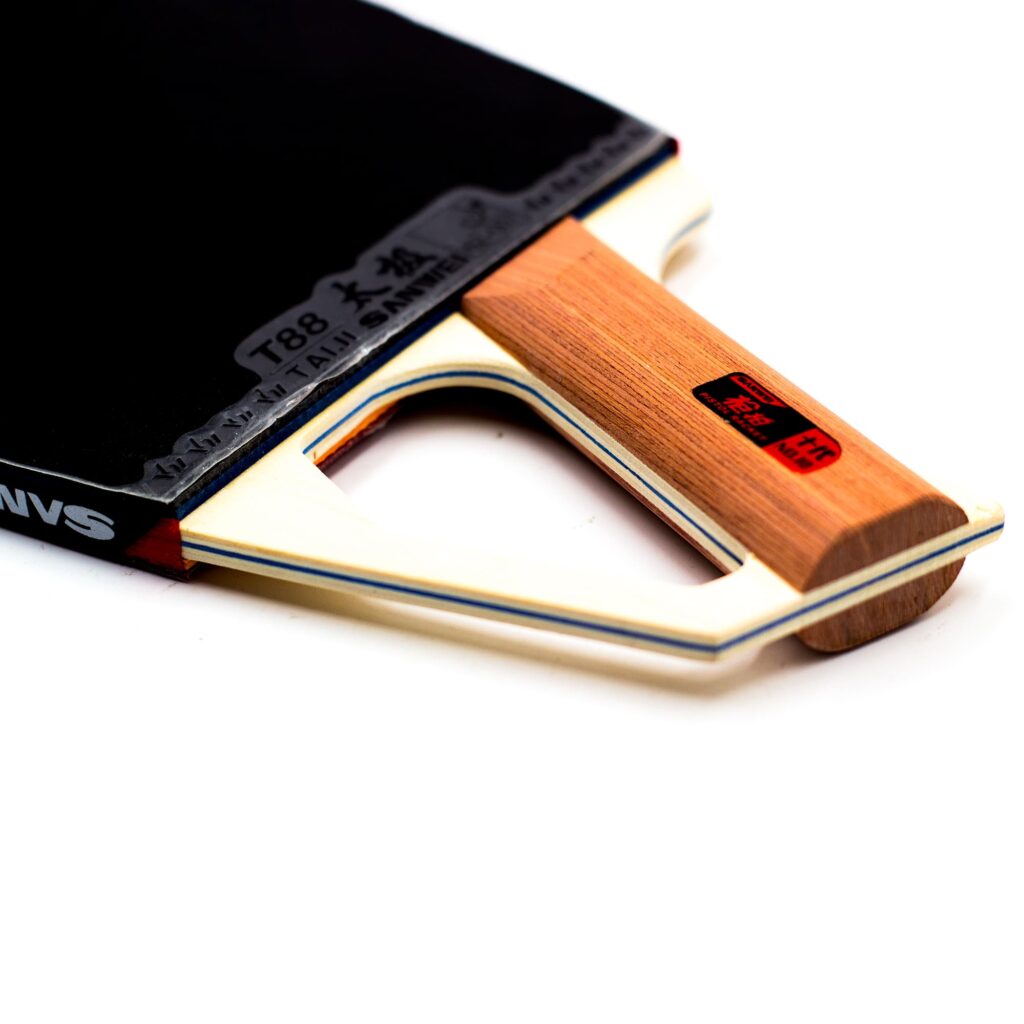
At SANWEI, we developed the Pistol Racket with a distinctive handle designed to support a more natural relationship between the racket and forearm. For players whose grip or forehand movement feels awkward, this design may help them develop a more repeatable stroke and transfer power more efficiently.
Of course, no handle can automatically correct every technical problem. Players still need to develop proper footwork, timing, and coordination. The right equipment should support that process, not replace it.
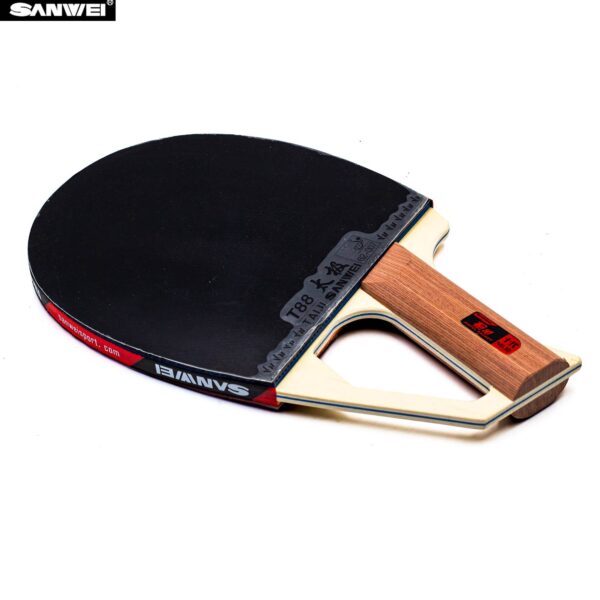
Sanwei Pistol Racket 10th Pre-Assemble Bat
- ITTF Approved: Fully compliant with ITTF regulations, the Sanwei Pistol Racket is approved for use in any level of table tennis competition, ensuring you stay competitive at all times
- Ergonomic Swing Design: The unique design aligns the hitting point with the natural extension of your arm.
- Dual-Channel Force Guidance: Simplified movements enhance power and speed by up to 15%, giving you a competitive edge
- Anti-Rotation Palm Support: The built-in anti-rotation palm support stabilizes the racket
- Guided Motion for Shortened Training Cycles: The Pistol Racket’s design promotes proper technique and reduces errors during training.
- Free Shipping Worldwide.
4. They Learn From Mistakes Instead of Repeating Them
Making mistakes is unavoidable. What matters is whether you learn anything from them.
Some players miss a shot, become frustrated, and immediately try to hit the next ball harder. They repeat the same movement without understanding why the previous shot failed.
Players who improve faster are more likely to pause and examine the situation.
Was the ball too deep for the shot they attempted? Were they out of position? Did they rush their swing? Was the decision itself wrong, even if the technique was reasonable?
There is an important difference between a technical error and a tactical error.
Sometimes your stroke is fine, but you choose to attack a ball that would have been better returned with control. Other times, you make the right decision but execute it poorly.
Learning to distinguish between these situations helps you choose the right correction.
You can even keep a small training notebook. Write down the two most common reasons you lost points during a practice match, then use those observations to plan your next session.
Over time, this habit can make your training much more efficient.
5. They Practice Under Conditions That Resemble Real Matches
A player may look excellent during predictable drills but struggle when an opponent changes the speed, spin, or placement of the ball.
This is because executing a stroke and choosing the right stroke are two different skills.
During structured practice, you often know where the next ball will go. In a match, you must read your opponent, move into position, judge the incoming ball, and make a decision in a fraction of a second.
Players who progress quickly gradually bridge this gap.
They begin with predictable drills to establish technique, then introduce more variation. Eventually, they practice combinations and point-based situations that require them to make decisions under pressure.
For example, instead of practicing forehand attacks exclusively against a fixed ball, ask your partner to vary the placement. You must then decide whether to attack, control the ball, or reposition yourself for the next shot.
This kind of practice helps your training transfer into competition.
6. They Adapt Quickly Without Changing Everything at Once
Some players are good at making adjustments.
If a technique isn’t working, they are willing to reconsider their grip, timing, footwork, or tactical approach. They listen to coaching, observe other players, and test different solutions.
However, there is a trap here: changing too many things at once.
A player might change their blade, rubber, grip, and swing technique within the same week. If their performance improves—or gets worse—they have no clear way to determine which change made the difference.
Fast learners tend to approach adjustments more systematically. They identify a problem, test a solution, and give themselves enough time to evaluate the result.
Equipment is part of this process. A blade that is too fast for your current control level may make development more difficult, while a grip that feels uncomfortable may interfere with your ability to reproduce a stroke.
The goal is not to find the most expensive equipment or copy the setup of a professional player. It is to find a setup that suits your technique, physical comfort, and playing style.
Once you have a suitable combination, spend time learning to use it consistently before making another change.
7. They Know How to Use Feedback
You cannot always feel what you are doing wrong while playing.
You may believe your forehand swing is consistent, but a video might reveal that your contact point changes considerably. You may think you recover quickly, yet your feet remain stationary after attacking.
This is why feedback is so valuable.
A coach can help identify technical problems that are difficult to recognize on your own. A training partner can point out recurring patterns. Even a phone recording can reveal useful details about your movement.
The important part is to turn feedback into action.
Don’t collect ten different suggestions and attempt to apply them all at once. Choose one or two corrections, practice them deliberately, and check whether they make a difference.
The ability to receive feedback without becoming defensive is a real advantage. Improvement requires accepting that the way a stroke feels is not always the way it actually looks.
8. They Stay Consistent and Give Improvements Time to Develop
Finally, players who improve quickly often have a better relationship with the learning process.
They understand that progress is rarely a straight line. Sometimes a new technique initially makes their performance worse because they are moving away from an old habit. Sometimes a skill improves in practice long before it becomes reliable in competition.
These periods do not necessarily mean training has failed.
The key is to maintain a sensible routine, get enough rest, and evaluate progress over weeks rather than judging everything by one session.
You also don’t need to train every day. A focused schedule that allows time for recovery can be more effective than constantly practicing while tired and reinforcing poor habits.
Be patient with individual changes, but remain honest about whether your training is producing results.
Final Thoughts
Why do some table tennis players improve so much faster than others?
In my experience, the difference often lies in how they approach improvement. They identify weaknesses accurately, practice with a purpose, develop stable technique, learn from mistakes, and apply their skills under realistic match conditions.
Talent and physical ability certainly matter, and players do not all progress at the same rate. But many aspects of improvement are within your control.
If you want to make faster progress, start with one question: What is the biggest problem preventing me from playing better right now?
Find the answer, build your next training session around it, and measure the results. Don’t simply practice harder—practice with a clearer understanding of what you are trying to achieve.
At SANWEI, we believe that good equipment should help players develop their potential. But the most important investment is still the time and thought you put into learning the game.
Su Zhimin
Founder of SANWEI Sports