Have you been playing table tennis for years, but recently started to feel that your technique has become fixed?
Your forehand looks much the same as it did several years ago. Your backhand is reasonably reliable, and you know how to play your favorite shots. Yet, no matter how much you practice, your overall level seems to have stopped improving.
Many players reach this stage and begin to wonder whether they have reached their limit.
My answer is no. Having an established technique does not mean you have reached your maximum potential. In many cases, it simply means that your existing habits have become deeply ingrained—and the next stage of improvement requires a different approach.
Let me explain how experienced players can continue to develop their game.
1. An Established Technique Is Not a Perfect Technique
When we talk about a player having a fixed technique, we usually mean that their movements have become habitual. They no longer need to think consciously about every part of a forehand loop or backhand block.
This is generally a good thing. Reliable habits allow you to react quickly during a match.
However, a movement can become automatic without being optimal.
For example, you might have developed a forehand loop that works well against balls at a comfortable height. But when the ball comes deeper, lower, or wider, your timing breaks down. Perhaps your swing relies too heavily on your arm, or you lose balance when moving into position.
You may have practiced the same movement thousands of times, but repetition alone cannot guarantee that every part of it is correct.
The first step toward further improvement is to distinguish between a technique that has become familiar and one that can handle a wide range of situations.
You do not necessarily need to rebuild your entire game. Sometimes, a small adjustment to your contact point, footwork, or recovery position can make a meaningful difference.
2. Improve the Efficiency of Your Existing Movements
Once your basic technique is established, progress often comes from making your movements more efficient rather than completely changing them.
Consider forehand power.
Many players assume that hitting harder requires a bigger backswing or more force from the arm. But effective attacking depends on coordination: positioning the body correctly, timing the contact, accelerating the racket at the right moment, and maintaining balance.
If your existing stroke wastes energy or requires unnecessary adjustments, simply swinging harder may increase your error rate.
Instead, ask yourself:
- Can I reach the correct contact point more consistently?
- Am I using my body efficiently, or relying too heavily on my arm?
- Can I generate similar quality without feeling tense?
- Can I recover quickly enough to play the next ball?
These questions become especially important for experienced players. When your basic movements are already familiar, refining their efficiency can help you produce more reliable shots without making dramatic changes to your technique.
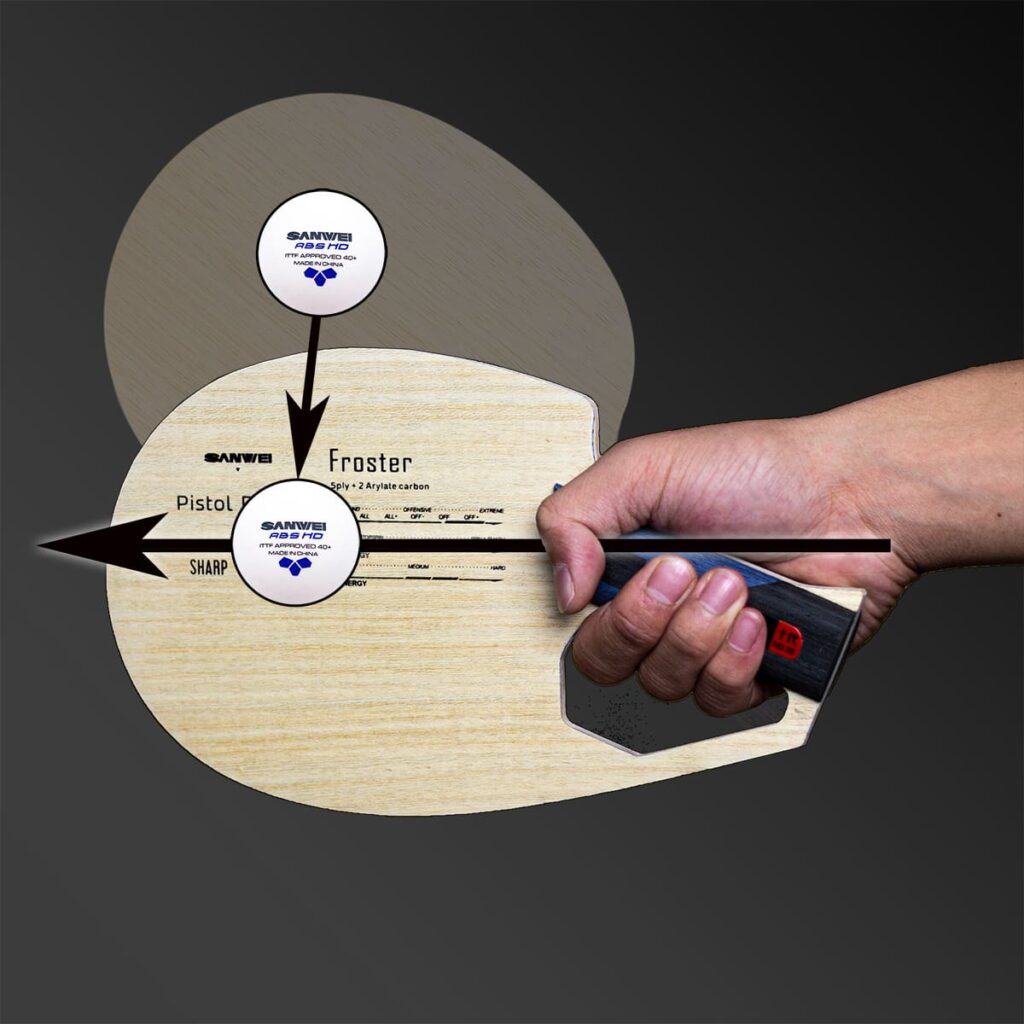
At SANWEI, this is one of the ideas behind our Pistol Racket. Its distinctive handle is designed to support a more natural relationship between the forearm and racket, helping players develop a repeatable movement and transfer power more efficiently.
For players whose grip or forehand movement is holding them back, exploring a different handle design may be worthwhile. However, equipment should complement technical development, not replace it. If your technique is already comfortable and effective, there is no reason to change your racket simply for the sake of changing it.
3. Expand the Situations in Which Your Technique Works
A stroke that works well in practice may not work equally well in every match situation.
This is one reason experienced players can continue to improve even when their basic movements change very little.
Imagine that your forehand loop is already reliable against a medium-speed ball. Instead of spending all your training time repeating that same shot, challenge yourself to use it under different conditions.
Practice against:
- Balls with different amounts of topspin and backspin.
- Shorter and deeper placements.
- Balls that force you to move sideways.
- Faster incoming shots that leave less preparation time.
- Unpredictable combinations that require you to choose between attacking and controlling the ball.
The objective is not simply to make your technique more complicated. It is to make your existing technique more adaptable.
A player who can execute one excellent forehand from a comfortable position has developed a useful skill. A player who can adjust that forehand to different balls, recover quickly, and make good decisions has developed a more complete game.
This is often where experienced players can find their next breakthrough.

Sanwei Pistol Racket 10th
- ITTF Approved: Fully compliant with ITTF regulations, the Sanwei Pistol Racket is approved for use in any level of table tennis competition, ensuring you stay competitive at all times
- Ergonomic Swing Design: The unique design aligns the hitting point with the natural extension of your arm.
- Dual-Channel Force Guidance: Simplified movements enhance power and speed by up to 15%, giving you a competitive edge
- Anti-Rotation Palm Support: The built-in anti-rotation palm support stabilizes the racket
- Guided Motion for Shortened Training Cycles: The Pistol Racket’s design promotes proper technique and reduces errors during training.
- More structures are available for selection.
- FL/ST handles are available to suit players of varying skill levels.
- Free Shipping Worldwide!
4. Sometimes, You Need to Correct Old Habits
There is another possibility worth considering: your technique may have become fixed around a weakness.
Perhaps you learned to compensate for poor footwork by reaching with your arm. Maybe you developed a grip that felt comfortable at first but makes certain strokes difficult. Or perhaps you have always used excessive force because it helped you win against weaker opponents when you were younger.
Over time, these habits can become difficult to notice because they feel natural.
When you encounter stronger opponents, however, the limitations become more obvious.
The solution is not to abandon everything you have learned. Instead, identify the specific habit that is limiting you and work on changing it gradually.
Video recordings can be particularly useful here. Ask a coach to examine your movement, or record a few training sessions from different angles. Look for recurring problems rather than judging your technique based on one imperfect shot.
You may discover that your plateau has less to do with a lack of talent and more to do with one or two habits that have never been properly addressed.
Correcting an established habit can take time, and your performance may temporarily become less consistent while you adjust. That does not necessarily mean the change is wrong. Give the new movement enough practice before deciding whether it is helping.
5. Improve Your Tactical Understanding, Not Just Your Strokes
Technical ability is only one part of table tennis.
As players become more experienced, tactical decisions often have an increasingly important influence on their results.
You might already have a powerful forehand, but do you know when to use it?
Can you recognize which serves are likely to produce a weak return? Can you identify an opponent’s preferred placement? Do you know when to attack aggressively and when to keep the ball in play?
Sometimes, the fastest way to win more points is not to improve the quality of your favorite shot. It is to create better opportunities to use it.
For example, varying your serve placement and spin may force an opponent to return the ball less comfortably. A well-placed third ball can then be more effective than a harder attack played without preparation.
Likewise, learning to recognize an opponent’s patterns can help you position yourself earlier and make better decisions.
If your strokes are already reasonably stable, spend some of your training time studying opponents, developing serve-and-attack combinations, and reviewing the reasons you lose points.
You may find that your results improve even though your basic technique looks almost unchanged.
6. Change How You Practice When Progress Slows Down
One common mistake is to respond to a plateau by simply increasing training volume.
More practice can help, but only when the practice addresses the problem.
If you have repeated the same drills for years, adding more repetitions may reinforce existing habits without challenging your weaknesses.
Try changing the structure of your training instead.
First, identify one measurable weakness. For example, you may struggle to attack after moving to the wide forehand.
Second, isolate the problem. Practice the necessary footwork and stroke pattern at a manageable speed.
Third, introduce variation. Ask your partner to change the placement so you must react rather than follow a predetermined pattern.
Finally, test the skill in a match. Observe whether you can use the new movement when the outcome matters.
This approach gives you a clear path from technical practice to competitive performance.
You should also review your progress regularly. If a drill feels comfortable but your match performance never changes, it may be time to make the drill more realistic or reconsider whether you are working on the right weakness.
7. Know When to Change Equipment—and When Not To
When progress slows down, it is natural to look for a new blade, rubber, or handle design.
Equipment can make a difference. The wrong setup may make it harder to control the ball, execute your preferred strokes, or maintain a comfortable grip. The right setup can support the way you want to play.
But equipment changes should solve a specific problem.
If your current racket feels too fast and you struggle to keep attacking balls on the table, a more manageable setup might help. If your handle causes discomfort or makes your grip feel unnatural, another handle shape may be worth testing.
On the other hand, if your main problem is poor footwork or late contact, changing your blade is unlikely to solve the underlying issue.
For players who want to refine their forehand movement, the SANWEI Pistol Racket offers an alternative handle design intended to support a natural forearm-racket relationship and efficient power transfer. It may be worth considering if your current grip interferes with your movement, but the best choice depends on your technique and playing style.
My advice is to identify the problem first, make one change at a time, and allow enough time to evaluate the result. Don’t confuse the excitement of new equipment with genuine improvement.
Final Thoughts
Can you still improve after your table tennis technique has become fixed?
Absolutely. But the way you improve may need to change.
When you are a beginner, progress often comes from learning the basic strokes and building coordination. Once those movements become habitual, further improvement may depend more on refining efficiency, correcting old habits, adapting to different balls, and making smarter tactical decisions.
You do not need to change your entire technique to become a better player. You need to understand which parts of your game are already reliable and which parts are preventing you from moving forward.
After decades of working with table tennis players and equipment, I believe an established technique should be a foundation, not a boundary.
Keep the habits that serve you well. Question the ones that hold you back. And remember that improvement does not always mean learning a completely new movement—it can mean learning to use the movement you already have more effectively.
Su Zhimin
Founder of SANWEI Sports