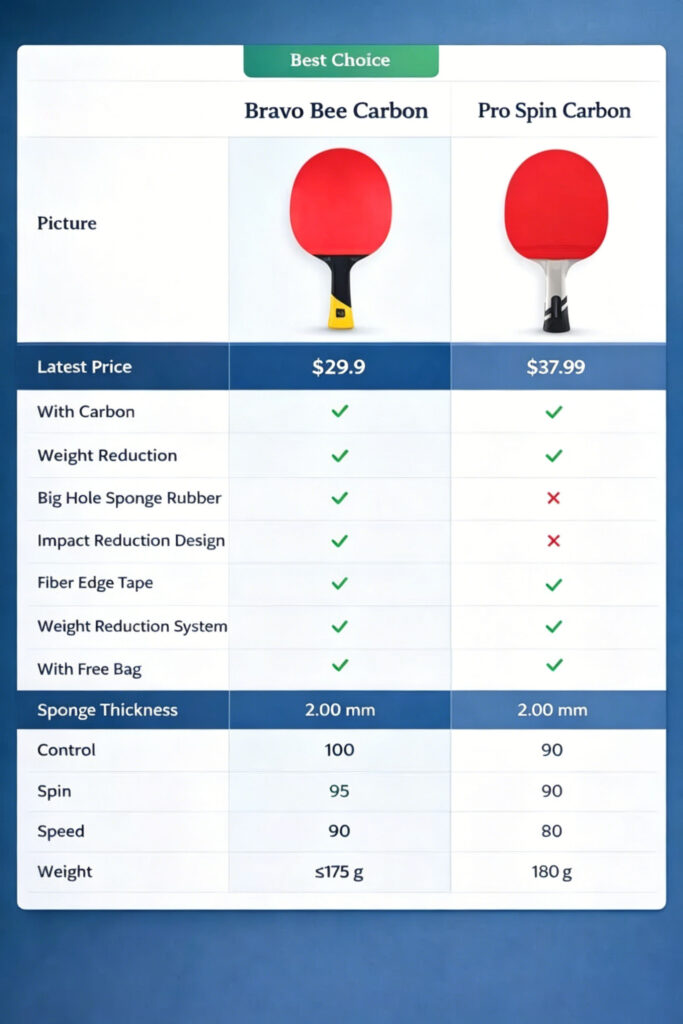
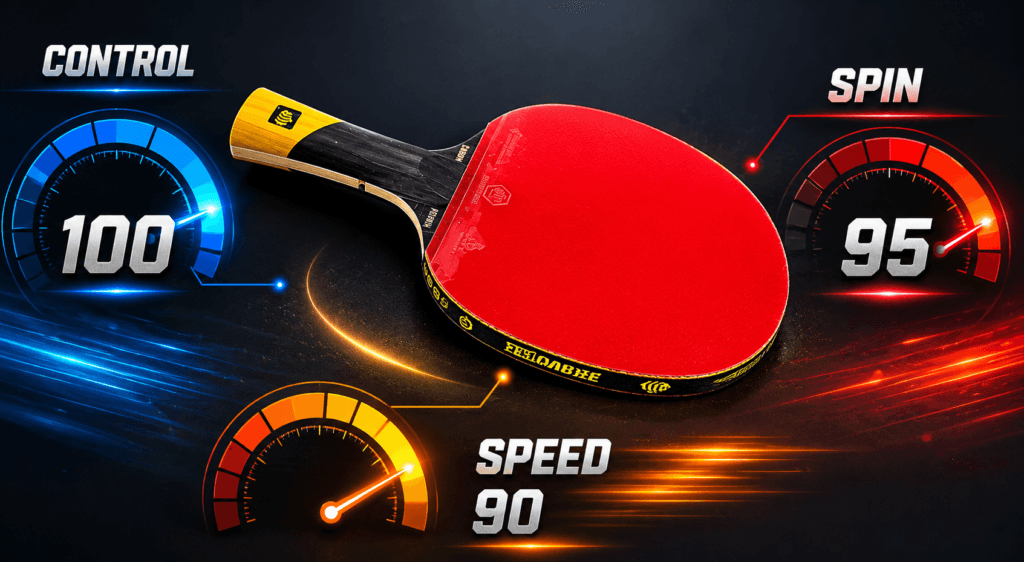
When I first saw “100/95/90” on the SANWEI BravoBee Carbon product page, my eyes glazed over. I had no idea what those numbers meant. But once I learned, I realized that understanding the ping pong rating system is like having a cheat sheet for buying your next paddle. In this guide, I’ll break down control spin speed explained in plain English. I’ll focus on the BravoBee 100 95 90 specs, but this table tennis spec guide applies to any paddle you’re considering. And if you’re an amateur looking for a simple amateur rating chart, you’ve come to the right place. No jargon, no marketing fluff – just what you need to know to pick a paddle that matches your game.
Control Rating (100): How Forgiving the Paddle Is – Higher Number = Fewer Wild Shots
Control is the most important number for amateur players. It tells you how forgiving the paddle is when you don’t hit the sweet spot. A high control rating means the ball will still go roughly where you aim, even on off‑center hits. A low control rating means the ball will spray wildly, and you’ll spend more time chasing than playing.
- What 100 control feels like: You make a slightly sloppy stroke, but the ball still lands on the table. Mishits are reduced, not magnified. You build confidence because you’re not constantly missing.
- Who needs high control: Beginners, intermediates, and anyone who wants to win by consistency rather than pure power.
- BravoBee’s 100 rating: It’s the highest possible. This means the paddle is exceptionally forgiving. Even when your technique isn’t perfect, the ball stays in play.
When you see a paddle with a control rating below 80, be cautious – it’s likely very fast and unforgiving, designed for advanced players with perfect strokes. For most amateurs, shoot for 90 or higher. The BravoBee’s 100 is the gold standard.
Spin Rating (95): How Much It Grips the Ball – Higher Number = More Dip and Bite
Spin is what makes ping pong exciting. It allows you to curve serves, dip loops, and make pushes die on the bounce. A high spin rating means the rubber is grippy and the sponge has enough dwell time to impart rotation.
- What 95 spin feels like: You brush the ball with a moderate swing, and you see immediate results – the ball curves, dies, or kicks. You don’t need perfect technique to generate rotation.
- Who needs high spin: Players who want to develop a modern, attacking game. Spin helps you control the rally and force errors.
- BravoBee’s 95 rating: It’s near the top of the scale. The high‑elasticity, big hole sponge grips the ball aggressively, making it easy to add backspin and topspin.
Low spin ratings (below 70) usually come from cheap, slick rubbers that make spin almost impossible. For amateurs, look for at least 85 spin. The BravoBee’s 95 gives you the tools to learn real spin quickly.
Speed Rating (90): How Fast the Ball Comes Off – High Numbers Aren’t Always Good
Speed is often misunderstood. Beginners think faster is better, but that’s a trap. A very fast paddle (95‑100) launches the ball before you can control it. You’ll make more errors, not fewer. A moderate speed rating (80‑90) is much more suitable for learning.
- What 90 speed feels like: The ball has enough pop to finish points, but you still have time to feel your stroke. You’re not fighting the paddle to keep the ball on the table.
- Who needs high speed: Advanced players with consistent technique who can handle the pace. For amateurs, 80‑90 is ideal.
- BravoBee’s 90 rating: It’s fast enough to be dangerous, but controlled enough to be forgiving. You can generate power when needed, but you won’t overshoot constantly.
If you see a paddle with speed 95+ and control below 80, it’s designed for tournament players. Avoid it until you’ve mastered the basics. The BravoBee’s 90 speed is the sweet spot for most amateurs.
The Perfect Triangle: BravoBee’s 100 Control + 95 Spin + 90 Speed = Confidence
What makes the BravoBee Carbon such a standout is how these three numbers work together. It’s not just high in one category – it’s balanced. The 100 control keeps you in the rally. The 95 spin gives you weapons. The 90 speed allows you to finish points. This combination is rare in the under‑$50 price range. Many budget paddles have decent spin but low control, or high speed but no spin. The BravoBee’s 100/95/90 is a harmonious triangle that builds confidence. You can focus on your game, not on fighting your equipment. That’s why this paddle is so often recommended for amateurs.
When I look at a paddle’s specs, I now imagine a radar chart. The BravoBee’s chart is almost an equilateral triangle – balanced, stable, and effective.
Why Intermediate Players Should Look for High Control First, Then Spin
If you’re an intermediate player (you have basic strokes but struggle with consistency), here’s my advice: prioritize control over spin and speed. A high control paddle will reduce your unforced errors, which is the fastest way to win more points. Once you have the confidence to keep the ball on the table, then you can focus on adding spin. The BravoBee’s 100 control allows you to do exactly that. You can learn to loop and serve with spin without worrying about the ball flying off. After you’ve mastered spin, the 90 speed will be there when you need to add pace. This progression – control → spin → speed – is the smart way to improve.
I’ve seen players jump to a 95‑speed, 80‑control paddle too early and develop bad habits. Don’t be that person. Follow the triangle.
How to Compare Other Paddles Using This System
Now that you understand the ping pong rating system, you can evaluate any paddle. Look for three numbers, usually presented as “Control / Spin / Speed” or “Speed / Spin / Control.” A good amateur paddle should have:
- Control: 90+
- Spin: 85+
- Speed: 80‑90
If you see a paddle with control 70, spin 90, speed 95 – that’s a pro‑oriented blade. Skip it. If you see control 95, spin 75, speed 70 – that’s a defensive paddle, good for beginners but limited for growth. The BravoBee’s 100/95/90 hits the sweet spot for all‑round development. Use this amateur rating chart as your guide when shopping.
I also recommend ignoring brand names and marketing terms like “pro” or “tournament grade.” Focus on the numbers. They don’t lie.
Real Example: BravoBee vs. a Hypothetical Fast Paddle
Let’s compare the BravoBee (100/95/90) to a hypothetical “Speed Demon” paddle (75/85/98). Which one is better for an intermediate player?
- BravoBee: You’ll make fewer errors (100 control), you can generate good spin (95), and you’ll have enough pace to win points (90).
- Speed Demon: You’ll spray balls because of low control (75). Despite high spin (85), you’ll struggle to use it because you can’t keep the ball on the table. The high speed (98) will only make things worse.
The BravoBee is clearly the better choice for 90% of amateurs. The numbers don’t lie. This is why understanding control spin speed explained is so powerful – it saves you from bad purchases.
Know the Numbers, Know Your Game
The next time you see a paddle rated 100/95/90, you won’t be confused. You’ll know that 100 means maximum forgiveness, 95 means heavy spin potential, and 90 means controllable speed. This table tennis spec guide applies to any brand, not just SANWEI. But when you see the BravoBee Carbon’s numbers, you’ll appreciate how perfectly they balance for amateur play. So go ahead – use this amateur rating chart to shop smart. And remember: control first, spin second, speed third. That’s the formula for progress. The BravoBee 100 95 90 is your shortcut to confidence.
👉 Get your BravoBee Carbon here and enjoy a paddle that’s rated perfectly for you.
Have you ever been confused by paddle ratings? Share your questions in the comments – I’d love to help you decode the numbers!
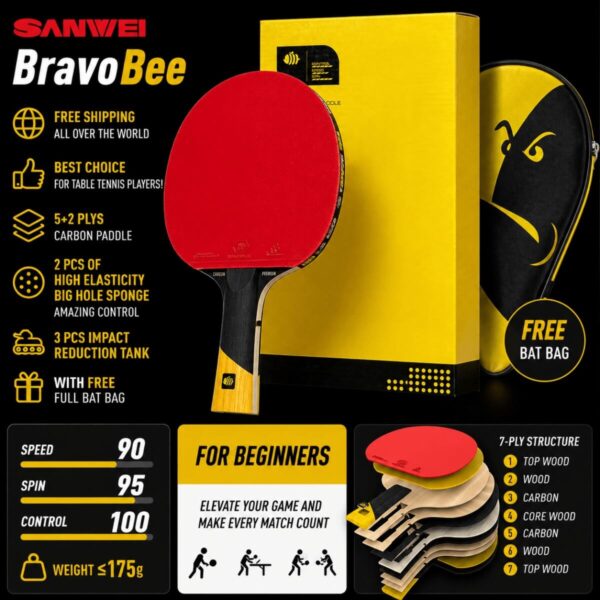
BravoBee Carbon Ping Pong Paddles
- Free Shipping All Over The World
- Best choice for table tennis players!
- 5+2 plys carbon paddle
- 2 pcs of high elasticity big hole sponge, amazing control
- 3 pcs Impact reduction tank
- with FREE full bat bag