By Amelie · Updated October 27, 2026
When I first saw numbers like 100/95/90 on a paddle product page, my eyes glazed over. Three numbers, no explanation, and a quiet assumption that I already knew what they meant. If you have felt the same confusion, you are not alone — and the good news is that these three ratings are much simpler than they look.
This guide explains control, spin, and speed in plain language: what each one actually measures, what a high or low score feels like on the table, and why the balance between the three matters more than any single number. By the end, you will be able to read a paddle’s ratings and know what kind of player it was built for.
The Three Ratings at a Glance
Before the detailed explanation, here is the short version. Each rating is scored on a 0–100 scale, and each one describes a different physical quality of the paddle:
| Rating | What it measures | High score means | Low score means |
|---|---|---|---|
| Control | How consistently the ball lands where you aim | Mishits stay on the table; easy to place the ball | Small errors turn into lost points; harder to keep rallies alive |
| Spin | How much rotation you can generate on the ball | Serves dip, loops kick, the ball grips the rubber | Flat shots; harder to make the ball arc down into the table |
| Speed | How much ball speed the paddle produces from your swing | Compact swings produce pace; easier to finish points | You must swing hard to generate speed; attacking is tiring |
Ratings are relative scales used by paddle manufacturers. They are most useful for comparing paddles within the same brand or price range, not as absolute physical measurements.
Control: The Rating That Keeps You in the Rally
Control is the most important number for a beginner, and the one most often overlooked because it sounds boring. Control measures how forgiving the paddle is: when you hit the ball slightly off-center, does it still go where you wanted, or does it fly off the table?
A paddle with control 100 — the highest possible score — is designed so that small mistakes do not automatically cost you the point. The sweet spot is large, the blade resists twisting on off-center contact, and the ball stays on the table even when your technique is not perfect. That forgiveness is what lets you build confidence and keep rallies going long enough to actually learn.
What low control feels like
A paddle with control in the 70s or 80s is not “bad” — it is built for a different player. High-speed, low-control paddles reward precise technique and punish sloppy contact. For an advanced player, that punishment is useful feedback. For a beginner, it is just frustrating: you know where you wanted the ball to go, and it went somewhere else.
Why control matters more than speed for new players
If you are still learning stroke mechanics, a high-control paddle keeps the ball in play while you develop. A high-speed paddle ends the rally before you have a chance to learn from it. This is why most beginner recommendations prioritize control over speed — not because speed is unimportant, but because you cannot learn to use speed until you can reliably keep the ball on the table.
Spin: What Makes the Ball Dip, Kick, and Curve
Spin measures how much rotation the paddle can put on the ball. This is the rating that separates a flat, predictable shot from a ball that dips sharply into the table or kicks forward after bouncing. Spin is what makes table tennis feel like a game of angles rather than a game of reflexes.
A paddle with spin 95 — near the top of the scale — uses a grippy, elastic rubber that grabs the ball and lets you generate real rotation even without perfect brushing technique. The effect is most noticeable on serves (the ball dips and breaks), on opening loops (the ball arcs down onto the table), and on pushes (the ball stays low and heavy).
What low spin feels like
A paddle with spin in the 70s or low 80s produces flatter shots. You can still generate some rotation, but the ball does not grab the rubber the same way, so your serves are easier to read and your loops are easier to block. For a beginner, low spin is not fatal — but it does make it harder to learn the touch and feel that spin-based play requires.
Spin and rubber work together
Spin is not only about the blade. The rubber’s tackiness and sponge hardness do most of the work. This is why two paddles with the same blade can have very different spin ratings: one may use a high-grip, large-pore sponge, and the other a harder, lower-grip sheet. When you compare paddles, spin is the rating that tells you most about the rubber setup.
Speed: Why More Is Not Always Better
Speed measures how much ball velocity the paddle produces from a given swing. A high-speed paddle does more of the work for you: a compact swing produces real pace, and you do not need to wind up like a pitcher to hit a winner. A low-speed paddle requires you to generate most of the pace yourself, which makes attacking exhausting and often ineffective.
A paddle with speed 90 sits in a useful middle zone. It is lively enough that a short swing or a wrist flick actually produces pace, but not so fast that you lose control of the ball off the table. For a developing player, this is the difference between “learning to survive rallies” and “learning to construct points.”
What low speed feels like
A paddle with speed around 60 feels controlled but limited. Your loops float, your drives get blocked back at you, and you spend rallies pushing and blocking because attacking costs more energy than it returns. The fatigue is not only physical — you stop trying to finish points because the paddle will not let you.
What too much speed feels like
A paddle with speed in the high 90s is built for advanced players who can control it. For a beginner, the ball jumps off the rubber faster than your technique can respond, and every small error is amplified. This is why “buy the fastest paddle” is bad advice for new players: speed without control is just a faster way to lose points.
Now You Understand the Ratings — What Are Your Paddle’s Numbers?
Here is where the knowledge becomes personal. You now know what control, spin, and speed mean. The next question is whether the paddle in your hand is actually helping you — or quietly costing you points every session.
If you have ever noticed any of these three things, the problem may not be your technique:
- You lose points on shots that felt fine. The ball came off the paddle reasonably, but it did not land where you expected. That is often a control problem, not a technique problem.
- You cannot finish a point even when you get a good look. You see the opening, you swing, and the ball floats back to your opponent. That is a speed ceiling — the paddle is not producing enough pace from your swing.
- Your serves are easy to return, and your loops get blocked back flat. That is a spin limitation. The ball is not gripping the rubber hard enough to create real rotation.
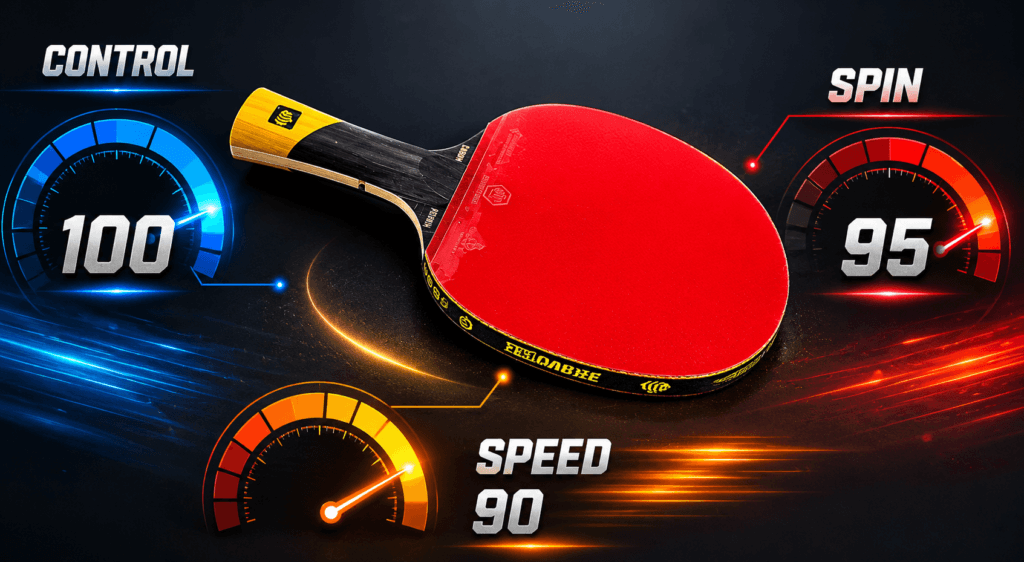
These are equipment problems, and equipment problems have equipment solutions. A paddle rated control 100 / spin 95 / speed 90 is built specifically for this situation: maximum forgiveness so your errors stay on the table, high spin so your serves and loops actually do something, and enough speed that your attacking shots produce pace without requiring a perfect swing. The SANWEI BravoBee Carbon is built around exactly those three numbers — and the reason it comes up in a ratings guide is that it is a clear example of what a balanced rating profile looks like in practice.
SANWEI BravoBee Carbon
$29.90 · Free worldwide shipping · Free waterdrop bat case
Control 100 · Spin 95 · Speed 90 · ≤175g · 5+2 carbon
You just read what each rating actually does. This is what all three look like when they are balanced for a developing player — maximum forgiveness, real spin, and enough speed to finish a point.
Get the BravoBee Carbon — $29.90, free worldwide shipping
Want the full spec sheet first? See every rating and spec in detail here →
The “Perfect Triangle”: Why Balance Beats Any Single High Number
Here is the idea that makes ratings useful. A paddle can score 100 in one category and still be a bad choice, because the three ratings interact. A paddle with speed 100 and control 60 is fast, but you cannot keep the ball on the table. A paddle with control 100 and speed 50 is safe, but you cannot finish a point. What you want is a profile where the three numbers support each other.
That is what people mean when they describe a paddle’s ratings as an almost equilateral triangle: control, spin, and speed all sit near the top of the scale, and none of them is sacrificed to boost another. The BravoBee’s 100 / 95 / 90 profile is a clear example of this shape. The control score is maxed, which keeps errors on the table. The spin score is near the top, so serves and loops actually do something. The speed score is high enough to finish points, but not so high that it overwhelms a developing player’s technique.
Why this matters more than “which rating is highest”
Many paddle listings lead with their highest number — usually speed — because speed sounds impressive. But a rating profile is a system, not a headline. A paddle that scores 95 in speed but 70 in control is not “better” than a paddle that scores 90 in speed and 100 in control. It is built for a different player. When you read ratings, look at the shape of the three numbers together, not the single highest figure.
What Should Intermediate Players Look At First?
If you have moved past the absolute beginner stage, your priorities shift slightly. Control is still important, but you can now afford to trade a little forgiveness for more speed and spin — because your technique can handle the ball coming back faster.
The practical rule for intermediate players is: do not drop control below 85. Below that, the paddle starts punishing small errors in a way that slows your progress rather than accelerating it. Above 85, you have room to look for higher speed and spin scores that match your playing style. A balanced profile like 90+ control with 90+ speed and 90+ spin is a strong all-round setup — it lets you attack when the opportunity appears without turning every rally into a coin flip.
How to Compare Paddle Ratings Without Getting Fooled
1. Compare within the same brand first
Rating scales are not standardized across manufacturers. A “speed 90” from one brand may feel different from a “speed 90” from another. The safest comparison is between paddles from the same brand, where the scale is at least internally consistent.
2. Look at the profile, not the headline
Ignore the single highest number and read the three ratings together. A balanced profile (high control, high spin, high speed) is usually a better all-round paddle than one with an extreme score in one category and a weak score in another.
3. Match the profile to your level
A beginner should prioritize control. An intermediate player can trade some control for speed and spin. An advanced player can handle lower control in exchange for maximum attacking performance. The “best” ratings depend entirely on who is holding the paddle.
4. Read the construction, not just the numbers
Ratings describe performance, but construction explains it. A paddle with 5+2 carbon layers will generally have a larger sweet spot and more stability than an all-wood paddle with the same ratings. When two paddles have similar numbers, construction is the tiebreaker.
Still Not Sure How Your Current Paddle Compares?
Ratings only become useful when you have something to compare them against. If you have read this far and you are still unsure whether your current paddle’s profile is holding you back, do not guess from a single article. The full BravoBee rating breakdown, spec sheet, and construction details are in one place, and the next step is low-friction:
→ Read the full BravoBee Carbon rating and spec breakdown before you decide
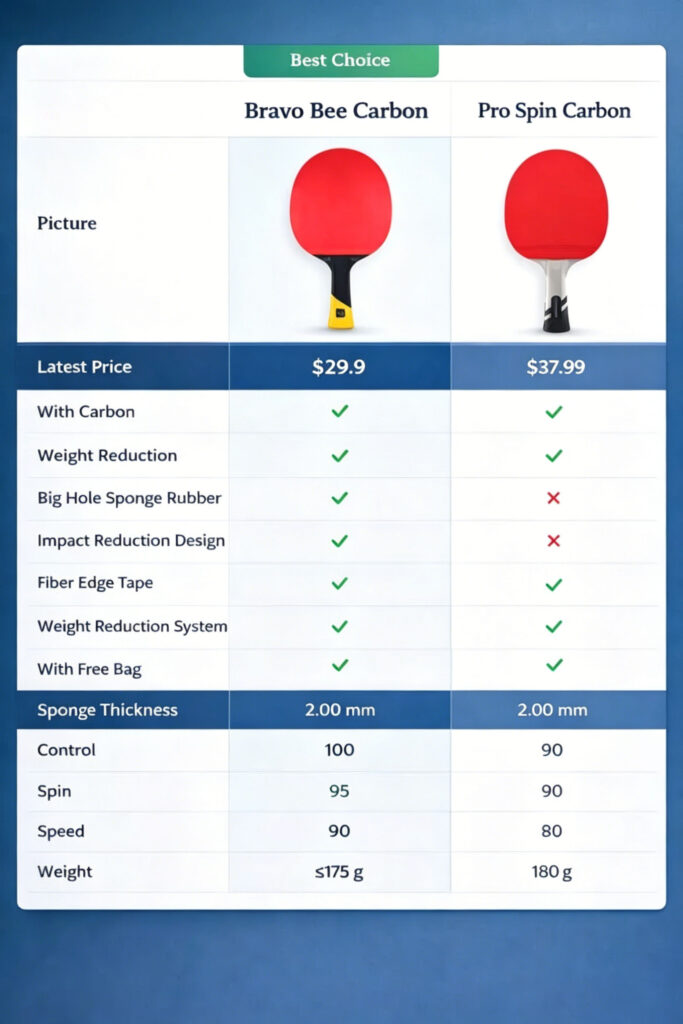
If you are already leaning toward a first serious paddle, we have also put the BravoBee head-to-head against the usual beginner suspects — so you can see how a balanced 100 / 95 / 90 profile compares side by side:
- BravoBee Carbon vs Pro Spin Carbon: the beginner battle, rating by rating →
- Why BravoBee’s control 100 and balanced profile make it the all-round amateur pick →
FAQ: Ping Pong Paddle Ratings Explained
What do control, spin, and speed ratings mean on a ping pong paddle?
Control measures how forgiving the paddle is on off-center hits — a high score means mishits still land on the table. Spin measures how much rotation the rubber can generate — a high score means serves dip and loops arc down. Speed measures how much ball velocity the paddle produces from your swing — a high score means compact swings generate real pace. All three are scored on a roughly 0–100 scale and are most useful when read together.
Which rating matters most for a beginner?
Control matters most for a beginner. A high-control paddle keeps the ball on the table while you develop stroke mechanics, which lets you stay in rallies long enough to learn. Speed and spin become more important as your technique improves, but a beginner who buys a high-speed, low-control paddle usually ends up fighting the equipment instead of learning from it.
Is a 100 control rating actually the highest score?
On most manufacturers’ scales, yes — 100 is the top of the control scale. But it is important to read it alongside the other two ratings. A paddle with control 100 and low speed and spin is very safe but limited. A balanced profile like control 100 with spin 95 and speed 90 gives you the same forgiveness while still letting you attack.
Can I compare ratings between different paddle brands?
Only with caution. Rating scales are not standardized across manufacturers, so a “speed 90” from one brand may feel different from a “speed 90” from another. Ratings are most reliable when comparing paddles from the same brand. When comparing across brands, use construction details — blade layers, sponge type, weight — as the tiebreaker.
What do the BravoBee Carbon’s 100 / 95 / 90 ratings mean in practice?
The BravoBee Carbon scores control 100, spin 95, speed 90. In practice, that means off-center hits still land (control 100), serves and loops generate real rotation (spin 95), and compact swings produce enough pace to finish points (speed 90). It is a balanced profile designed for developing players who want to attack without losing forgiveness.