
You’ve watched every YouTube tutorial. You’ve practiced your wrist snap until it hurts. You’ve tried to copy the pros’ brushing motion. But your serves still float like lazy balloons, your loops refuse to dip, and your opponents keep smashing your weak returns. If this sounds familiar, I’ve got news for you: ping pong no spin isn’t a technique problem – it’s an equipment problem. The culprit is almost always dead rubber problems, and no amount of practice will fix a paddle that can’t grip. The solution? A paddle with a real BravoBee spin rating of 95 and a high-elasticity big hole sponge that actually grabs the ball. In this guide, I’ll show you how to add spin to your game by fixing the root cause: your ping pong rubber grip.
Dead Rubber Warning Signs: Is Your Paddle Sabotaging You?
Before we talk about solutions, let’s diagnose the problem. How do you know if your rubber is dead? Here are the telltale signs:
The Shine Test: Hold your paddle at an angle under a light. If the surface looks glossy or shiny, your rubber has lost its tackiness[reference:0]. Fresh rubber has a matte, slightly textured feel. Shiny rubber = dead rubber.
The Finger Test: Lightly rub your finger across the rubber surface. If it feels slippery or doesn’t grip your finger at all, it’s dead[reference:1][reference:2]. A living rubber should grip your finger as you rub across the surface[reference:3].
The Ball Test: Take a ping pong ball and rub it softly across the surface of your paddle. If the ball slides without any resistance, your rubber has lost its grip[reference:4].
Visible Wear: Look for cracks, tears, uneven wear patterns, or pimples showing through the rubber surface[reference:5][reference:6]. These are all signs that your rubber is past its prime.
If you’re seeing any of these signs, your paddle is working against you. As one source puts it, “If it is not gripping even a little then it’s game over for that rubber”[reference:7]. A dead rubber has “zero grip” and makes spin “literally impossible”[reference:8].
Why Cheap Paddles Can’t Grip: The Science of Dead Rubber
So why do so many paddles lose their grip so quickly? It comes down to three factors: sponge quality, rubber composition, and construction.
Thin, Dead Sponges: The sponge layer under the rubber is what allows the ball to sink in and create dwell time. A thicker sponge (2.0mm or more) compresses deeper, storing energy that amplifies spin[reference:9]. Cheap paddles often have thin, low-quality sponges that don’t compress properly. “Thinner or no sponge rubbers result in shorter ball contact and produce less spin”[reference:10]. When the ball doesn’t sink in, the rubber can’t grip it effectively.
Low-Quality Rubber: The top sheet of cheap paddles is often made from inferior materials that lose their tackiness quickly. Over time, rubber loses its tackiness and grip if you don’t cover it and clean it after every use[reference:11]. The surface becomes “glassy” and “slippery,” making spin generation nearly impossible[reference:12].
No Big Hole Technology: The BravoBee’s big hole sponge is designed specifically to enhance grip. Those larger pores allow the ball to sink in deeper, increasing contact time and friction[reference:13]. Cheap paddles use standard, dense sponges that don’t offer this advantage.
The result? You can practice your brushing motion for hours, but if the rubber doesn’t grip, you’re fighting a losing battle. As one player put it, “Most likely your rubbers are dead, the blade itself should be fine. Over time your rubber will lose tack or grip”[reference:14].
How BravoBee’s 95 Spin Rating and Big-Hole Sponge Give You Instant Rotation
Now let’s talk about the solution. The SANWEI BravoBee Carbon is engineered specifically to solve the “no spin” problem. Here’s how:
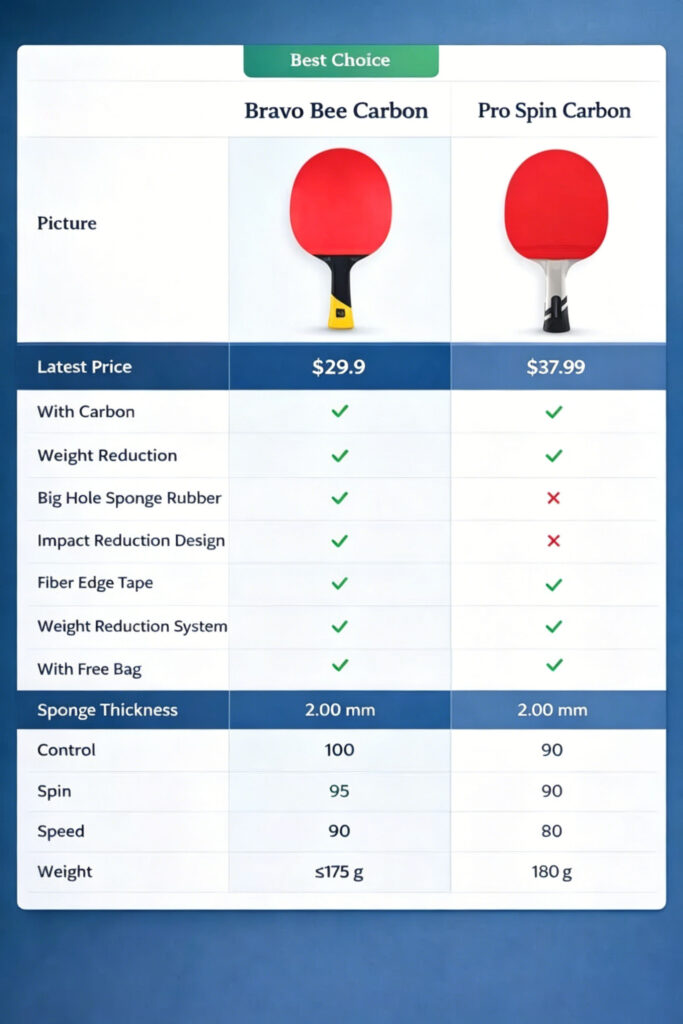
Spin Rating 95: The BravoBee boasts a spin rating of 95 – near the top of the scale[reference:15][reference:16]. That’s not just a number; it translates directly to real, noticeable grip. As one reviewer put it, “Spin 95: You can generate real rotation from day one”[reference:17].
Big Hole Sponge: The BravoBee features a high-elasticity, big hole sponge (also called a cake-hole sponge on the forehand and a high-density sponge on the backhand)[reference:18]. This technology is designed to “grab the ball and rip it with heavy rotation”[reference:19]. The large pores allow the ball to sink in deeper, creating more dwell time and more friction[reference:20].
Grips Even with Imperfect Brushing: This is the key for beginners. The BravoBee’s 95 spin rating “is achieved with a high-elasticity, big hole sponge that grips even with imperfect brushing”[reference:21]. You don’t need perfect technique to generate spin – the paddle does the heavy lifting for you[reference:22].
As the official BravoBee product description explains, the rubbers are “formulated with a high elasticity, large pore sponge” that “enables beginners to hit the ball with more spin, enhancing their ability to control the ball’s landing point”[reference:23].
The Difference Between ‘Spin Potential’ and Actual Grip You Can Feel
Here’s something important to understand: there’s a difference between a paddle that has “spin potential” on paper and a paddle that actually gives you grip you can feel. Many paddles claim high spin ratings, but if the sponge is dead and the rubber is slick, you won’t feel any grip.
The BravoBee is different. The high-elasticity big hole sponge gives you tactile feedback you can actually feel. When you brush the ball, you feel it sink in and release with rotation[reference:24]. That feedback is essential for learning – you know when you’ve made good contact because you can feel the grip.
As one source explains, “Inverted (smooth) rubber creates maximum friction”[reference:25]. The BravoBee uses inverted rubber with a grippy surface that maximizes friction and spin generation[reference:26]. When combined with the 2.00mm sponge thickness, it provides “enough dwell time to generate heavy spin (rating 95)”[reference:27].
The difference between a paddle with “spin potential” and a paddle with actual grip comes down to the combination of: sponge thickness (2.00mm is ideal), sponge type (big hole for grip), rubber quality (high-elasticity, grippy top sheet), and construction (consistent, high-quality materials). The BravoBee has all four.
Real Talk: How Players Finally Got Spin with BravoBee
Don’t just take my word for it. Here’s what real players have said about the BravoBee’s spin capabilities:
“The 95 spin rating and big hole sponge did the heavy lifting. I was hooked.”[reference:28]
“Without its 95 spin rating and 100 control, I’d still be hitting flat, predictable shots.”[reference:29]
“The SANWEI BravoBee Carbon gives you the grip, the sponge, and the 95 spin rating to make spin easy.”[reference:30]
One reviewer who went “from zero to spin” in just one week with the BravoBee said: “The BravoBee’s 95 spin rating and high-elasticity big hole sponge made learning to spin possible”[reference:31].
Another player noted: “Spin 95: you can actually generate topspin, backspin, and sidespin. Your loops will dip…”[reference:32].
These aren’t pro players with years of training – they’re everyday players who finally discovered what real grip feels like. The common thread? They stopped blaming their technique and started using a paddle that actually grips.
How to Check Your Rubber’s Grip (And When to Replace It)
Still not sure if your rubber is dead? Here’s a quick checklist:
- Rub your finger across the surface. If it feels slippery, it’s dead. If it grips your finger, it’s still alive[reference:33].
- Hold it at an angle under light. If you see shiny spots that won’t go away, the rubber has been polished smooth[reference:34].
- Check for loss of tackiness. After cleaning, if the rubber still feels slick, it’s time to replace it[reference:35].
- Look for visible wear. Cracks, peeling, or pimples showing through the surface mean it’s game over[reference:36].
If you’re experiencing any of these signs, it’s time to upgrade. Your technique isn’t the problem – your paddle is. The BravoBee Carbon is designed to give you the grip you need to finally generate spin.
Stop Blaming Your Stroke – Get Rubber That Actually Grabs the Ball
You’ve been practicing. You’ve been trying. But if your paddle can’t grip, you’re never going to get the spin you want. Ping pong no spin isn’t a technique issue – it’s an equipment issue caused by dead rubber problems. The solution is a paddle with a real BravoBee spin rating of 95 and a high-elasticity big hole sponge that grabs the ball. How to add spin starts with fixing your ping pong rubber grip. Once you have a paddle that actually grips, you’ll be amazed at how quickly your spin game develops.
👉 Get your BravoBee Carbon here and finally experience what real spin feels like. Your serves – and your opponents – will thank you.
What’s your experience with dead rubber? Share your story in the comments – I’d love to hear how you solved your spin problems!
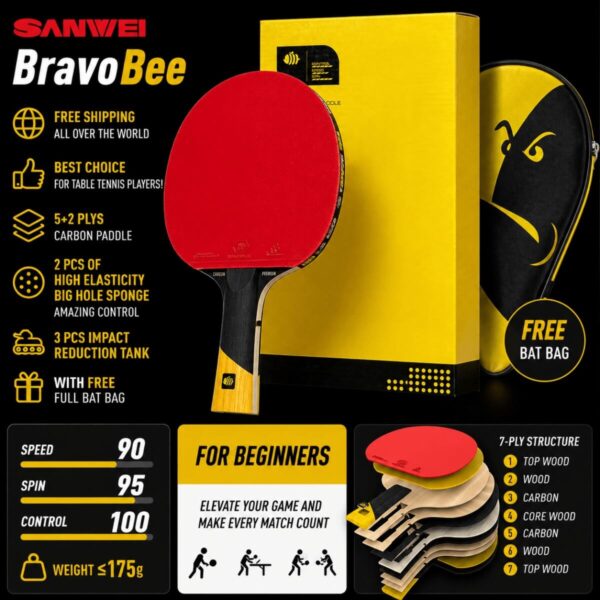
BravoBee Carbon Ping Pong Paddles
- Free Shipping All Over The World
- Best choice for table tennis players!
- 5+2 plys carbon paddle
- 2 pcs of high elasticity big hole sponge, amazing control
- 3 pcs Impact reduction tank
- with FREE full bat bag