This is a problem I have seen countless times:
“Mr. Su, during training I can hit beautiful forehand loops. The ball has speed, spin, and a good arc. But once I enter a match, everything seems to disappear. Why?”
I think many players misunderstand what is happening.
Your technique may not have disappeared.
Your body simply stopped repeating it under pressure.
Training and Competition Are Two Different Situations
During training, you know what ball is coming.
You have time to prepare.
Your feet are in position.
Your body is relaxed.
You can repeat the same movement again and again.
But during a match, everything changes.
You are moving.
You are reacting.
You are thinking about the score.
You are worried about making mistakes.
And when pressure increases, the first thing many players lose is their movement quality.
Pressure Makes Technique Change
A player may have a technically correct forehand during training.
But under pressure, you might see:
- The swing becoming shorter.
- The wrist becoming tense.
- The contact point moving closer to the body.
- The racket angle changing.
- The player rushing the ball.
These changes may only be a few centimeters.
But in table tennis, a few centimeters can completely change the quality of a loop.
The result?
The ball that was flying deep into the opponent’s court during training suddenly goes into the net—or flies long.

Sanwei Pistol Racket 10th
- ITTF Approved: Fully compliant with ITTF regulations, the Sanwei Pistol Racket is approved for use in any level of table tennis competition, ensuring you stay competitive at all times
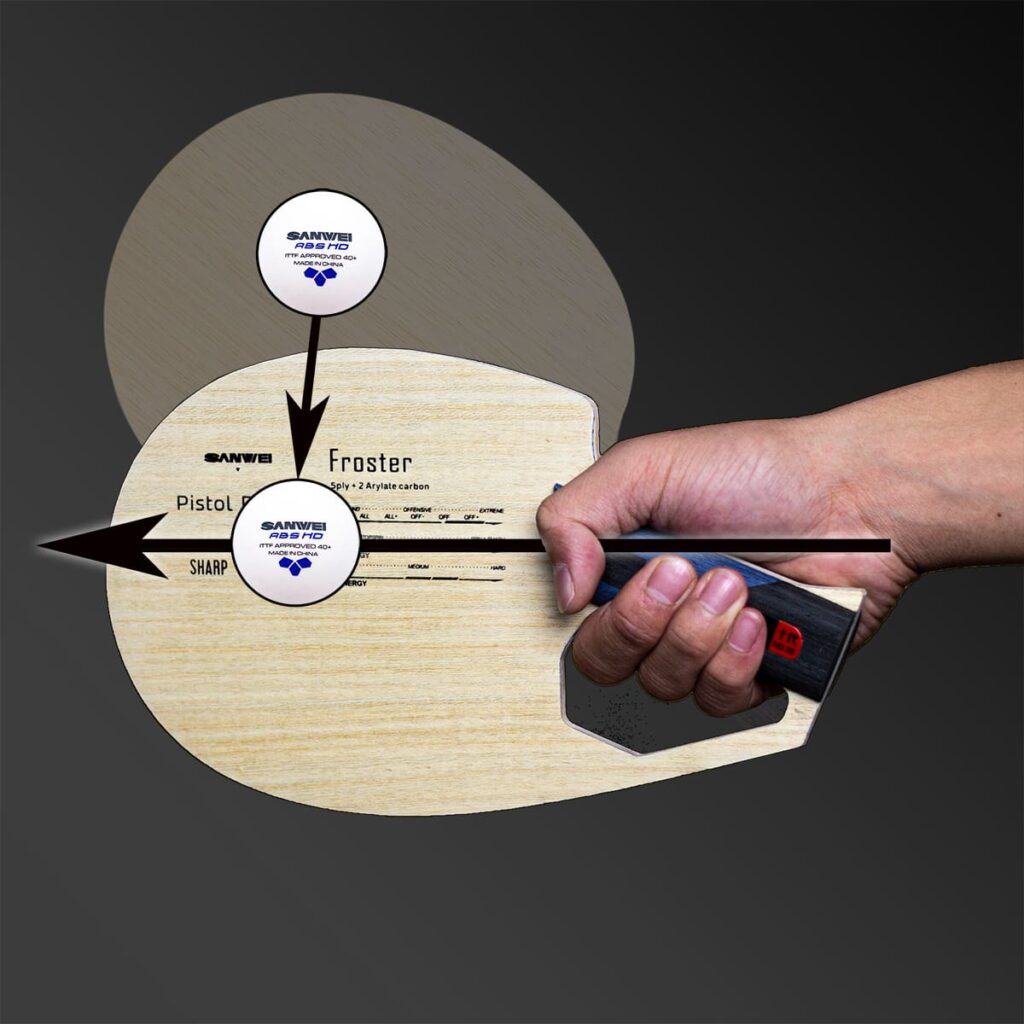
- Ergonomic Swing Design: The unique design aligns the hitting point with the natural extension of your arm.
- Dual-Channel Force Guidance: Simplified movements enhance power and speed by up to 15%, giving you a competitive edge
- Anti-Rotation Palm Support: The built-in anti-rotation palm support stabilizes the racket
- Guided Motion for Shortened Training Cycles: The Pistol Racket’s design promotes proper technique and reduces errors during training.
- More structures are available for selection.
- FL/ST handles are available to suit players of varying skill levels.
- Free Shipping Worldwide!
The Problem May Be Your Grip and Position
This is one reason I believe the relationship between your hand and racket is so important.
When you become nervous, you naturally try to control the racket more.
Your grip tightens.
Your wrist becomes less free.
Your swing becomes less natural.
In other words, the pressure of the match exposes weaknesses in your movement that you don’t notice during relaxed training.
Why I Recommend the Pistol Racket
When I designed the Pistol Racket, I wanted to address exactly this kind of problem.
The handle is designed so that the hitting point is closer to the natural extension of the forearm.
This creates a more intuitive relationship between the arm and the racket.
Instead of relying heavily on small wrist adjustments, the racket follows the natural direction of the arm more closely.
For many players, this makes it easier to maintain a consistent racket position—even when the pace increases.
Your Goal Is Not to Create a New Stroke
One important point:
I am not saying the Pistol Racket will magically give you perfect technique.
You still need to practice.
You still need proper footwork.
You still need timing.
What I want is for the racket to make your existing movement easier to repeat.
If your training forehand is already good, the goal is to make that movement more reliable when the pressure comes.
Train Under Pressure, Too
Of course, equipment is only part of the solution.
If you always practice with predictable balls, your technique may only work in predictable situations.
I recommend gradually adding pressure to your training:
Start with regular multiball.
Then increase variation.
Then add movement.
Finally, practice with scoring.
This teaches your body to maintain the same movement even when your mind becomes nervous.
And that is when your training technique truly becomes match technique.
Final Thoughts
If you can hit excellent loops in training but struggle during matches, don’t immediately think:
“My technique is useless.”
You may simply need to make your movement more repeatable under pressure.
A stable grip, natural racket position, proper footwork, and pressure-based training all matter.
That is why I recommend trying the Pistol Racket.
Its ergonomic design, with the hitting point closer to the extension of the forearm, is intended to make the stroke feel more natural and easier to reproduce.
Because ultimately, the best technique isn’t the one you can perform when everything is perfect.
It is the one that stays with you when the score is 9–9.
—
Su Zhimin
Founder of SANWEI Sports