This is a question I hear from many players who already have a decent forehand:
“Mr. Su, I can attack with my forehand, but why doesn’t it feel dangerous enough? How can I make my forehand more threatening?”
My answer is simple:
You need more than power. You need power that you can control and repeat.
That is one of the reasons I developed the Pistol Racket.
A Dangerous Forehand Is More Than Just Fast
When players talk about a dangerous forehand, they usually think about speed.
But if you watch high-level table tennis carefully, you will notice something else.
The most dangerous forehands are:
- Fast.
- Stable.
- Well placed.
- Difficult to predict.
- Repeatable under pressure.
A player who can hit one extremely powerful ball is impressive.
A player who can hit the same quality ball five times in a row is dangerous.
Why Does Forehand Power Sometimes Disappear?
Many players already have enough physical strength.
The problem is that they cannot transfer that strength efficiently.
When the grip is uncomfortable or the racket position requires too much adjustment, the wrist and forearm begin compensating.
The swing becomes less natural.
The racket angle changes.
And when you try to hit harder, the problem becomes even worse.
You may gain speed—but lose accuracy.
This Is Why I Focused on the Grip
When I developed the Pistol Racket, I started from a simple idea:
The racket should follow the natural movement of the player’s arm.
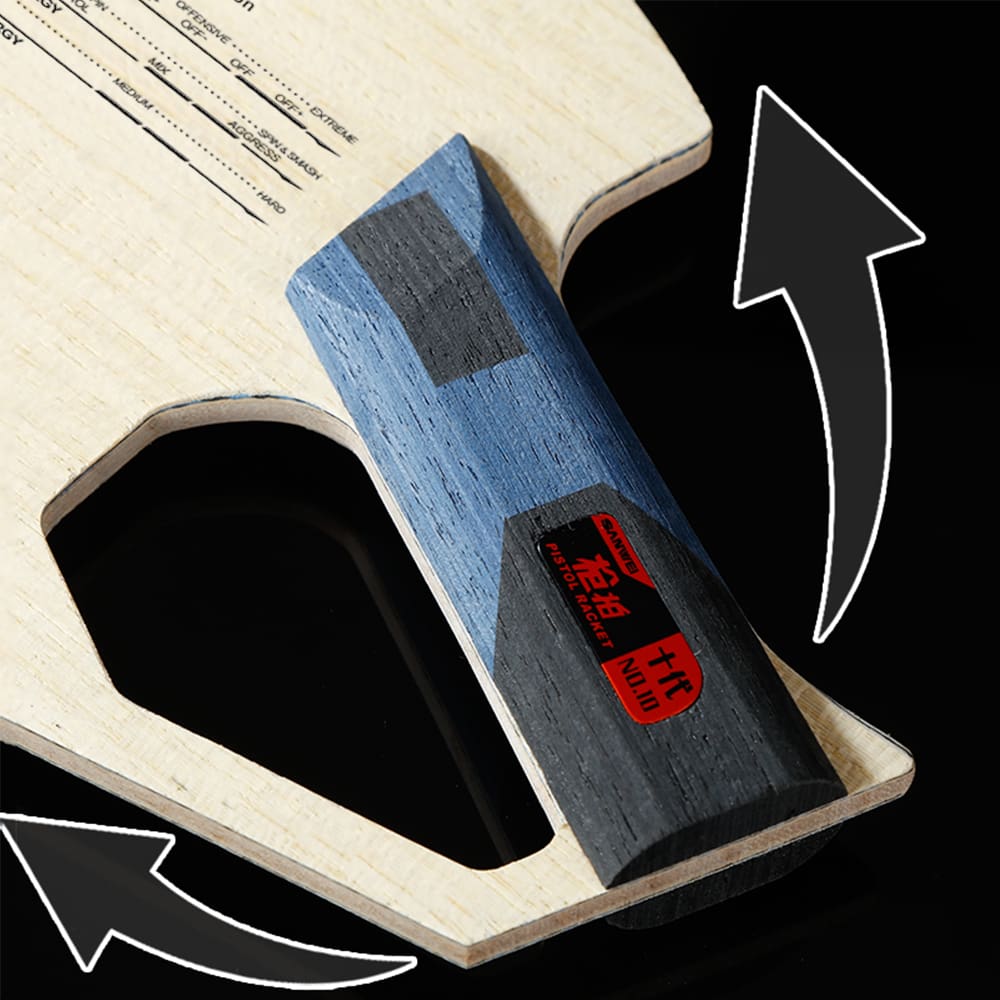
The hitting point is positioned closer to the extension line of the forearm.
This creates a more direct relationship between your arm and the racket.
Instead of constantly correcting the racket with your wrist and fingers, the entire arm can participate more naturally in the swing.
More Efficient Power Transfer
Imagine pushing a door.
If your arm is aligned naturally with the direction you’re pushing, the movement feels easy.
If your wrist is bent awkwardly, you can still push—but part of your effort is wasted.
The same principle applies to table tennis.
The Pistol Racket is designed to help the racket follow the natural extension of the forearm.
For many players, this creates a stronger feeling of connection during forehand acceleration.
The result is not simply “more power.”
It is more usable power.
Power that you can control.
Power that you can repeat.

Sanwei Pistol Racket 10th
- ITTF Approved: Fully compliant with ITTF regulations, the Sanwei Pistol Racket is approved for use in any level of table tennis competition, ensuring you stay competitive at all times
- Ergonomic Swing Design: The unique design aligns the hitting point with the natural extension of your arm.
- Dual-Channel Force Guidance: Simplified movements enhance power and speed by up to 15%, giving you a competitive edge
- Anti-Rotation Palm Support: The built-in anti-rotation palm support stabilizes the racket
- Guided Motion for Shortened Training Cycles: The Pistol Racket’s design promotes proper technique and reduces errors during training.
- More structures are available for selection.
- FL/ST handles are available to suit players of varying skill levels.
- Free Shipping Worldwide!
Stability Makes Power Dangerous
This is the part I think many players overlook.
If you hit the ball extremely hard but only one out of three attacks lands, your opponent is not afraid.
But if you can attack with speed and spin while keeping the ball on the table again and again, your opponent starts feeling pressure.
That is what makes a forehand dangerous.
The Pistol Racket is designed to help create this combination:
Natural movement + stable racket position + efficient power transfer.
Don’t Forget Placement
There is another secret to a dangerous forehand:
You don’t always need to hit harder.
Sometimes the most effective attack is simply placed better.
Once your grip and movement become stable, you can focus more on changing:
- Crosscourt angles.
- Down-the-line attacks.
- Deep and short placements.
- Speed and spin.
A stable technique gives you more options.
My Advice to Players
If your forehand already has some power but doesn’t feel threatening enough, don’t immediately start doing more strength training.
First ask yourself:
“Am I actually transferring the power I already have?”
If your grip, wrist, and racket position are creating unnecessary compensation, fixing that foundation may make a bigger difference than simply trying to swing harder.
This is exactly why I recommend trying the Pistol Racket.
Final Thoughts
After more than 30 years in table tennis, I believe the strongest forehand is not necessarily the one with the fastest ball.
It is the one you can trust.
When the racket follows the natural extension of your forearm, the movement becomes more intuitive.
When the movement becomes more natural, power becomes easier to generate.
And when power, stability, and placement come together, your forehand becomes something your opponent truly has to respect.
That is the idea behind the Pistol Racket.
Not simply to help you hit harder.
But to help you turn your existing power into a more reliable weapon.
—
Su Zhimin
Founder of SANWEI Sports