
For the longest time, I just “called” points. “I think it’s my serve.” “Wait, wasn’t it 9‑9?” “Is that game point?” Sound familiar? I was having fun, but I had no idea how to keep real score. Then I decided to learn the official ping pong scoring rules. And you know what? It’s actually easy. Once you understand how to keep score table tennis style, you’ll never have awkward arguments again. This beginner’s guide covers everything: the basic point system, what happens at deuce and advantage, and the proper serving rotation. Plus, I’ll show you how the SANWEI BravoBee Carbon paddle – with its 100 control rating – helps you focus on the score instead of chasing wild balls. Let’s demystify scoring once and for all.
Scoring Basics: First to 11 Points, Win by 2 (Don’t Stop at 10‑10!)
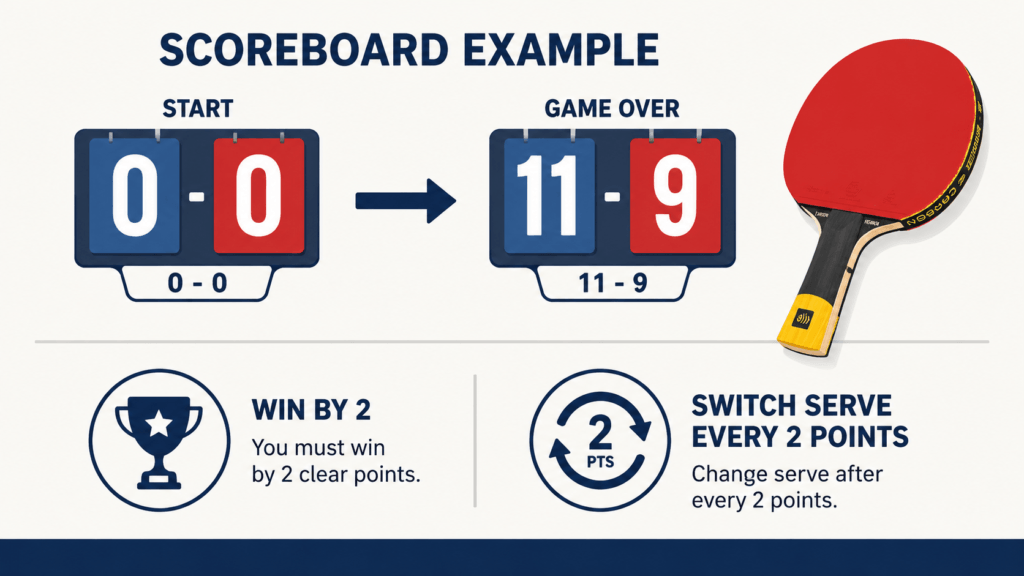
The most important point system rule is simple: a game goes to 11 points. The first player to reach 11 wins – but only if they lead by at least 2 points. So if the score is 11‑10, the game continues until someone leads by 2 (e.g., 12‑10, 13‑11, etc.). In casual play, people sometimes stop at 11‑10, but that’s not official. The “win by 2” rule ensures a fair margin of victory. So next time you’re at 11‑10, keep playing! It also makes the game more exciting – comebacks are possible, and every point matters. This is one of the ping pong scoring rules that beginners often forget. Remember: 11 points, win by 2. No exceptions.
Service Rotation: Every 2 Points, the Serve Switches
The serving rotation is another key part of how to keep score table tennis. Players serve two points each, then the serve switches to the opponent. So if you serve first, you serve the first two points. Then your opponent serves the next two points. Then you serve two more, and so on. This pattern continues throughout the game. Keeping track is easy: when the total score is even (0, 2, 4, 6…), the serve changes. For example, after 0‑0, the score becomes 1‑0 (odd), so the same server serves again. After 2‑0 (even), the serve changes. This rhythm is consistent. The BravoBee’s 100 control rating helps you focus on this rotation because you’re not constantly dealing with erratic shots – you can actually remember whose turn it is. Trust me, it’s harder when the ball flies off the table every other rally.
Deuce: At 10‑10, the Match Is Tied, and You Must Win by 2 Points
When the score reaches 10‑10, it’s called deuce. The ping pong scoring rules change slightly: from that point on, players serve only one point each, not two. So after 10‑10, you serve one point, then your opponent serves the next point, and so on. The game continues until one player leads by 2 points (e.g., 12‑10, 13‑11, 14‑12…). This is known as “win by 2 at deuce.” It’s the same rule as tennis. Deuce can be nerve‑wracking, but it’s also where the excitement peaks. The BravoBee’s 95 spin rating gives you a weapon to win those crucial points – a well‑placed spin serve can be the difference. Practice your serves, because deuce is when you need them most.
Who Serves at Deuce? The Players Alternate Serving Every Point
At deuce (10‑10), the serving rotation becomes one point per server. This is a common source of confusion. Let’s clarify: the player who served the last point before deuce will serve the first point of deuce. After that point, the serve switches to the opponent, and they alternate each point. So at 10‑10, Player A serves point 1 (score 11‑10 or 10‑11). Then Player B serves point 2 (maybe 11‑11 or 11‑12). Then Player A serves point 3, and so on. Remember, the serve still rotates, just now after every point instead of after two points. The key is to keep track of who served the last point, and then it’s the other player’s turn. It’s simpler than it sounds. The BravoBee’s lightweight design (≤175g) means your arm won’t tire during long deuce battles, so you can stay sharp.
Edge Balls: If It Hits the Top Edge, It’s In. Side Edge? It’s Out.
Edge balls are another detail in how to keep score table tennis. When the ball hits the edge of the table, you need to know if it’s a good point. The rule: if the ball hits the top edge of the table (the flat playing surface), it’s considered in. Play continues. If it hits the side edge (the vertical side of the table), it’s out, and the point goes to the other player. In casual play, people often argue about this. But now you know the official rule. The BravoBee’s vibration reduction slots give you clear feedback on contact, so you’ll know if you hit the ball cleanly – but for edge calls, you’ll have to rely on your eyes. When in doubt, replay the point if both players agree.
How BravoBee Simplifies Scoring: Consistent Rallies Mean You Can Focus on the Score
You might be wondering: what does a paddle have to do with scoring? Everything. When you’re using a cheap, dead paddle, the ball flies everywhere. You spend half your time chasing balls, arguing about whose turn it is, and losing track of the score. The BravoBee’s 100 control rating keeps the ball on the table. Your rallies last longer, so you get into a rhythm. And when you’re in a rhythm, it’s easier to remember the serving rotation and the score. Plus, the BravoBee’s 95 spin rating means your serves are more effective – so you’ll be the one scoring points, not just hoping to return. In short, a good paddle helps you focus on the game, not on chasing errors. That’s why the BravoBee is the perfect companion for learning ping pong scoring rules.
Sample Scorekeeping Scenarios
Let’s walk through a few examples to solidify your understanding:
- Normal play: The score is 5‑3. Player A serves two points (making it 6‑3, then 7‑3 or 6‑4). After that, serve switches to Player B.
- Deuce: The score is 10‑10. Player A served the last point (to get to 10‑10). So Player A serves the next point. If Player A wins, score is 11‑10, and now Player B serves the next point.
- Win by 2: The score is 12‑10. That means the winner won by 2 points. The game ends immediately. No need to serve again.
Practice keeping score with a friend. Use the BravoBee to have longer rallies, so you get more practice counting. Soon it will become automatic.
Common Scoring Mistakes (And How to Avoid Them)
Even with the rules clear, beginners make errors. Here’s what to watch for:
- Forgetting to switch serve every 2 points: Use the total score as a reminder. Even numbers (0,2,4…) mean a serve change.
- Stopping at 11‑10: Remember, win by 2. Keep playing.
- Losing track at deuce: Say the score out loud before each serve. “10‑10, Player A serving.”
- Arguing about edge balls: If you’re unsure, offer the point to your opponent or replay it. Good sportsmanship overrules strict rules.
The BravoBee’s 100 control reduces arguments because the ball is less likely to hit edges – you’ll be placing it more cleanly. But when it does happen, you’ll be ready.
Conclusion: No More ‘I Thought It Was My Serve’ Arguments
Now you know the essential ping pong scoring rules. It’s first to 11, win by 2. Serve rotates every 2 points normally, and every point at deuce. Edge balls: top edge in, side edge out. And you can use the BravoBee Carbon to keep rallies consistent, so you can focus on the score, not on chasing balls. No more awkward arguments about whose turn it is. No more guessing if the game is over. You’ve got this. So grab your BravoBee, find an opponent, and put your new scoring knowledge to the test. You’ll be surprised how much more enjoyable the game becomes when everyone plays by the same point system. Game on!
👉 Get your BravoBee Carbon here and start keeping score like a pro.
What’s the most confusing part of ping pong scoring for you? Ask your questions in the comments – I’d love to help!
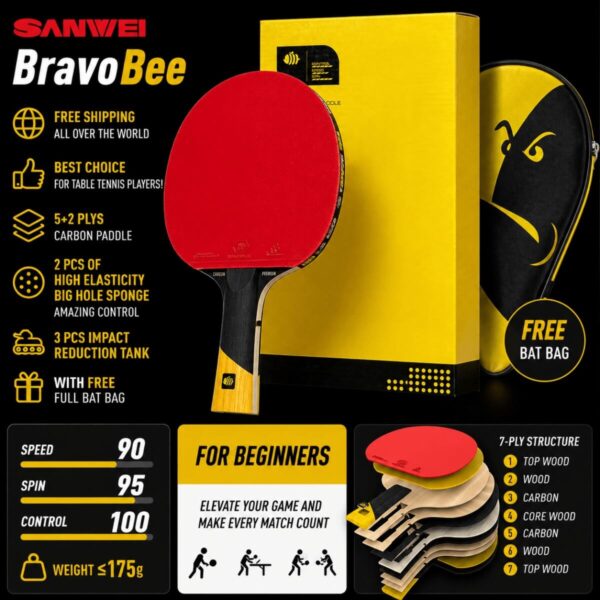
BravoBee Carbon Ping Pong Paddles
- Free Shipping All Over The World
- Best choice for table tennis players!
- 5+2 plys carbon paddle
- 2 pcs of high elasticity big hole sponge, amazing control
- 3 pcs Impact reduction tank
- with FREE full bat bag