
If you’ve spent any time browsing ping pong gear, you’ve seen the buzzwords: “carbon fiber,” “carbon layers,” “carbon blade.” Everyone talks about carbon fiber ping pong paddle designs like they’re magic. But is it just hype, or does carbon actually help your game? In this article, we’ll cut through the marketing and answer the question is carbon worth it for amateur players. We’ll compare carbon vs wood blades, explain the technology, and show you why the BravoBee Carbon – a perfect example of BravoBee carbon engineering – offers the best of both worlds. By the end, you’ll understand table tennis tech explained in plain language, and you’ll know exactly why carbon can be genuinely helpful.
What Does Carbon Fiber Actually Do in a Ping Pong Paddle?
Let’s start with the basics. A traditional ping pong blade is made of several layers of wood (usually 5 or 7 plies). When you add one or more layers of carbon fiber to that stack, you increase the blade’s stiffness. A stiffer blade flexes less when you hit the ball. That has three important effects:
- Larger sweet spot: The blade resists twisting on off‑center hits, so even mishits stay more controlled.
- More power without extra effort: Less energy is absorbed by the blade, so more energy goes into the ball.
- More consistent feedback: The blade’s response is more uniform across the face.
These are real benefits. That’s why almost all professional players use some form of carbon blade. But – and this is a big but – too much carbon can be a problem for amateurs.
Too Much Carbon = Loss of Feel and Control
Some high‑end blades use three, four, or even five carbon layers. They are extremely stiff and very fast. For a pro with perfect technique, that’s fine. For an amateur, a super‑stiff blade reduces dwell time – the split second the ball stays on the paddle. With very little dwell time, you lose the ability to feel the ball and control your spin. Shots become unpredictable, and the paddle feels “dead” or “twitchy.”
That’s why the question is carbon worth it depends entirely on how much carbon and how it’s balanced with wood. Pure carbon is not the answer. The answer is a hybrid.
Carbon vs Wood: The Trade‑Offs
Let’s compare a typical all‑wood blade to a thick‑carbon pro blade, and then see where the BravoBee fits in.
All‑Wood Blades (Traditional)
- Pros: Excellent feel, good dwell time, very forgiving. Great for learning touch and spin.
- Cons: Less power, smaller sweet spot, can feel “soft” against heavy hitters.
Thick‑Carbon Pro Blades (3+ Carbon Layers)
- Pros: Massive power, large sweet spot, very stable.
- Cons: Very low dwell time, harsh feedback, punishes imperfect technique. Not beginner‑friendly.
This carbon vs wood trade‑off leaves many amateurs stuck. They want the stability and power of carbon, but they need the feel and forgiveness of wood. The solution is a balanced hybrid: a blade with enough wood for feel and enough carbon for stability. That’s exactly what the BravoBee delivers.
BravoBee’s 5 Wood + 2 Carbon: Best of Both Worlds
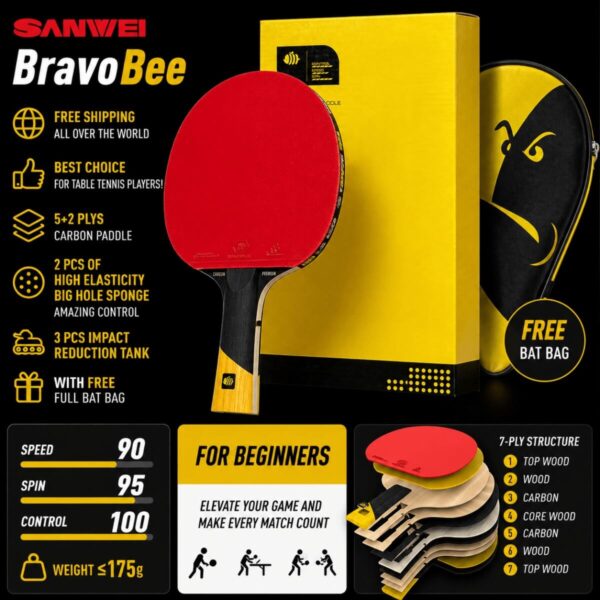
The BravoBee Carbon uses 5 layers of wood and 2 layers of carbon. That’s the sweet spot for amateur players. The five wood layers provide the natural flex, dwell time, and feedback you need to develop spin and touch. The two carbon layers add just enough stiffness to enlarge the sweet spot and boost power without killing the feel.
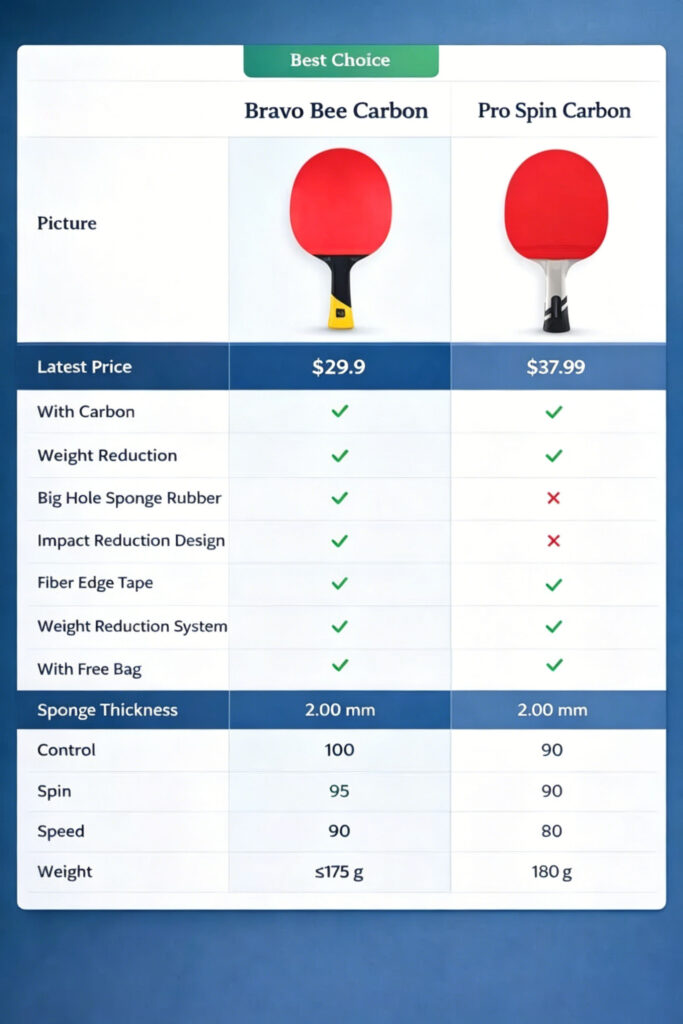
The result is a paddle with a control rating of 100 (maximum forgiveness) and a spin rating of 95 (excellent grip). The speed is a manageable 90 – fast enough to finish points, not so fast that you lose control. This is BravoBee carbon engineering at its finest: pro‑level stability, amateur‑friendly playability.
Let’s break down why that matters for your game.
How the BravoBee’s Carbon Helps Your Game
Larger Sweet Spot = More Consistent Hits
When you’re learning, you don’t hit the center of the blade every time. The BravoBee’s carbon layers resist twisting, so even off‑center shots stay on target. You’ll make fewer unforced errors, and you’ll build confidence faster.
More Power Without Swinging Harder
With a traditional all‑wood blade, you have to swing hard to generate pace. The BravoBee’s carbon gives you extra pop, so you can focus on placement and spin instead of muscling the ball. That’s a huge advantage for players with less arm strength.
Better Stability on Blocks
When your opponent hits a hard loop, an all‑wood blade can twist in your hand, sending the ball wild. The BravoBee’s carbon layers keep the blade stable, so your blocks stay low and controlled. You’ll win more points just by keeping the ball on the table.
Spin 95 – Because Carbon Alone Doesn’t Create Spin
Carbon affects the blade’s stiffness, but spin comes from the rubber and sponge. The BravoBee pairs its carbon construction with a high‑elasticity, big hole sponge (2.00mm) that grips the ball aggressively. That’s why it earns a 95 spin rating. You get the stability of carbon and the grip of a spin‑friendly rubber. That’s a rare combination at this price point.
Is Carbon Worth It for Amateurs? Yes – If It’s the Right Blend.
After testing the BravoBee for several weeks, I can confidently answer is carbon worth it for recreational and club players: absolutely, but only if the carbon is balanced with enough wood to retain feel and control. A pure carbon rocket will frustrate you. A well‑tuned hybrid like the BravoBee will elevate your game without causing constant errors.
In the carbon vs wood debate, the winner isn’t one or the other – it’s the intelligent combination. The BravoBee’s 5+2 construction is the perfect example of table tennis tech explained in a way that benefits real players. You get the modern advantages of carbon (larger sweet spot, more power, better stability) without losing the traditional feedback that helps you learn and enjoy the game.
Why Other Cheap Carbon Paddles Fail
You might have seen other budget carbon paddles online. Many of them use a single, thick, cheap carbon layer that makes the blade overly stiff and dead. Others put carbon only in the handle as a marketing gimmick. The BravoBee uses two thin, woven carbon layers near the surface – the same construction as much more expensive blades. This provides genuine performance, not just a carbon sticker.
Additionally, the BravoBee includes fiber edge tape to protect the blade, three impact reduction slots in the handle to filter bad vibrations, and a free water‑drop‑shaped bat bag. These details show that BravoBee carbon isn’t just about the material – it’s about thoughtful engineering for the amateur player.
Final Verdict: Helpful, Not Hype
So, are carbon fiber ping pong paddles just hype? No. When done right, carbon is genuinely helpful. The BravoBee Carbon proves that you can have pro‑level stability, a larger sweet spot, and extra power without sacrificing control or feel. It’s the ideal bridge between old‑school all‑wood blades and unforgiving pro rockets.
If you’ve been wondering is carbon worth it for your game, the answer is yes – as long as you choose the right blend. The BravoBee’s 5 wood + 2 carbon, 100 control, and 95 spin make it a no‑brainer upgrade for amateurs.
👉 Get your BravoBee Carbon here and experience the perfect balance of wood and carbon. Your game will thank you.
Have you tried a carbon paddle before? Share your experience in the comments – I’d love to hear what worked (or didn’t) for you!
BravoBee Carbon Ping Pong Paddles
- Free Shipping All Over The World
- Best choice for table tennis players!
- 5+2 plys carbon paddle
- 2 pcs of high elasticity big hole sponge, amazing control
- 3 pcs Impact reduction tank
- with FREE full bat bag