
When choosing a table tennis blade, one of the first decisions players need to make is the handle type.
Among the most common choices are CS (Chinese Penhold) and FL (Flared Handle). CS is designed for the penhold grip, while FL is a popular handle shape for shakehand players.
I often hear amateur players ask me: Which one is better? Is CS more difficult to learn? Does FL offer better control? And should beginners always choose FL?
After many years in table tennis, I believe the answer depends on your playing habits, technical goals, and how much time you are willing to invest in training.
However, if you are a complete beginner and have no particular preference, I would generally recommend starting with FL. Let me explain why.
1. FL: A More Straightforward Choice for Beginners
The biggest advantage of the FL handle is that it supports the shakehand grip, which allows players to develop forehand and backhand strokes using two different sides of the racket.
For many beginners, this feels natural.
The handle is held in a handshake-like position, with the thumb and index finger positioned on opposite sides of the blade. The remaining fingers wrap around the handle.
This provides a relatively balanced starting point for learning both sides of the game.
Some advantages of FL for amateur players include:
- Easier backhand development: Players can learn backhand drives, blocks, and topspins using the reverse side of the racket.
- Balanced forehand and backhand: Neither side needs to rely on an unusual grip adjustment.
- A familiar learning process: Many coaches and training resources teach the shakehand grip, making it easier for beginners to find guidance.
- Versatility: It supports a wide range of playing styles, from close-to-table attacking to mid-distance topspin rallies.
Of course, FL does not automatically make someone a better player. Good technique, footwork, timing, and practice are still essential.
But for someone starting from zero, it offers a relatively straightforward foundation.
2. CS: More Wrist Freedom and a Different Playing Style
The Chinese Penhold grip has a very different character.
Unlike shakehand players, penhold players hold the racket between the thumb and index finger, with the other fingers supporting the back of the blade.
This grip gives players considerable freedom of wrist movement.
One of its most noticeable advantages is forehand flexibility.
For players who enjoy attacking close to the table, CS can provide:
- Greater freedom for wrist-based adjustments.
- Excellent touch when serving and receiving short balls.
- Flexible racket angles and variations in spin.
- A natural feeling for quick forehand attacks.
- Smooth transitions between certain forehand and traditional penhold backhand movements.
These characteristics make Chinese penhold particularly attractive to players who enjoy an aggressive, close-to-table style.
However, CS also has a challenge: developing a complete backhand game.
Traditional penhold backhand techniques have certain limitations compared with shakehand backhand strokes. Modern RPB (Reverse Penhold Backhand) has addressed many of these limitations, but it requires dedicated training.
For amateur players, this means CS may involve a longer technical learning process, especially if they want to develop a strong two-sided attacking game.
3. Which Grip Is Easier for Amateur Players to Master?
This is where the difference becomes more practical.
For most beginners, FL is generally easier to learn because the forehand and backhand techniques follow a more familiar structure.
With CS, players need to pay more attention to finger placement, grip pressure, wrist movement, and the relationship between the traditional forehand and RPB.
Here is a simple comparison:
| Comparison | CS (Chinese Penhold) | FL (Shakehand) |
|---|---|---|
| Beginner learning | Requires more grip adaptation | Generally more straightforward |
| Forehand flexibility | Excellent wrist freedom | Good, with a different wrist position |
| Backhand development | Requires traditional backhand or RPB adaptation | More direct learning path |
| Short-game touch | Very flexible wrist movement | Good control with proper technique |
| Close-to-table attacks | Particularly suitable | Also very effective |
| Coaching resources | May be less widely available in some regions | Generally easier to find |
| Technical development | Requires attention to grip and RPB transitions | Offers a balanced foundation |
I want to emphasize that this is a general comparison, not a rule that applies to every player.
Some beginners adapt to penhold very quickly, while others feel much more comfortable with shakehand.
The best starting point is always the grip that feels natural and allows you to develop sound technique.
4. Which Is Better for Different Types of Amateur Players?
Instead of asking which handle is universally better, I suggest choosing according to your playing goals.
If you are a complete beginner: Consider FL.
If you have never played table tennis seriously and have no preference, FL is usually a sensible starting point. It provides a straightforward way to learn both forehand and backhand fundamentals.
If you enjoy forehand attacks and close-to-table play: Consider CS.
If you naturally prefer using your forehand to control the rally, attack quickly, and create different spin variations, Chinese penhold may suit your style.
If you want to develop RPB: Consider CS.
If learning Reverse Penhold Backhand is one of your main goals, CS gives you the opportunity to develop a distinctive two-sided penhold attacking system.
You should be prepared to spend time developing the correct grip, finger coordination, and backhand technique.
If you prefer balanced forehand and backhand development: Consider FL.
For players who want to build a relatively balanced game without spending too much time adapting to a specialized grip, FL is a practical choice.
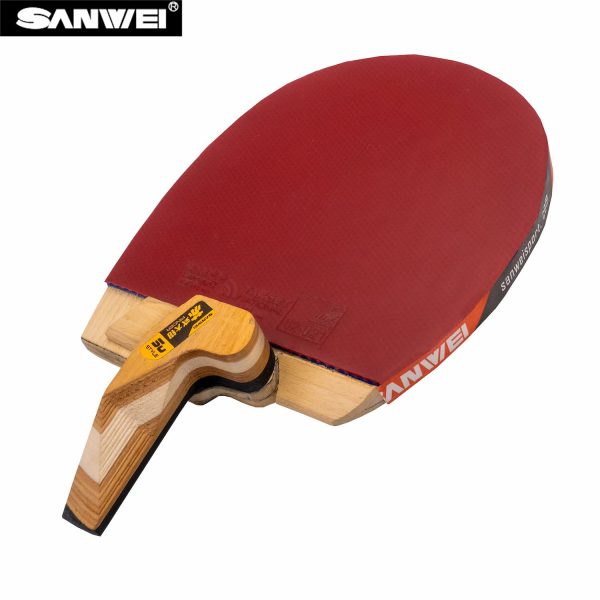
Pre-assembled Bat- Su Style & Target National & Gear Hyper
SANWEI Preassembled Bat – The Ultimate Pen-Hold Combination: Su Style Froster + Target National & Gear Hyper
Designed for pen-hold players who demand the perfect balance of power, spin, and precision, this preassembled bat brings together the best of SANWEI’s advanced technology.
- 🔹 Su Style Froster Blade – Precision Meets Innovation
The Su Style Froster blade redefines pen-hold play with its ergonomic swing design, aligning the racket face parallel to the palm for effortless control and precision. Built with Arylate Carbon, it delivers a stable, high-speed performance while reducing strain on the wrist, making it ideal for players seeking both comfort and power. Fully ITTF-approved, it meets the highest competition standards. - 🔹 Target National (Forehand) – The Spin & Power Master
For the forehand, Target National combines the high-viscosity Chinese topsheet with a European cake sponge, offering explosive spin and sustained power. Enhanced with SANWEI NANO surface technology, it provides faster speed, greater fault tolerance, and consistent performance—perfect for dominating rallies and overpowering opponents. - 🔹 Gear Hyper (Backhand) – Speed, Precision & Control
For the backhand, Gear Hyper is the ultimate complement. Its high-tension European topsheet, treated with SANWEI Pixel Technology, ensures maximum grip, fast rebounds, and excellent control. Paired with a mid-hole cake sponge (available in 37°/38°/39° hardness options), it delivers low energy loss and high elasticity, allowing for quick counterattacks and stable defensive play. - ✅ The Best Rubber Combination for Pen-Hold Players
With Target National’s unparalleled forehand spin & power and Gear Hyper’s precise backhand control, this preassembled bat is the ultimate setup for serious pen-hold players. Every component is carefully tuned to work in harmony, ensuring effortless transitions between offense and defense. - 🎯 Perfectly Assembled & Ready to Dominate
Expertly assembled by SANWEI’s professional team, this bat is ready to unleash its full potential the moment you step onto the table. Whether you’re attacking with powerful loops or controlling the game with strategic placement, this combination offers everything you need to take your pen-hold game to the next level.
5. Can Handle Design Make CS More Comfortable?
One issue I have noticed among amateur penhold players is that they sometimes focus too much on the blade’s speed and rubber characteristics while overlooking the handle.
But for penhold players, the handle has a particularly important relationship with finger position and grip stability.
A handle that does not fit the player’s hand may create unnecessary pressure or make it difficult to maintain a comfortable position during RPB.
This is one of the reasons I developed the SANWEI Su Style series.
The Su Style Tiger Claw is designed for players who want to develop modern RPB. Its thenar support helps provide a more secure grip, while the angled index-finger platform increases the contact area for the index finger.
For players who prefer forehand blocking while also using RPB, the Su Style Eagle Beak offers a different handle shape. Its distinctive pointed design aims to improve index-finger comfort and support a more natural forehand blocking position.
These designs are not intended to make CS universally better than FL. They are intended to give penhold players more options when choosing a handle that suits their hands and playing techniques.
A comfortable handle cannot replace training, but it can make it easier to maintain a natural grip and focus on improving your game.
6. Should You Switch from CS to FL, or from FL to CS?
My advice is not to switch simply because one grip is more popular or because a professional player uses it.
If you have already spent several years developing your technique with CS, changing to FL means rebuilding many familiar movements. The same is true in the opposite direction.
Before considering a switch, ask yourself:
- Is my current grip genuinely uncomfortable?
- Am I struggling with a technical limitation that I cannot address through training?
- Do I enjoy playing with the alternative grip more?
- Am I prepared to spend time rebuilding my technique?
If you are already comfortable with your current grip, it is usually better to improve your footwork, timing, consistency, and tactical understanding before changing equipment.
A different handle will not automatically solve technical problems.
Final Thoughts
So, CS or FL—which is better for amateur table tennis players?
If you are a beginner without a strong preference, I generally recommend FL because it offers a more straightforward learning path for developing both forehand and backhand techniques.
But if you naturally enjoy penhold, value wrist flexibility, and want to build an aggressive forehand game with RPB, CS can be an excellent choice.
I have always believed that table tennis equipment should adapt to the player, not the other way around.
Do not choose a grip simply because it is popular. Choose one that fits your hand, your playing style, and the kind of table tennis you want to enjoy.
Su Zhimin
Founder of SANWEI Sports