Whenever players talk about increasing power, the conversation usually turns to faster blades, harder rubbers, or more physical training.
But after decades in table tennis, I have come to believe that one of the most overlooked factors is much simpler:
The way you hold the racket.
Most Players Focus on Strength, Not Efficiency
I often see players trying to swing harder and harder.
Yet the ball speed barely increases.
Why?
Because power is not only about how much force you produce.
It is also about how efficiently that force travels from your body into the ball.
If part of that force is lost because of an unstable grip, poor alignment, or unnecessary wrist compensation, the result is reduced power and reduced consistency.
In other words, strength and efficiency are not the same thing.
Why Does Grip Matter So Much?
Think about throwing a punch or swinging a hammer.
The most efficient movements occur when force travels naturally through the arm and into the target.
The human body is remarkably good at generating power when everything is aligned.
The same principle applies to table tennis.
If your grip causes the racket to feel disconnected from the arm, your body must constantly make small adjustments during the stroke.
Those adjustments consume energy and reduce efficiency.

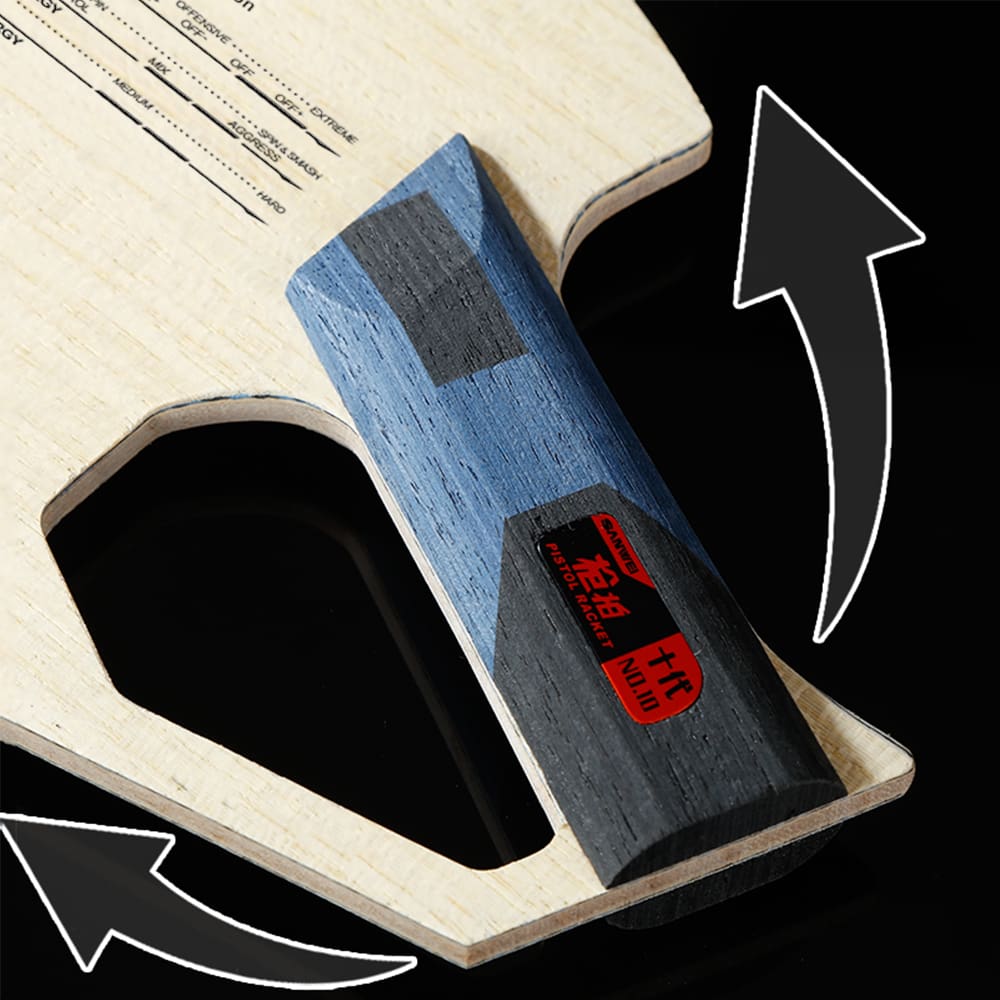
Sanwei Pistol Racket 10th
- ITTF Approved: Fully compliant with ITTF regulations, the Sanwei Pistol Racket is approved for use in any level of table tennis competition, ensuring you stay competitive at all times
- Ergonomic Swing Design: The unique design aligns the hitting point with the natural extension of your arm.
- Dual-Channel Force Guidance: Simplified movements enhance power and speed by up to 15%, giving you a competitive edge
- Anti-Rotation Palm Support: The built-in anti-rotation palm support stabilizes the racket
- Guided Motion for Shortened Training Cycles: The Pistol Racket’s design promotes proper technique and reduces errors during training.
- More structures are available for selection.
- FL/ST handles are available to suit players of varying skill levels.
- Free Shipping Worldwide!
The Hidden Cost of Traditional Compensation
Traditional shakehand blades have produced countless champions, and I have tremendous respect for the design.
However, many club players spend years learning how to compensate for the relationship between the hand, wrist, and racket angle.
Experienced players do this automatically.
Beginners often do not.
As a result, they may struggle to transfer power efficiently even when their technique appears correct.
Why I Developed the Pistol Racket
One of the ideas behind the SANWEI Pistol Racket was to explore a different path.
Instead of asking the player to adapt to the racket, I wanted the racket to work more naturally with the body.
By placing the hitting point closer to the extension line of the forearm, the racket behaves more like a continuation of the arm itself.
This follows natural human movement patterns and often allows players to feel a more direct connection between their body and the ball.
Many players describe the sensation as “point and hit.”
The racket tends to move where the arm wants to move.
What Is the Dual-Power Concept?
When designing the Pistol Racket, I noticed that many players felt they could utilize both forearm drive and grip force more naturally.
I often refer to this as a dual-power effect.
Instead of relying heavily on wrist compensation, the player can transfer force through both the arm structure and the hand more directly into the shot.
The result is often a stronger feeling of impact and improved power efficiency, especially during offensive strokes.
Of course, technique remains the foundation.
No racket can replace good footwork, timing, and body rotation.
But efficient equipment can help players make better use of the power they already have.
Power Is Not Just About Hitting Harder
One lesson I learned many years ago is that the strongest player is not always the most dangerous player.
The most dangerous player is often the one who can repeatedly generate quality shots without wasting energy.
Efficient power leads to:
- Better consistency.
- More stable loops.
- Less fatigue.
- Greater confidence during rallies.
- More effective attacks under pressure.
And all of these begin with how the racket connects to the body.
Final Thoughts
If you want more power, don’t immediately look for a faster blade.
First, ask yourself a simpler question:
“Is my grip helping my body generate force, or is it forcing my body to compensate?”
Because in table tennis, the biggest improvements often come not from producing more power—
But from wasting less of it.
—
Su Zhimin
Founder of SANWEI Sports