
Almost every all-wood blade you can buy is five plies or seven. There is a good reason for that. Glue too many layers of wood together and the thing tends to warp, so most makers stop at seven.
So when Sanwei sent me a blade with eleven wood veneers and no composite layer anywhere in it, I wanted to know what the extra four plies were actually for.
I set it up with Sanwei’s own Target Europe Soft on both sides and played it in drills and club matches. The short version is that those eleven plies do something you cannot get from a normal blade, and it has almost nothing to do with speed.
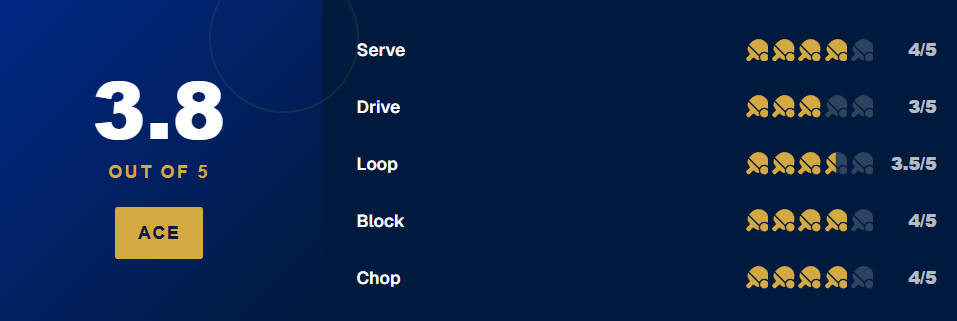
SANWEI MULTILAYER W REVIEW SUMMARY
The Multilayer W is the rarest thing in a market full of near-identical blades: a construction almost nobody else makes. Eleven limba veneers, no carbon, no fibre, at a price most brands charge for seven plies. That alone makes it worth a look.
This is a control blade. The sweet spot is large, the dwell is long, and the short game is a real strength. It will not blast winners for you, so go in wanting feel and forgiveness rather than raw pace.
Perfect for: Developing intermediate players with one to three years of experience who want an all-wood blade to build technique on, and modern defenders pairing long pimples with a control-first setup.
Benefits
✓An 11-ply all-wood construction you cannot easily buy anywhere else
✓Large, forgiving sweet spot that rewards imperfect contact
✓Long dwell time makes short-game touch and placement straightforward
✓Pairs well with long pimples for modern defensive play
✓Clean edge finish and a comfortable flared handle straight out of the box
✓Costs roughly what a decent 7-ply all-wood blade costs
Drawbacks
✗Lacks the top-end speed to finish points from distance; this is a control blade, not an attacker
✗The pale limba handle picks up sweat and grime and will discolour over time
✗Thin distribution outside Sanwei’s own website makes it awkward to buy
Recommended Playstyles
The Multilayer W suits players who win points through placement, consistency and variation rather than raw pace. Its defensive credentials are stronger than the marketing suggests.


Design of the Sanwei Multilayer W
The Multilayer W arrives in Sanwei’s standard blade packaging, the same brushed silver box with red foil branding that comes with the rest of their range. A cut-out window shows you the handle before you open anything. It presents well for a blade at this price.
 Sanwei’s usual silver box, shared across their blade range.
 Moulded tray, no rattling, no plastic sleeve to wrestle with.
Construction and Plies
Eleven plies, every one of them limba, alternating between softer and harder cuts. There is no carbon, no arylate, no basalt, and no fibreglass anywhere in the blade. Total thickness is 6mm, and the head measures roughly 150mm by 157mm, which is standard enough that a sheet of rubber cut for another blade will fit this one.
The edge tells the story better than any spec sheet. You can count the veneers, and you can see the lilac glue lines separating them.
 Count them. I did, twice, because eleven still seems like a lot.
Why bother? All those thin layers and glue lines soak up the buzz you get from a stiffer blade and spread the hit over a wider area. That is what gives the Multilayer W its huge forgiving middle, and it is also why it never gives you the sharp, springy kick a stiff 7-ply does. Our comparison of five-ply and seven-ply blades covers the same control-versus-speed trade, and the Multilayer W sits further along it with four more layers than a seven.
Thickness and Feel in the Hand
At 6mm the Multilayer W is thin for the number of layers it contains, and that thinness is what saves it. A thin blade lets you feel more of the ball through your fingers, and with eleven soft layers I half expected it to come out feeling dead. Instead the contact is a low, woody thud that carries, more like what you feel through a defensive blade than an attacking one.
I must admit I expected the layer count to kill the feedback, and the biggest surprise was that it didn’t. You feel exactly where the ball met the face, and you feel it a fraction sooner than on my usual setup.
Handle
My sample came with the flared handle, which is the one most people will want. Sanwei also list straight and Chinese penhold. The flare is gentle, about 10cm of it, with the same pale limba running through the grip and a thin blue and red pinstripe down each side, capped with a gold Sanwei badge on the face and a silver one on the butt.
 No sharp shoulders, no varnish ridge to rub a blister.
 The taper is subtle enough to suit small and large hands.
The finish is where I would raise a flag. That limba is very pale and it is sealed lightly, if at all. The heel of my palm has already left a faint shadow on the grip. Pick a ball off the floor, wipe your hand on your shorts, and the pale wood shows it. On a darker handle you would never notice.
 You can read the whole construction off the butt of the handle.

Multilayer W
Free Shipping Worldwide!!
The Multilayer W is initiative even structure, and with the awesome looking.
Strength could be more transferred, evenly from the bottom to the surface.
11 ply Pure wood
Allround+
With a soft touch feeling, offers you stored power for a mid-far table pulling loop.
This 11-layer pure wood blade is also good for defense.
Matched with long pimples rubber, brings to you a very comfortable playing experience.
Playtesting the Sanwei Multilayer W
I set the blade up with Target Europe Soft on both sides, which is a soft, springy, forgiving European-style sheet. That pairing matters. A soft rubber on a control blade compounds the control, and if you read the sections below and think the Multilayer W sounds slow, some of that is the rubber talking.
 Sanwei’s own rating scale, printed on the blade. The speed bar sits at ALL+.
Serving and Returning
This is the Multilayer W at its best. The long dwell means the ball sits on the face while you finish the motion, and short backspin serves came out lower and heavier than I am used to without any change to my action. Touch returns over the net were similarly obliging. I could drop a push short and know roughly where it would land, which is not something I can say about the stiffer blades I usually play.
The forgiveness deserves its own mention. Contact 20mm off centre, out towards the edge, and the ball still goes roughly where you aimed it. For anyone still building consistency in their strokes, that margin is worth more than a few metres per second of speed.
Driving and Looping
This is the part where the blade shows you its limit.
Opening a loop against backspin is easy and the arc is safe and high. Looping in rallies from mid-distance works well, and the blade stores a bit of energy and hands it back when you accelerate through the ball properly. Where it runs out is on the finish. Drive through it as hard as you like and the ball comes off at a speed a good blocker will handle comfortably. There is no extra gear waiting when you want to end the point.
That is worth knowing before you buy. Sanwei rate the blade Allround+, and that matches how it plays. One of their product pages does list it as OFF+, but ignore that one: a blade this controlled and forgiving in the short game was never going to hit like a carbon rocket, and I would not want it to.
Blocking and Chopping
Passive blocking is close to effortless. The plies soak up incoming topspin and the ball drops short and safe with almost no input, which is exactly what you want when a loop arrives faster than your feet did.
Chopping is where the blade makes its case. Sanwei pitch the Multilayer W for long pimples and they are right to. The same softness that costs it top-end speed is exactly what a chopper wants: no unpredictable spring off the face, a calm response, and enough feel to vary how much you brush the ball. If you are shopping for blades built for long pimples, this belongs on the list, and it is cheaper than most things on it.
 Assembled and ready. The red sheet is Target Europe Soft.
Overall Impressions
After the second session I scribbled “the most forgiving bat I have played all year” in my notes, and nothing since has made me want to cross it out.
Strip the badge off and what remains is one of the more interesting things Sanwei make. Eleven veneers of limba produce a sweet spot big enough to cover technical mistakes, a short game that flatters your touch, and a chopping platform that costs a fraction of what a dedicated defensive blade costs. It also gives you something no five-ply or seven-ply blade can, which is the particular sensation of a ball sinking into eleven thin layers of wood and coming back out slowly.
The ceiling is real, though, and you will meet it. A player who develops a proper forehand loop and starts wanting to finish points from a metre back will find the Multilayer W has nothing left to give them. That happens to every control blade eventually. Just do not buy it expecting to blast winners from distance, because outright speed is the one thing it does not offer.
So there are two people who should own this. The first is an improving player who wants to feel the ball properly while they build strokes, and who would be better served by a forgiving blade than a fast one. The rest of that argument is in our guide to choosing a table tennis blade. The second is a modern defender who wants a quiet, damped platform for long pimples and does not want to pay defensive-blade prices for it.
If you are neither, and you came here to find out whether an 11-ply blade goes faster than a 7-ply one, the answer is no. It is a little slower and a lot more forgiving, and for the right player that is a trade worth making. It is worth understanding how all-wood construction compares against carbon before you decide.