This is a question I have heard from many players:
“Mr. Su, I practice my forehand again and again, but why does my shot still lack explosiveness? I feel like I have power, but I cannot transfer it fully into the ball.”
In many cases, the problem is not your physical strength.
The problem may be the connection between your body and the racket.
Power Is Not Only About Swinging Harder
Many players think a powerful forehand comes from using more strength.
They tighten their arm.
They swing faster.
They try to hit the ball harder.
But true power in table tennis does not come from force alone.
It comes from efficient transfer.
Your legs, waist, arm, wrist, and racket must work together at the right moment.
If the grip and racket position create unnecessary resistance, part of that energy is lost before reaching the ball.
The Grip Is the Beginning of Power
The hand is the connection between the player and the racket.
If this connection is not natural, the body has to make extra adjustments.
The wrist compensates.
The forearm becomes tense.
The swing becomes less smooth.
Many players don’t realize that an uncomfortable grip can limit their power potential.
They are trying to generate more force, but the racket is not helping them transfer it efficiently.
Why I Developed the Pistol Racket
When I designed the Pistol Racket, my goal was not simply to create a different-looking handle.
I wanted to solve a fundamental question:
How can we make the racket work more naturally with the human body?
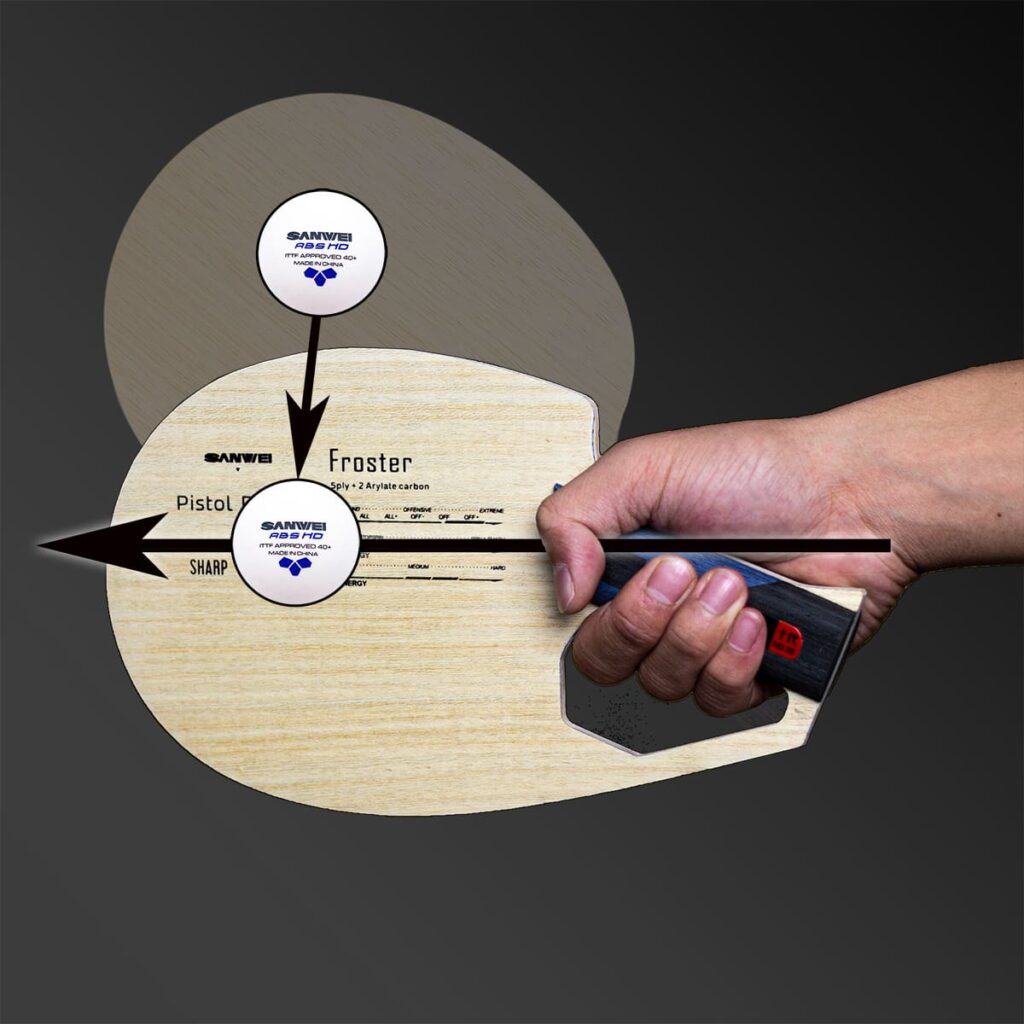
The design places the hitting point closer to the extension line of the forearm.
In simple words:
The racket follows the direction your arm naturally wants to move.
This reduces unnecessary adjustments between the hand, wrist, and racket.
A More Direct Path for Forehand Power
When your grip position is more natural, your body can focus on producing power instead of correcting the racket position.
Many players experience:
- A smoother acceleration through the ball.
- A more stable racket face at impact.
- A stronger feeling of connection between arm and racket.
- More confidence when attacking with the forehand.
The goal is not to make you swing harder.
The goal is to help more of your existing power reach the ball.

Sanwei Pistol Racket 10th
- ITTF Approved: Fully compliant with ITTF regulations, the Sanwei Pistol Racket is approved for use in any level of table tennis competition, ensuring you stay competitive at all times
- Ergonomic Swing Design: The unique design aligns the hitting point with the natural extension of your arm.
- Dual-Channel Force Guidance: Simplified movements enhance power and speed by up to 15%, giving you a competitive edge
- Anti-Rotation Palm Support: The built-in anti-rotation palm support stabilizes the racket
- Guided Motion for Shortened Training Cycles: The Pistol Racket’s design promotes proper technique and reduces errors during training.
- More structures are available for selection.
- FL/ST handles are available to suit players of varying skill levels.
- Free Shipping Worldwide!
Power and Accuracy Should Work Together
Some players believe powerful forehands must sacrifice control.
I disagree.
The best forehands from high-level players are not just fast.
They are repeatable.
A shot that is powerful once but difficult to reproduce is not a real weapon.
A great forehand is one that you can trust under pressure.
That is why stability is just as important as speed.
Is the Pistol Racket a Replacement for Practice?
Of course not.
No racket can replace footwork, timing, and thousands of repetitions.
Equipment is only a tool.
But a good tool should make it easier to develop correct movements.
If the racket fits the body’s natural movement, players can spend more energy improving their technique instead of fighting their equipment.
Final Thoughts
After more than 30 years of designing table tennis equipment, I have learned that many players are not lacking effort.
They are simply not getting the maximum return from the movements they already have.
The Pistol Racket was created to help solve this problem.
By following the natural extension of the forearm, it helps players create a more efficient connection between the body and the racket.
When the grip is right, the movement becomes smoother.
When the movement becomes smoother, power becomes easier to generate.
And when power and stability come together, the forehand becomes a truly dangerous weapon.
—
Su Zhimin
Founder of SANWEI Sports