This is one of the most honest questions players ask me before trying the SANWEI Pistol Racket.
“Mr. Su, if I switch to the Pistol Racket, will it affect my backhand? And what about chopping?”
I always give the same answer:
Your backhand is unlikely to suffer—in fact, many players find it becomes even more natural. Chopping, however, does require some adaptation.
Every piece of equipment has strengths and compromises, and I believe it’s important to talk about both.
Let’s Talk About the Backhand First
Many people assume that because the Pistol Racket changes the handle angle, every stroke must change.
That isn’t what I have observed.
For most players, the backhand remains very familiar.
Some even tell me it feels more stable than before.
Why?
Because the handle encourages a more natural relationship between the hand and the forearm.
When the racket feels like an extension of the arm, it becomes easier to keep the racket angle consistent during backhand drives, blocks, and topspin rallies.
Of course, every player is different.
There is always a short adaptation period whenever you change equipment.
But once players become familiar with the handle, the backhand usually feels just as comfortable—and in many cases, even more confident.
What About Chopping?
This is where my answer is different.
Yes, the Pistol Racket can have some influence on chopping.
Defensive chopping often requires a wider range of wrist angles and a very different racket orientation compared with modern attacking strokes.
Because the Pistol Racket is designed primarily to optimize forehand attack and overall ergonomic alignment, players who rely heavily on traditional defensive chopping may need additional time to adjust.
I don’t think it is honest to pretend there are no compromises.
There are.

Sanwei Pistol Racket 10th
- ITTF Approved: Fully compliant with ITTF regulations, the Sanwei Pistol Racket is approved for use in any level of table tennis competition, ensuring you stay competitive at all times
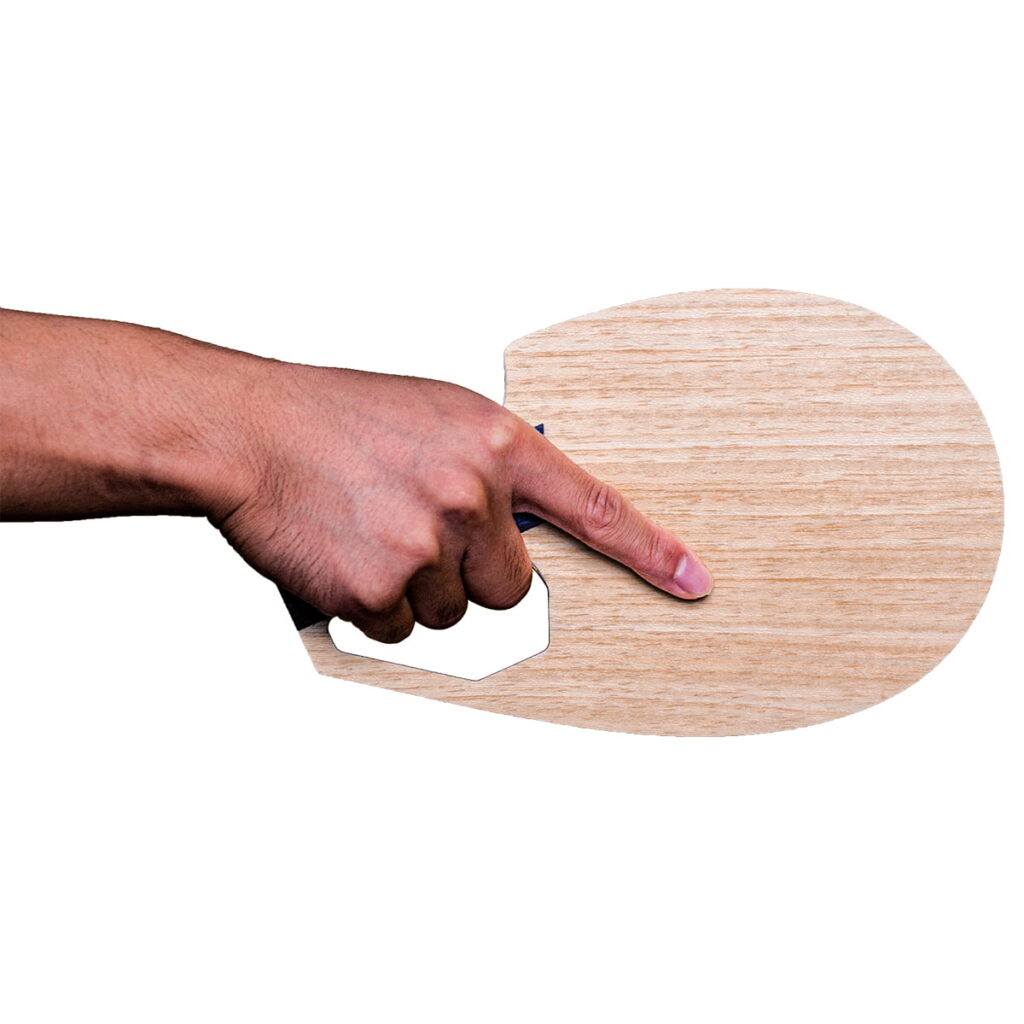
- Ergonomic Swing Design: The unique design aligns the hitting point with the natural extension of your arm.
- Dual-Channel Force Guidance: Simplified movements enhance power and speed by up to 15%, giving you a competitive edge
- Anti-Rotation Palm Support: The built-in anti-rotation palm support stabilizes the racket
- Guided Motion for Shortened Training Cycles: The Pistol Racket’s design promotes proper technique and reduces errors during training.
- More structures are available for selection.
- FL/ST handles are available to suit players of varying skill levels.
- Free Shipping Worldwide!
But How Many Players Build Their Game Around Chopping?
Today, the vast majority of table tennis players play an offensive style.
Whether you are a club player or a competitive athlete, your game is probably built around:
- Forehand topspin
- Counter-driving
- Looping
- Blocking
- Backhand attacks
- Fast transitions
Full-time chopping has become a much more specialized style.
For most players, chopping is an occasional emergency shot rather than a core part of their game.
That means the advantages they gain in their everyday attacking strokes are often far greater than the occasional adjustment needed for defensive chopping.
Why I Designed the Pistol Racket
When developing the Pistol Racket, my goal was never to create a racket that was equally optimized for every possible stroke.
That would be impossible.
Instead, I focused on the strokes that modern players use the most.
By positioning the hitting point closer to the natural extension of the forearm, the racket helps create a more intuitive forehand with efficient power transfer and improved consistency.
That is where I wanted players to benefit the most.
Every Innovation Involves Trade-Offs
Whenever equipment evolves, there are always trade-offs.
A faster blade sacrifices some control.
A softer rubber sacrifices some directness.
A lighter racket sacrifices some stability.
The important question is not whether there are compromises.
The important question is whether the advantages outweigh them.
For most modern offensive players, I believe they do.
Final Thoughts
If your game is built almost entirely around defensive chopping, then the traditional handle may still be a better choice.
But if your game is based on attacking, looping, blocking, and taking the initiative—as modern table tennis increasingly demands—I believe the Pistol Racket offers far more advantages than disadvantages.
That has always been my philosophy as a designer.
Not to build equipment that tries to do everything equally well, but to build equipment that helps players perform their most important strokes better.
And for today’s offensive game, that is exactly what the Pistol Racket was created to do.
—
Su Zhimin
Founder of SANWEI Sports