This is another question I hear very often from club players:
“Mr. Su, after two or three hours of training, my hand and wrist feel very tired. Is there any simple way to improve this?”
Over the years, I have observed that hand fatigue is rarely caused by a single factor. It is usually the result of accumulated tension from technique, equipment, and training habits.
1. The Most Common Cause: Excessive Tension in the Hand
Many players unknowingly grip the racket too tightly during long sessions.
At the beginning of training, this may not feel like a problem.
But as fatigue builds up, the forearm muscles stay in a constant state of tension, and the wrist loses its natural relaxation.
This is one of the fastest ways to accumulate hand fatigue.
In my experience, the best players are not the ones who grip hardest, but the ones who can stay relaxed even during fast rallies.
2. Training Load and Recovery Matter More Than People Think
Table tennis looks like a low-impact sport, but repetitive high-intensity strokes can still overload small muscles in the hand and forearm.
If a player trains for long periods without breaks, fatigue will naturally build up.
Simple habits can help:
- Take short breaks every 30–40 minutes.
- Shake out your hands between drills.
- Avoid playing full-intensity rallies for too long without recovery.
Sometimes improvement does not come from training more, but from training smarter.
3. Equipment Weight and Balance Play a Role
A racket that is too heavy or poorly balanced can increase strain on the wrist and forearm over time.
Even a small difference in weight distribution can affect long-session comfort.
This is why some players feel fine in short matches but tired after extended practice.
When we design blades at SANWEI, we always consider not only performance, but also how the racket feels after hundreds or thousands of repetitions.

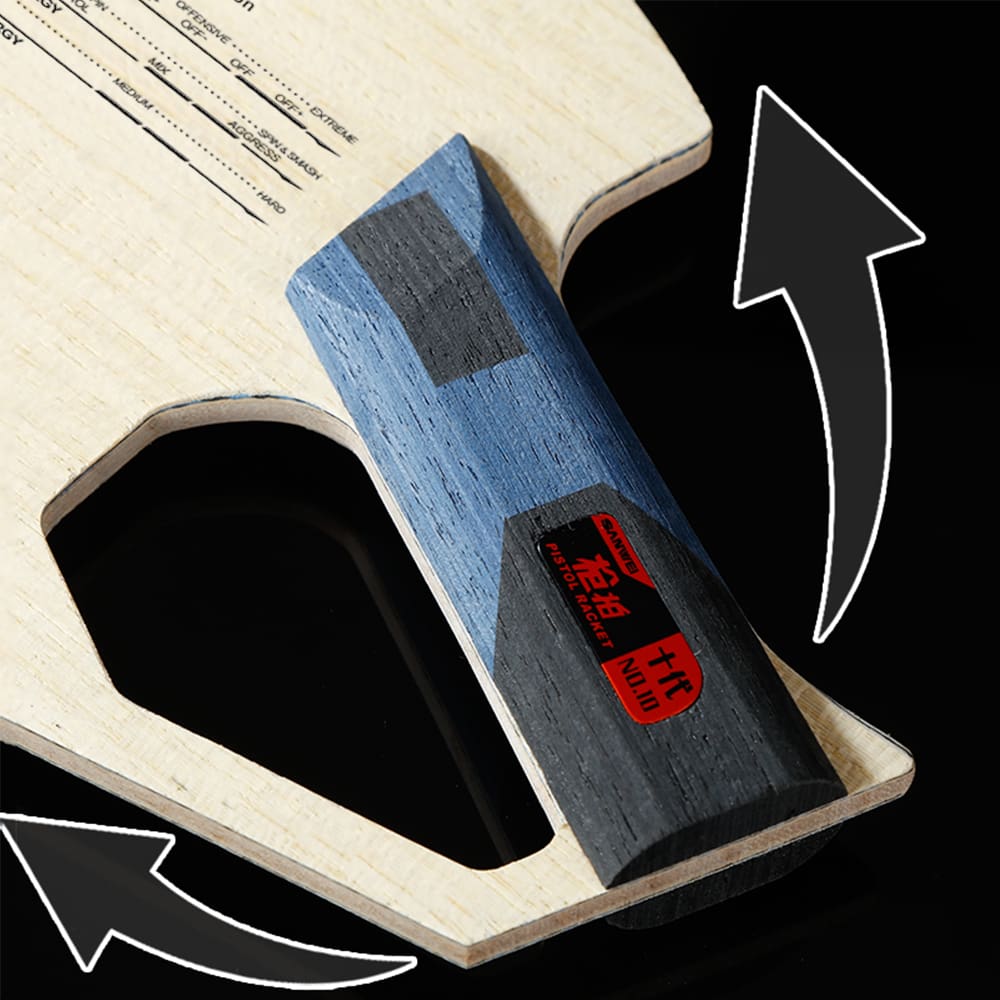
Sanwei Pistol Racket 10th
- ITTF Approved: Fully compliant with ITTF regulations, the Sanwei Pistol Racket is approved for use in any level of table tennis competition, ensuring you stay competitive at all times
- Ergonomic Swing Design: The unique design aligns the hitting point with the natural extension of your arm.
- Dual-Channel Force Guidance: Simplified movements enhance power and speed by up to 15%, giving you a competitive edge
- Anti-Rotation Palm Support: The built-in anti-rotation palm support stabilizes the racket
- Guided Motion for Shortened Training Cycles: The Pistol Racket’s design promotes proper technique and reduces errors during training.
- More structures are available for selection.
- FL/ST handles are available to suit players of varying skill levels.
- Free Shipping Worldwide!
4. Support Tools Can Help Reduce Fatigue
Some players find practical relief through simple accessories:
- Wrist supports can reduce unnecessary strain during long sessions.
- Kinesiology tape can provide mild support and awareness of wrist position.
- Absorbent grip tape can help maintain stability if sweating is an issue.
These are not “solutions” to technique problems, but they can help reduce unnecessary physical stress during training.
5. Why I Developed the Pistol Racket
When I started exploring alternative handle designs, one of my goals was to reduce unnecessary tension caused by unnatural hand alignment.
The SANWEI Pistol Racket adjusts the handle direction so that the hitting point is closer to the extension line of the forearm.
In other words, the racket behaves more like a natural continuation of the arm.
From a biomechanical perspective, this aligns better with instinctive human movement patterns.
Because of this alignment, many players report that their hand feels more relaxed during long sessions, especially when transitioning between forehand and backhand strokes.
Of course, it is not the only way to reduce fatigue, but it is one approach among several.
6. Technique Still Matters Most
No equipment can fully replace good movement habits.
If a player relies too much on wrist force or plays with excessive tension, fatigue will still appear, regardless of blade design.
Good footwork, proper timing, and relaxed acceleration are still the foundation of long-term comfort.
Final Thoughts
After many years of observing players, I have come to a simple conclusion:
Hand fatigue is not something you eliminate once and for all.
It is something you manage through a combination of relaxation, smart training, proper equipment, and awareness of your body.
When all of these elements work together, long training sessions become not only possible—but enjoyable.
And that, in my opinion, is what keeps players improving over time.
—
Su Zhimin
Founder of SANWEI Sports