One complaint I hear surprisingly often is:
“Mr. Su, I don’t know why, but I never feel completely secure holding the racket.”
Some players describe it as the racket moving in their hand during powerful loops.
Others feel that they constantly need to readjust their grip between points.
And some simply never develop confidence in their strokes because the racket never feels like a natural part of their body.
If that sounds familiar, you are certainly not alone.
The Problem May Not Be Your Hand
When players feel they cannot hold the racket steadily, their first reaction is often to grip harder.
Ironically, that usually makes the problem worse.
A tighter grip increases tension in the hand, wrist, and forearm. The stroke becomes less fluid, and the player starts fighting the racket instead of swinging naturally.
In my experience, the real question is not:
“How hard should I hold the racket?”
The better question is:
“Why do I feel the need to hold it so hard in the first place?”
Traditional Shakehand Grips Require a Delicate Balance
The classic FL handle has been used successfully by countless great players.
However, many players don’t realize that a proper shakehand grip is not actually a full, firm grip.
To maintain flexibility and racket angle control, players often hold the handle relatively lightly and allow the fingers and wrist to remain relaxed.
For experienced players, this becomes second nature.
But for beginners and club players, it can sometimes feel insecure.
They want to hold the racket more firmly, yet they are repeatedly told not to squeeze it.
This creates a conflict between instinct and technique.
Why Did I Become Interested in the Pistol Racket?
Many years ago, I began studying a simple question:
Why does holding a hammer feel natural, but holding a table tennis racket often requires instruction?
The answer, in my opinion, lies in alignment.
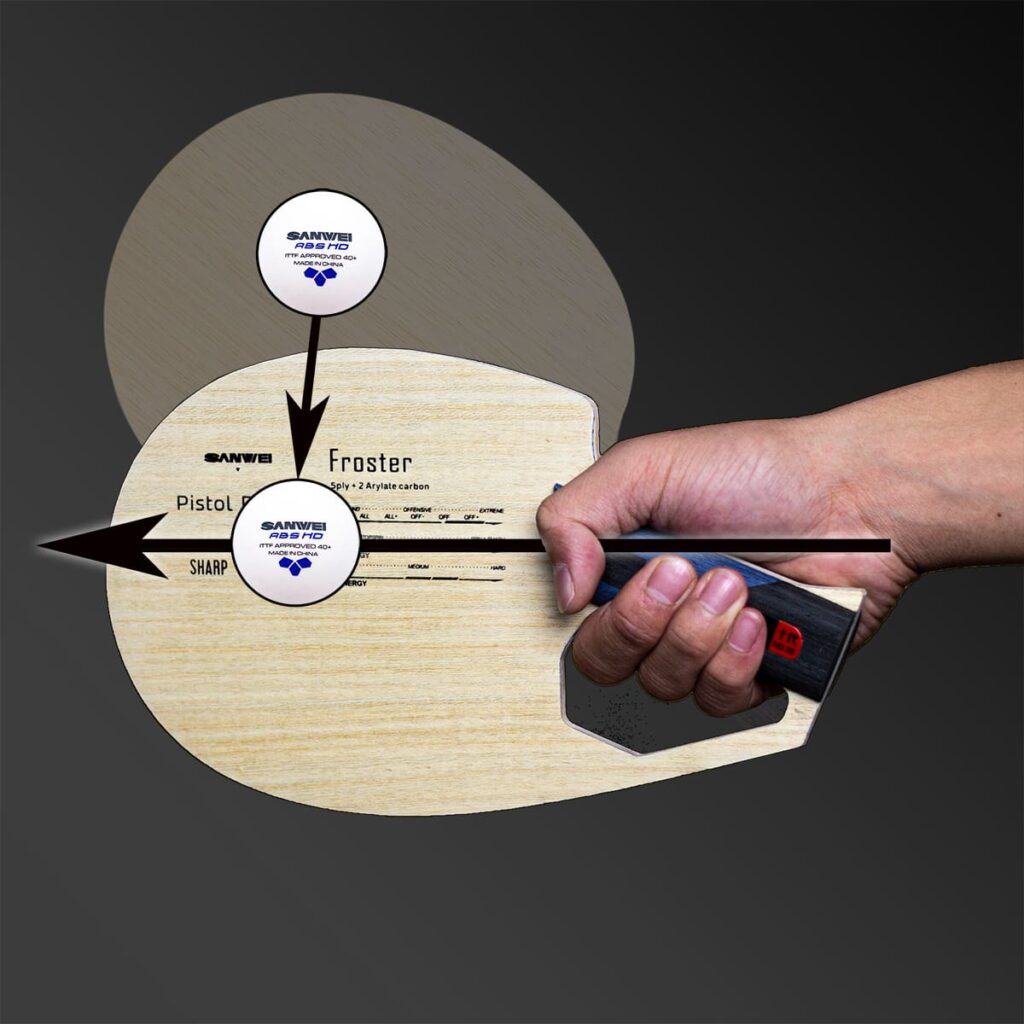
Traditional shakehand rackets place the blade slightly away from the natural extension of the forearm. Players must learn how to compensate through technique and wrist positioning.
With the SANWEI Pistol Racket, I tried a different approach.
By changing the handle angle, the hitting point moves closer to the extension line of the forearm.
In other words, the racket becomes more like a continuation of the arm itself.
Because this follows natural human instinct, many players find they can hold the racket more firmly and confidently without sacrificing comfort.
The result is often a greater feeling of connection between the hand and the blade.

Sanwei Pistol Racket 10th
- ITTF Approved: Fully compliant with ITTF regulations, the Sanwei Pistol Racket is approved for use in any level of table tennis competition, ensuring you stay competitive at all times
- Ergonomic Swing Design: The unique design aligns the hitting point with the natural extension of your arm.
- Dual-Channel Force Guidance: Simplified movements enhance power and speed by up to 15%, giving you a competitive edge
- Anti-Rotation Palm Support: The built-in anti-rotation palm support stabilizes the racket
- Guided Motion for Shortened Training Cycles: The Pistol Racket’s design promotes proper technique and reduces errors during training.
- More structures are available for selection.
- FL/ST handles are available to suit players of varying skill levels.
- Free Shipping Worldwide!
How Can a More Stable Grip Affect Your Game?
When the racket feels secure in your hand, several things often happen naturally:
- Stroke mechanics become more repeatable.
- Power transfer feels more direct.
- Timing becomes easier to reproduce.
- Players hesitate less during attacking shots.
- Confidence increases during fast rallies.
Many players focus on speed and spin, but consistency often begins with something much simpler: trust in your grip.
Other Reasons You May Feel Unstable
Of course, the handle is not always the only factor.
I have also seen instability caused by:
- Handles that are too small for the player’s hand.
- Excessively heavy rackets.
- Sweaty palms during competition.
- Constant grip adjustments between forehand and backhand.
- Lack of confidence in technique.
Sometimes a grip-enhancing overgrip, a wristband, or simply improving technique can make a noticeable difference.
Final Thoughts
Over the years, I have learned that the best racket is not necessarily the fastest one.
It is the one that feels like a natural extension of your body.
When you stop worrying about how to hold the racket, you can finally focus on the ball.
And in my opinion, that is when table tennis becomes much more enjoyable.
—
Su Zhimin
Founder of SANWEI Sports